


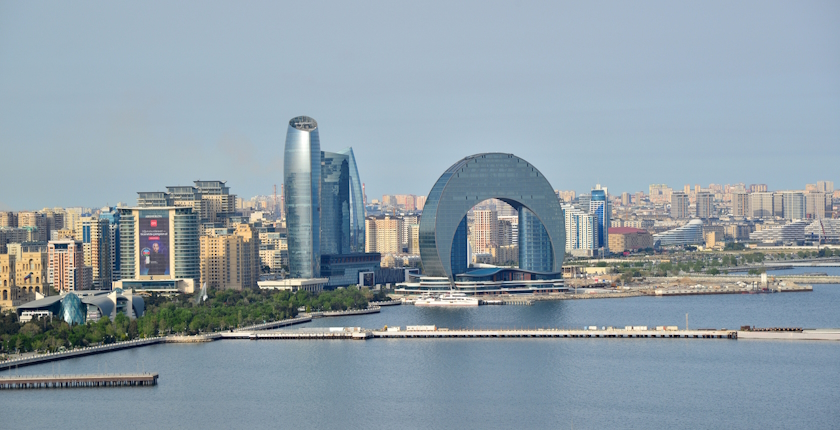
In an era of energy insecurity shaped by rising geopolitical tensions and conflicts, Azerbaijan stands out for its strategic and forward-looking approach to energy. The country has not only leveraged its energy sources to drive domestic economic growth and development but has also used them to foster international cooperation and enhance the energy security of its partners, particularly in Europe.
Straddling Europe and Asia, Azerbaijan is widely recognized as an oil and gas powerhouse. At the same time, it is pursuing its own green transition, with ambition for state-owned energy company SOCAR to achieve full decarbonization by 2050.
Each September 20, Azerbaijan marks the anniversary of the Contract of the Century – a landmark agreement signed in 1994, just three years after the country gained its independence following the dissolution of the Soviet Union. The agreement was signed between the Azerbaijan government and oil companies from six countries – the United States, the United Kingdom, Russia, Türkiye, Norway, and Saudi Arabia.
The contract envisaged joint development and production sharing of the Azeri and Chirag oil fields, as well as the deepwater portion of the Gunashli oil field, located in the Azerbaijan sector of the Caspian Sea. The participating companies were SOCAR, Amoco, bp, McDermott, UNOCAL, Lukoil, Statoil, TPAO, Pennzoil, Ramco, and Delta.
The oil and gas industry integrated Azerbaijan into the global economy and enabled financial backing for the investments in the sector and substantial foreign direct investment. It opened the way for numerous other partnerships with some of the world’s biggest corporations and banks, including Shell, Oracle, Masdar and JPMorgan Chase.
From world’s first oil wells to crucial role in Europe’s supply
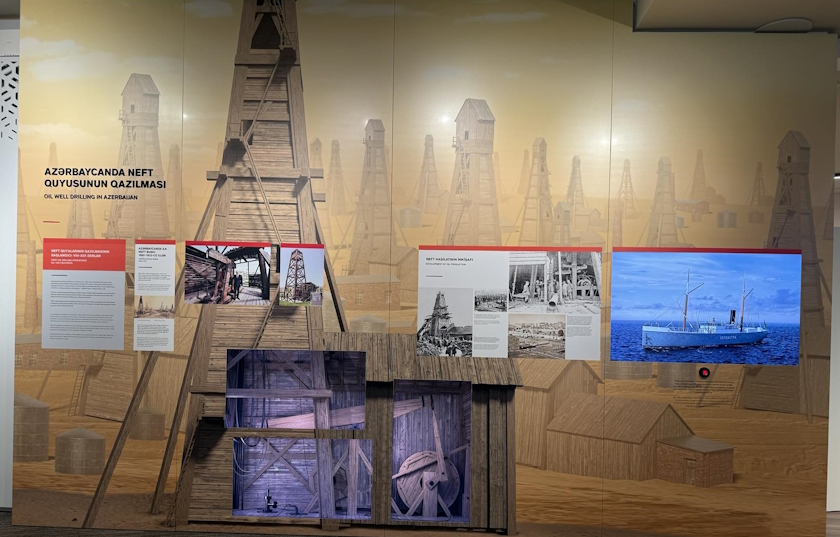
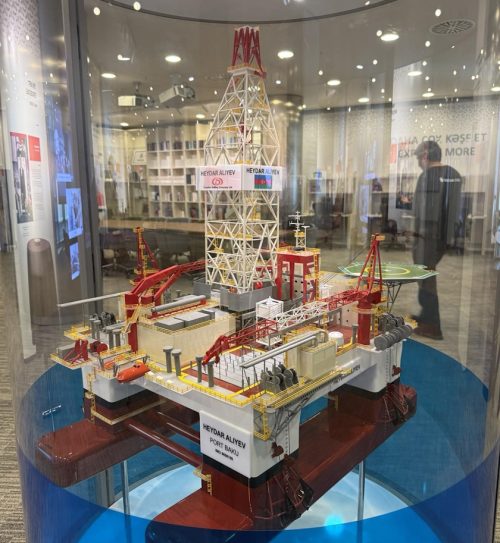
Azerbaijan’s rapid growth in energy is rooted in long and pioneering history. The country was home to the world’s first mechanically drilled industrial oil well and later became the site of the first offshore oil field.
Under the helm of State Oil Company of Azerbaijan Republic, or SOCAR, the country exports crude oil to 25 countries. The volume amounted to 170 million barrels last year. Italy bought most of it, followed by the Czech Republic, Croatia and Romania.
SOCAR Midstream Operations manages oil pipelines and storage facilities.
The Baku-Tbilisi-Ceyhan (BTC) pipeline transports crude from the Sangachal terminal on the Caspian Sea to Ceyhan on the Mediterranean coast. The capacity is 1.2 million barrels per day. BTC carries oil produced in Azerbaijan, Kazakhstan and Turkmenistan.
SOCAR Midstream Operations took over the management in July from its partner BP. They hold almost a third each in BTC. The stakes of other companies in the consortium, such as MOL Group, Eni and TotalEnergies, are under 9%.
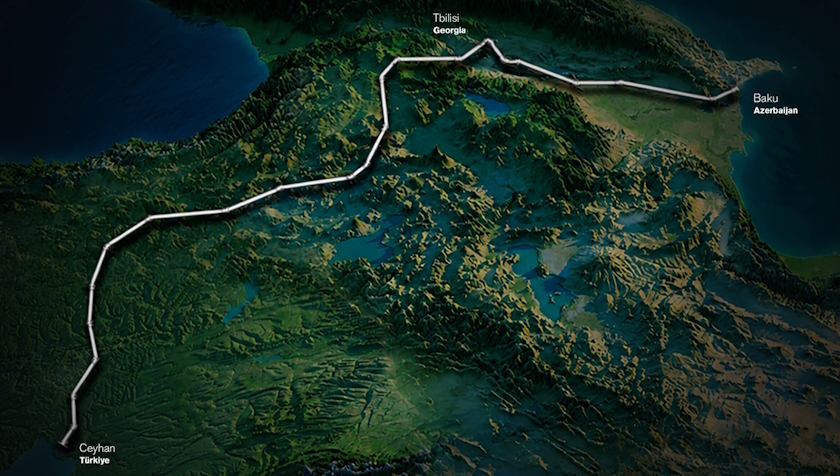
The Baku-Supsa Pipeline, also known as Western Route Export Pipeline or WREP, ends on Georgia’s Black Sea coast. It transports 90,000 barrels per day, while its maximum capacity is 106,000 barrels.
“Our vision is to be the most tested and sustainable energy corridor,” Chief Technical Officer of SOCAR Midstream Operations Eldar Gaziyev said at a press brief last week in the country’s capital Baku, on the occasion of the anniversary of the Contract of the Century.
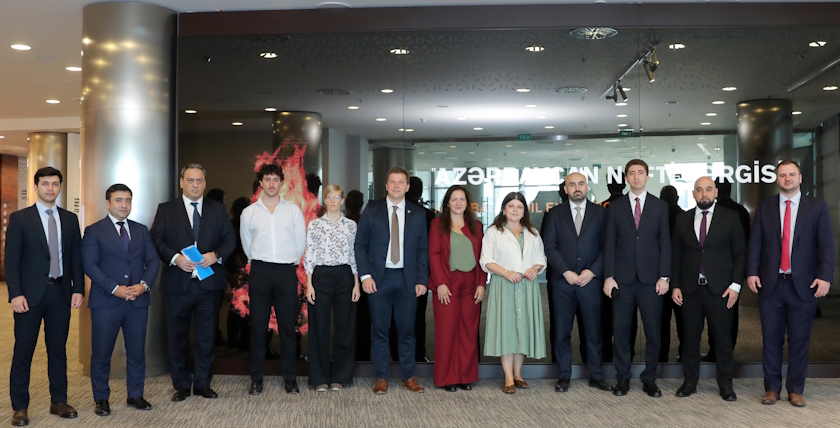
Azerbaijan exporting 25 billion cubic meters of natural gas per year
As natural gas has grown in importance over the past several decades, Azerbaijan has emerged as one of the superpowers, playing an important role in safeguarding Europe’s security of energy supply.
The country delivers 25 billion cubic meters of natural gas per year to 16 countries, mostly in Europe, Deputy Minister of Energy Orkhan Zeynalov said.
Running from Azerbaijan’s part of the Caspian Sea, the Southern Gas Corridor (SGC) is of vital importance for Europe and the Mediterranean. The system begins with the Shah Deniz field.
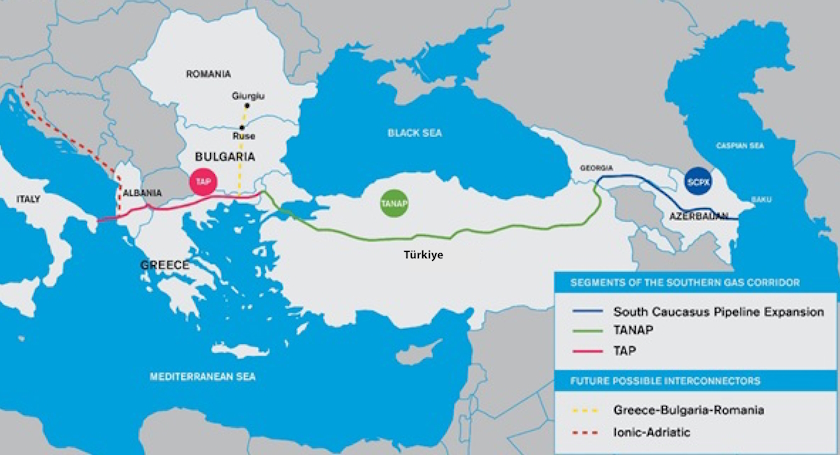
In 2006, the South Caucasus Pipeline (SCP) was launched to supply Georgia and Turkey. The capacity was more than tripled in 2018 to 24 billion cubic meters per year. That same year, the Trans Anatolian Natural Gas Pipeline (TANAP) took the corridor all the way to the Greek border.
Hajiyev: SOCAR and its partners need investment support from the EU to be able to increase gas volumes
The Trans Adriatic Pipeline (TAP), which reaches Italy from there, has an annual capacity of 12.7 billion cubic meters. It can be expanded to 20 billion.
Azerbaijan and the European Union are examining the possibility of expanding gas supply to existing and new markets, such as Austria and Germany. In order to achieve this ambitious goal, SOCAR and its partners need investment support from the EU for the project, said Chief Financing Officer of SOCAR Midstream Gas Operations Anar Hajiyev.
EU-Azerbaijan partnership to facilitate gas supply increase, green energy investments
A cornerstone of energy partnership between the European Union and Azerbaijan was laid in 2022, when European Commission President Ursula von der Leyen and Azerbaijani President Ilham Aliyev signed a memorandum on a strategic partnership in the field of energy. Under the agreement, they committed to doubling annual gas supply to 20 billion cubic meters.
Upon her visit this July to Baku, Von der Leyen highlighted the close relationship and energy cooperation between the EU and Azerbaijan.
A clean energy business roundtable is scheduled within the forthcoming EU-Azerbaijan summit in Brussels
The regular Azerbaijan-EU High-Level Energy Dialogue is continuing in early October in Brussels. It includes the EU-Azerbaijan Clean Energy Business Roundtable, and Von der Leyen and Aliyev are expected to deliver statements. The idea is to convene senior officials and representatives of the private sector.
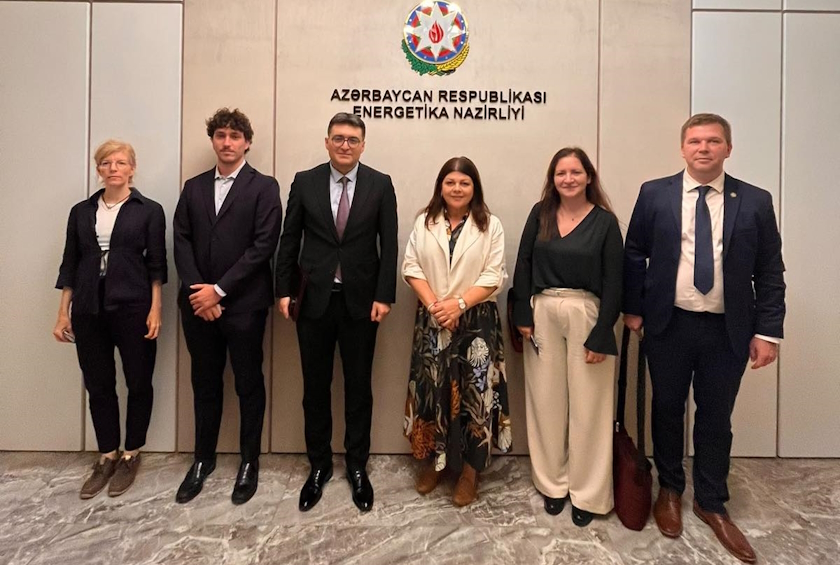
Beyond the discussions on gas supply, Azerbaijan is set to outline clean energy business opportunities for EU-based companies.
In 2025, Azerbaijan’s exports to Europe reached 13 billion cubic meters or 59% more than five years before, Deputy Minister Zeynalov said. The country is ready to further increase the gas supply to the growing European market. However, long-term agreements and financing sources are necessary, the official explained and suggested that the European Investment Bank (EIB) and European Bank for Reconstruction and Development (EBRD) could have a role.
Joint gas power plant project to strengthen strategic partnership with Serbia
Zeynalov highlighted Serbia as Azerbaijan’s strategic partner, pointing to the continuous growth in gas supply and the joint project for a gas-powered cogeneration plant near the city of Niš.
Azerbaijan and Serbia are ready to sign the agreement and are working on the final details for the future facility, the official added. It would have a capacity of 350 MW for electricity and 150 MW for heat.
Deputy Minister Orkhan Zeynalov expects the the gas-fired cogeneration plant project in Serbia to reach construction phase soon
Azerbaijan started exporting gas to Serbia a few years ago. Its share in demand has grown steadily, to as much as 16%, and the volume will keep rising, particularly because of the gas power plant project, Zeynalov asserted.
“The construction phase should start soon. This is our flagship project,” he stated, noting that it is establishing SOCAR’s presence in the surrounding region. In addition, the deputy minister stressed the significance of Serbia’s gas and electricity interconnectors.
SOCAR now has two refineries in Italy, together with major retail chain
SOCAR owns more than 7,000 fuel retail stations abroad. There are 6,300 in Italy, where four months ago the company completed the acquisition of Italiana Petroli (IP), including two refineries.
In addition to its Heydar Aliyev refinery in the home market and several petrochemical facilities, the company built the STAR oil refinery in Turkey, after acquiring a petrochemical plant there.
A new refinery is planned, for replacing the existing one. SOCAR’s Head of Refinery and Petrochemical Segment Orkhan Aliyev said the investment would be worth up to USD 7 billion.
Project pipeline includes 8 GW of renewables within six years
Azerbaijan is developing a comprehensive decarbonization policy for transforming its economy, where SOCAR has committed to achieving net zero emissions by 2050. The accent is on renewable energy.
“If you invest in just one single source, it compromises your security. So, our position is that we have to invest in all sources at the same time,” Zeynalov said.
By the end of 2027, solar and wind power plants of 2 GW overall are coming online, he added. It is the result of USD 2.6 billion in foreign direct investment. Furthermore, 8 GW is planned within the next six years, together with four interconnectors to export power and feed AI data centers, the official said.
Azerbaijan hosts the largest wind and power plants in the Caucasus
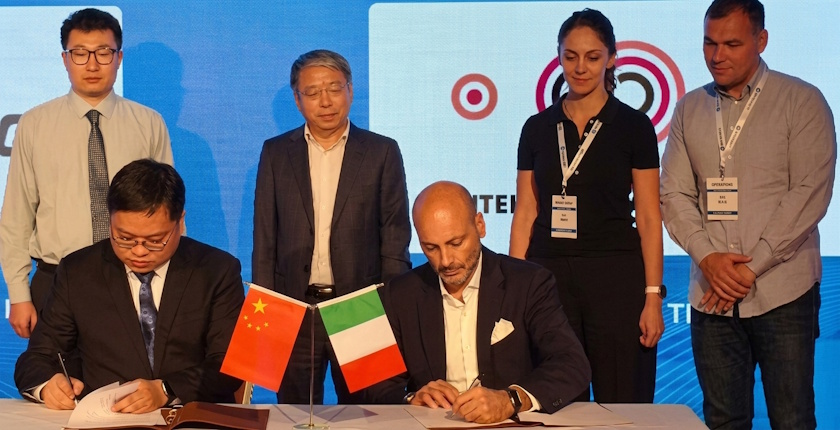
SOCAR’s subsidiary SOCAR Green is responsible for the renewables segment. It has also established several international partnerships with companies such as Abu Dhabi Future Energy Co. (Masdar), PowerChina and FAS Renewables from Saudi Arabia.
Just last week, China-based Universal Energy inaugurated its Gobustan solar power plant of 100 MW near Baku. The project won Azerbaijan’s first renewable energy tender, held in 2024.
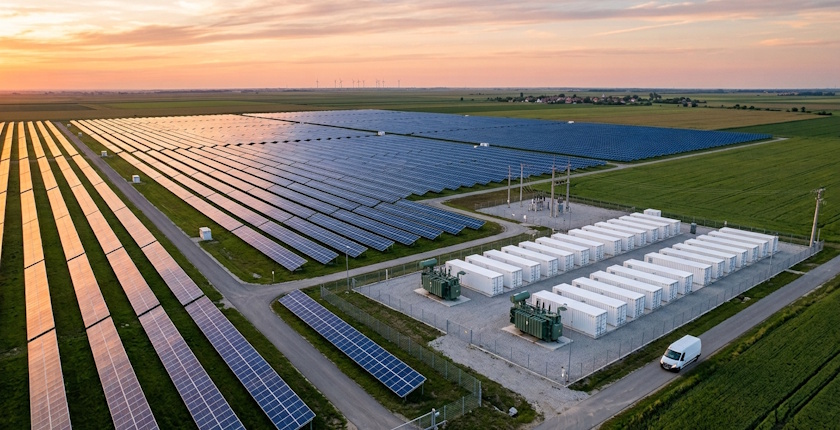
Nearby is Masdar’s Garadagh photovoltaic system of 230 MW. It was completed three years ago under a wider public-private partnership with Azerbaijan. The project is getting an expansion of at least 350 MW of PV capacity, alongside energy storage.
ACWA Power from Saudi Arabia commissioned its Khizi-Absheron wind farm of 240 MW in January, under another public-private partnership. Both facilities are the largest in the Caucasus region.
Offshore wind to contribute to reduction in demand for gas power plants
Renewables, including hydropower, make up one fifth of the country’s total electricity capacity. The goal for 2040 is 38%, compared to 43% by 2045. It is equivalent to gas power plant output that would require 1.1 billion cubic meters of gas per year, Deputy Minister Zeynalov said.
Clean Energy Capital, a subsidiary of Azerbaijan Green Energy Co. (AGEC), intends to build a 200 MW offshore wind park and expand it to 600 MW. Several other large-scale wind and PV projects on land are under construction or nearing maturity.
Four power interconnectors for green electricity exports
Azerbaijan is planning to become a significant green power exporter.
A project is underway for a power link from Azerbaijan to Hungary, including a cable under the Black Sea between Georgia and Romania. At the same time, a green energy corridor project is being developed with Georgia, Turkey and Bulgaria.
The third one would go through Armenia and Azerbaijan’s Nakhchivan exclave to reach Turkey, with a capacity of 1 GW. Separately, Azerbaijan is working on the first electricity link with Central Asia.
Sovereign wealth fund SOFAZ helping energy transition abroad
The government is using a part of its State Oil Fund of the Republic of Azerbaijan (SOFAZ) for green energy investments abroad. The sovereign wealth fund had USD 72.6 billion in assets under management at the end of June.
One of the most recent projects is a renewable energy infrastructure partnership with Enfinity Global. The company headquartered in the United States has a 402 MW photovoltaic portfolio in Italy, and SOFAZ invested USD 89 million.
The fund also participated in renewable energy, storage and grid flexibility projects throughout the world with the International Finance Corp. (IFC), Brookfield Asset Management and private equity firm EQT.