


Household electricity prices in Romania have risen the most, while Denmark recorded the largest drop in the first half of 2026 against the first half of 2025, according to the latest Eurostat data on electricity prices in national currencies. Western Balkan electricity prices barely moved, leaving country rankings intact.
Eurostat’s regular semi-annual data covers power prices for households with annual consumption between 2,500 kWh and 4,999 kWh, expressed both in euros and in the power purchasing standard (PPS) per 100 kWh. The latter, used by Eurostat, accounts for the relationship between nominal prices and the citizens’ actual purchasing power.
Eurostat also presents the amounts in national currencies.
Prices in the Western Balkans remained largely stable, recording minor increases and even one price drop, with the regional ranking remaining unchanged.
Serbia topped the list at 11.9 eurocents per kWh, followed by Albania (up from 11.7 to 11.9), North Macedonia at 11.6, Montenegro (up from 9.9 to 10.3), and BiH (up from 9.6 to 9.9). Kosovo* has the cheapest electricity, 8.69 eurocents per kWh, down from 8.77 eurocents, according to Eurostat.
Electricity prices rose 51.6% in Romania
In the EU, the strongest movements were recorded in the national currency category.
Compared with the first half of 2025, electricity prices rose sharply in Romania (+51.6%), Ireland (+19.8%), and Finland (+18.4%). By contrast, some countries recorded sharp decreases, notably Denmark (-31.7%) and Luxembourg (-24.1%).
Romania and Ireland are continuing their trend. In the second half of 2025, the increase was 58.6% in Romania and 32.7% in Ireland. Meanwhile, Denmark is following its path in the other direction, given the 11.9% decrease in the same period.
Prices remained well above levels from before the 2022 energy crisis
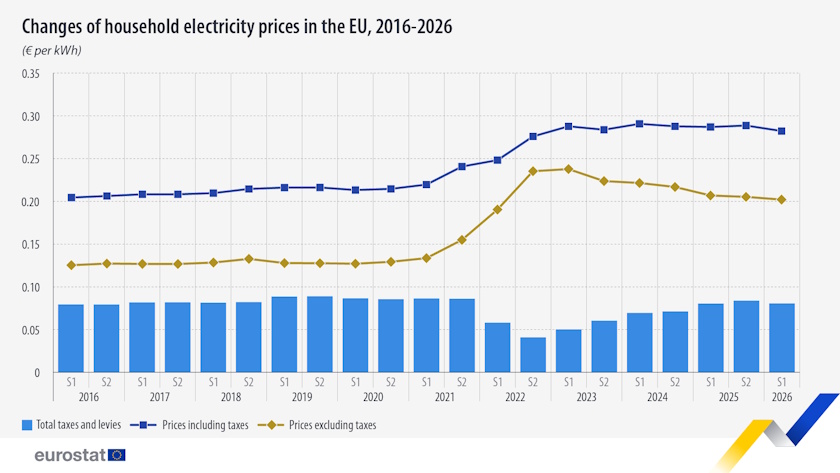
In the first half of 2026, average power prices for households in the EU decreased by 2.2% to 28 eurocents per kWh, down from 29 eurocents in the second half of 2025. Prices remained well above the levels from before the 2022 energy crisis, Eurostat stressed.
Ireland reported the highest electricity prices, 39 eurocents per kWh, followed by Germany and Belgium (both 36 eurocents). By contrast, the lowest prices were observed in Hungary (11 eurocents), Malta and Bulgaria (13 eurocents each). This is the same result as in the second half of 2025.
At the same time, taxes and levies also fell slightly as their share in the final bill decreased by 0.5 percentage points, from 28.9% in the second half of 2025 to 28.4% in the first half of 2026, the update reads.
Romania had the highest power prices for households expressed in PPS
Expressed in the purchasing power standard (PPS), electricity prices were the highest for households in Romania (46.9), against 49.52 in the second half of 2025. Poland holds second place (41.1), and Czechia (34.3) is third. Compared to the second half of 2025, the two countries just switched places.
The lowest prices denominated in PPS were in Malta (13.8), Hungary (14.7), and Luxembourg (15.5). The top two positions remained unchanged, while Luxembourg replaced Finland in third place, the Eurostat said.