


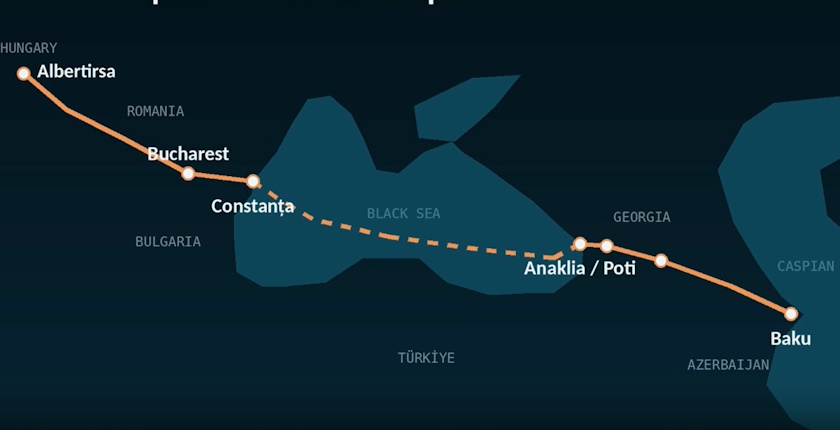
The proposed Green Energy Corridor from Baku in Azerbaijan to Hungary is valued at EUR 14.3 billion, plus EUR 7.8 billion for dedicated renewable electricity production capacity. It would consist of three routes including three 525 kV cables of 1.3 GW each, running under the Black Sea between Georgia and Romania.
Green Energy Corridor Power Co. (GECO), registered in Bucharest, was established to design, obtain financing for, build and operate an electricity transmission system connecting Azerbaijan, Georgia, Romania and Hungary. The project involves three submarine cables under the Black Sea.
The joint venture is equally controlled by transmission system operators (TSOs) AzerEnerji, Georgian State Electrosystem (GSE) and Transelectrica (of Romania), and the Hungarian state-owned energy utility MVM together with MAVIR – the TSO.
GECO is aspiring to become a project of mutual interest (PMI) under the European Union’s Trans-European Networks for Energy (TEN-E) Regulation.
The Green Energy Corridor is valued at EUR 22.1 billion, the latest update showed. According to the firm, the transmission segment would cost EUR 14.3 billion, and the dedicated renewable electricity production capacity amounts to EUR 7.8 billion.
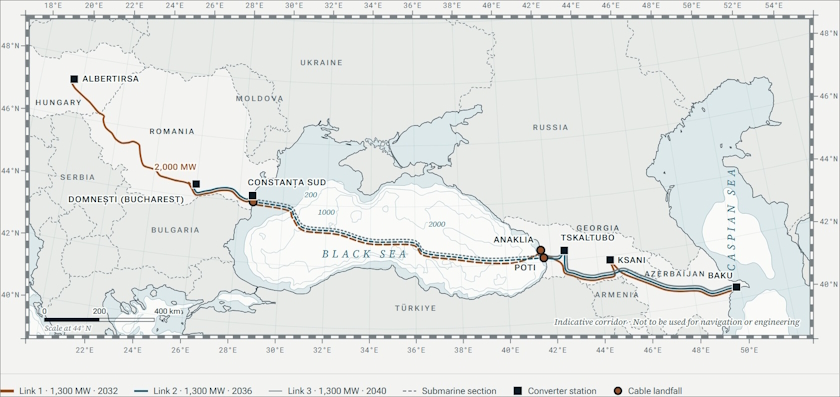
Cables to be laid at as low as 2.2 kilometers below sea surface
The map shows overhead and underground lines crossing Azerbaijan and Georgia to the coast at Anaklia and Poti. Converter stations at Ksani and Tskaltubo connect the corridor to the Georgian grid in both directions, so Georgia can export its renewable electricity surplus and import when it needs to.
From the Georgian coast, submarine cables of about 1,120 kilometers each cross the Black Sea, mostly over the abyssal plain at depths of up to about 2,200 meters. Landfall is at Constanța Sud in Romania.
The first and longest line, from Baku to Albertirsa near Budapest, is scheduled for launch in 2032
The first of the three links is planned to come online in 2032. The route goes from Baku in Azerbaijan to Albertirsa near Budapest. It is more than three thousand kilometers long, going between Anaklia and Constanța Sud on the opposing Black Sea shores. The second one, due in 2036, reaches Domnești near Bucharest.
Submarine high-voltage direct current (HDVC) cables would work at 525 kV. The three GECO lines are envisaged at 1.3 GW each, except the Constanța Sud – Albertirsa segment, of 2 GW.
GECO aims reach electricity transfers to the European Union totaling 20 TWh per year. The first link amounts to 8 TWh. The feasibility study was approved in July.
Of note, Azerbaijan, Georgia, Turkey and Bulgaria are working on a green energy corridor on land.
Hydrogen pipeline could stretch alongside power transmission lines
Within their Green Energy Corridor, the participants are considering the possibility of a hydrogen pipeline all the way from Baku to Albertirsa.
There are five versions for the diameter, 16 to 36 inches. It translates to between 100,000 and 950,000 tons per year, respectively, or 3.3 TWh to 31.7 TWh, the presentation revealed. The investment is seen at EUR 6.6 billion to EUR 13 billion.
Interestingly, at 150 to 200 meters below the surface, the Black Sea holds no more dissolved oxygen, while it does contain hydrogen sulphide, and life on the deep seabed is very limited.
It is where the largest part of the cables would lie. The marine studies therefore concentrate on the continental shelf and the coastal landfalls in Georgia and Romania, where habitats, fisheries and tourism are most sensitive, and on deep-water cultural heritage that the anoxic water preserves, GECO said.
The Black Sea is the world’s largest anoxic marine basin.