


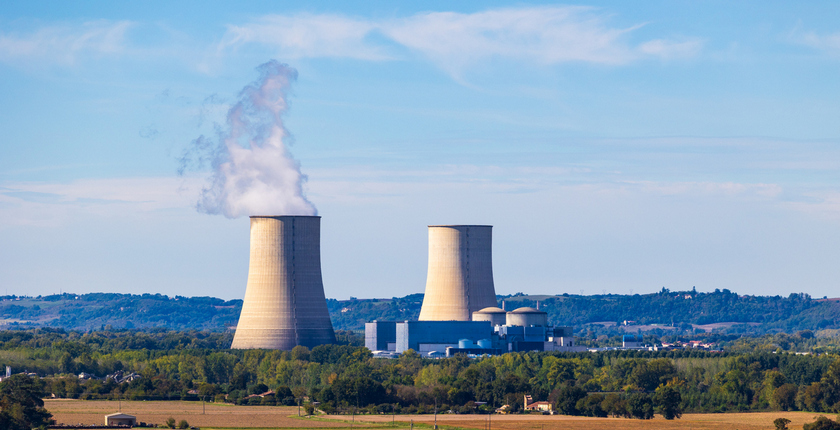
Romania is restarting production at its sole nuclear power plant, Cernavodă, which has been completely offline for nearly three months due to a lack of cooling water, caused by extreme heat and drought during the summer. For now, the plant’s operator, Nuclearelectrica, is reconnecting only one reactor, while the start-up of the second unit will depend on a sustained increase in the Danube level.
Following a rise in the Danube’s level in recent days, concrete steps to start up Cernavodă’s unit 1 were initiated on November 4, according to an announcement from Nuclearelectrica, Romania’s state-controlled nuclear power utility.
As for unit 2, it can be restarted only if the Danube’s water level continues to rise, given that unit 1 requires large volumes of cooling water and its operation will decrease the level in the intake basin, Nuclearelectrica explained.
The two reactors, of 700 MW each, together account for about 20% of Romania’s electricity output.
Since the shutdown, Romania has taken various measures to offset the decrease in electricity production, including restarting two coal-fired units at the Rovinari and Paroșeni thermal power plants.
The authorities have also offered consumers compensation for reducing electricity use during peak demand and even authorized the transmission system operator, Transelectrica, to limit power supply to industrial customers.
Mihai Gioară, general manager of Nuclearelectrica, said that work was underway to find short-, medium-, and long-term solutions to mitigate the impact of a similar event in the future.
Romania is seeking solutions to mitigate the impact of similar events in the future
Cernavodă’s unit 1 was shut down on July 28 amid critically low Danube levels that had left the power plant without sufficient cooling water.
The second reactor was disconnected on August 13 despite efforts to raise the river levels as the summer heatwave persisted. The measures included dredging, blasting a rock formation on the riverbed, and sinking loaded barges in the Danube.
The situation highlighted the need for more sophisticated cooling systems, especially given that Romania plans to build two more nuclear reactors.
The heatwave caused problems at nuclear power plants across Southeast Europe. In Hungary, the Paks nuclear plant was on the verge of going offline, while Slovenia’s Krško was forced to reduce reactor power to 80% due to high water temperatures in the Sava River. Both plants are now operating at full capacity.