


Hungary’s emergency engineering works and the forecasted rise of the Danube water level are allowing the country’s sole nuclear power plant Paks to restart the six idle turbines of the three reactors that had to be shut down. Prime Minister Péter Magyar said the facility would be able to work at full capacity on August 28 at the latest. It was literally inches away from going offline for the first time. But downstream on Europe’s second-largest river, Bulgaria’s Kozloduy is reducing capacity utilization for the first time.
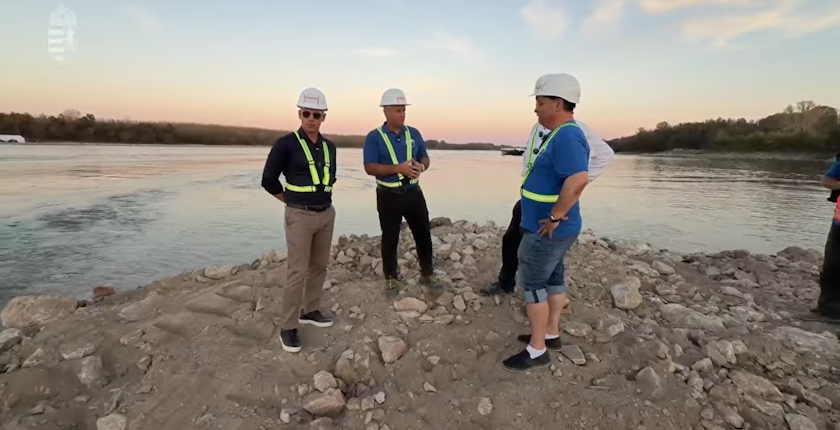
Halting entirely the operation of the Paks nuclear power plant would have incurred monthly expenses of HUF 50 billion (EUR 137 million), Hungarian Prime Minister Péter Magyar pointed out at the site. The worst scenario was avoided with emergency engineering works and the release of water through the Ráckeve lock system from the other arm of the Danube.
The government has sunk two rock-filled barges as a temporary solution for raising the water level near the intake pipes of Hungary’s only nuclear plant. At the same time, it is building an underwater weir or sill, a barrier in the bed of the river.
Krško nuclear plant in Slovenia is back at 100%, but Kozloduy is cutting production
Similar interventions earlier failed to prevent the forced shutdown of neighboring Romania’s Cernavodă nuclear plant downstream on the Danube.
Bulgarian Kozloduy, consisting of two equal reactors with 2 GW overall, is now forced to slash the capacity utilization of unit 5 by 120 MW. It is the first reduction in the facility’s history caused by extreme weather conditions. Built more than half a century ago, it is operated by state-owned Bulgarian Energy Holding (BEH).
The Ministry of Energy said the forecast indicates a further decline in the Danube.
Krško, the only other operational nuclear power plant in the region that Balkan Green Energy News tracks, has bounced back to 100% of capacity utilization. The facility in Slovenia, on the Sava river, is shared with Croatia.
Nationwide efforts result in crucial Danube water level rebound
Paks, run by state-owned MVM, has 2 GW. It consists of four reactors, each with two turbines. At the most critical point, only one turbine remained in operation. It was essential for the energy required to get the other reactors back on the grid.
River water is necessary for cooling the reactors. Both turbines of the same unit are currently working. The Danube in Hungary is forecasted to begin rising a little in a few days.
The donations include 200,000 tons of rock
Magyar said the gradual restart of the remaining three reactors is beginning by the end of the week. Paks is expected to generate power at full capacity on August 28 at the latest, he added.
The interventions helped bring the water level at the location up by 15 to 20 centimeters, the prime minister stressed and praised the coordinated efforts on the national level.
Magyar said 326 companies and individuals have offered knowhow, transportation and other kinds of assistance. They committed 200,000 tons of rock, lowering significantly the costs from the estimated HUF 6.2 billion, he revealed.