


From 2013 to the end of 2025, Serbia paid out EUR 1.52 billion in subsidies for electricity generation from renewable energy power plants through feed-in tariffs, according to an analysis produced by energy consultant Dejan Stojadinović. In return, the country gained benefits that can be quantified, and also ones that cannot. A total of 13.6 TWh of electricity was generated to supply domestic consumers, avoiding imports worth EUR 1.47 billion. Power plants with a total capacity of 619 MW were built, attracting EUR 1.5 billion in investments and creating at least 400 permanent jobs. Serbia also established a renewable energy sector and fulfilled its international obligations.
Energy consultant Dejan Stojadinović notes that the feed-in tariff system was introduced in November 2009 with the adoption of the decree on incentive measures for electricity generation using renewable energy sources.
The full implementation of this scheme and accompanying sector reforms took effect in 2010.
The objective of establishing the system was to develop the renewable energy sector, attract private investments, and meet international obligations, Stojadinović adds.
The analysis, perhaps the only one conducted on this topic to date, covers the period from mid-2013 to the end of 2025. Stojadinović explains that the first power plants began receiving incentives in 2012, and very few of them, so a significant number of plants wasn’t built before 2013, and that’s when state-owned power utility Elektroprivreda Srbije (EPS) began publishing reports.
A total of 378 subsidy payment contracts concluded
EPS’s available data show that 378 contracts have been concluded since the middle of 2014, of which 232 are still active, 120 have expired, and 26 have been terminated. Nineteen more contracts are set to expire by the end of 2026. All contracts last 12 years.
From mid-2013 to the end of 2025, EUR 1.519 billion was paid out for the purchase of 13.6 TWh (36% of the country’s annual electricity production in 2025). The funds were jointly provided by end consumers – through the renewable energy surcharge on electricity bills, and EPS.
End consumers – citizens and businesses – provided 68% of this amount, or approximately EUR 1.035 billion, while EPS covered around EUR 484 million (32%). It should be noted that EPS’s share includes the cost of balancing the subsidized power plants’ generation. According to Stojadinović, it amounted to around EUR 20 million.
“From the beginning, the system was designed in a way that EPS pays a price per kilowatt-hour equal to its own electricity generation cost, while the amount needed to purchase electricity above that price is covered by end consumers,” Stojadinović explains.
320 power plants with 619 MW capacity built
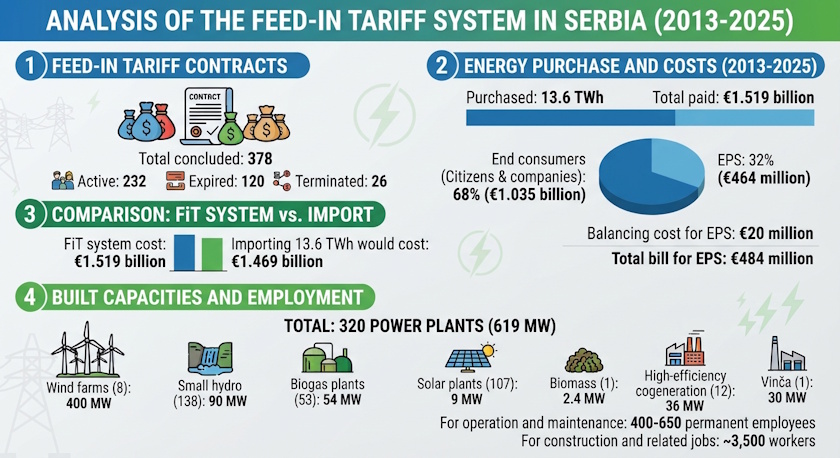
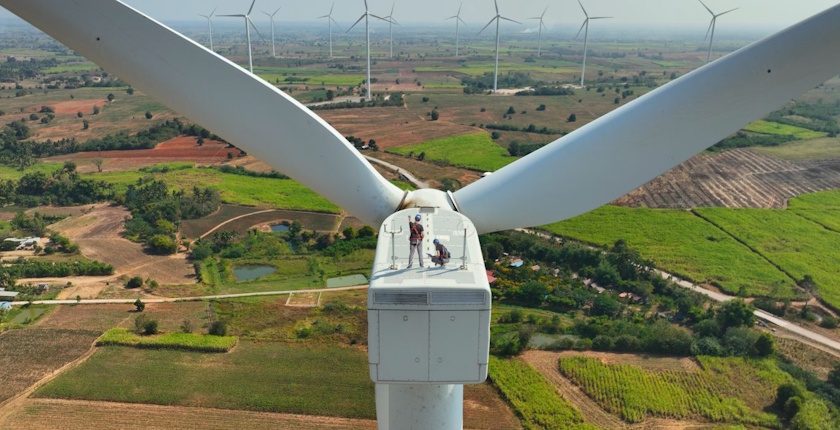
Stojadinović points out that thanks to this incentive system, around 619 MW of green energy power plants (nearly 7% of the country’s total generation capacity) were built: eight wind farms (400 MW), 138 small hydropower plants (90 MW), 53 biogas power plants (54 MW), 107 solar power plants (9 MW), and one biomass power plant (2.4 MW).
In addition, these incentives financed 12 high-efficiency cogeneration plants (36 MW) and one waste-to-energy plant, in Vinča (30 MW). In total, 320 power plants were built.
What did Serbia get in return?
Calculations show that importing 13.6 TWh would have cost EUR 1.469 billion, about EUR 50 million less than the amount paid for feed-in tariffs – EUR 1.519 billion. Stojadinović stresses that for this difference, Serbia gained a renewable energy market, including numerous companies operating in this field and employing a significant number of people.
Serbia does not keep statistics on how many people have so-called “green jobs,” but it can be estimated that operating and maintaining the power plants built under the FiT system requires 400 to 650 full-time employees.
EPS saved nearly EUR 1 billion
Their construction and related works required involving 3,500 workers.
The calculation regarding EPS is also relevant. The company obtained 13.6 TWh for EUR 484 million, or 3.6 eurocents per kWh. The purchase of 13.6 TWh on the market is estimated at EUR 1.469 billion, Stojadinović adds.
EPS’s regulated electricity price for households, at which it sold the purchased electricity, changed over time: in 2013 it was 5.12 eurocents per kWh, and it was rising every year, to reach 8.78 eurocents per kWh in 2025, the analysis shows.
Final assessment
Stojadinović points out that the feed-in tariff system in Serbia was both successful and necessary to spur the development of the renewable energy sector.
“Through its implementation, we gained a renewable energy market, including power plants, experience, and employment, which we previously lacked. It contributed to fulfilling Serbia’s international obligations, including binding targets for the share of renewable energy in gross final energy consumption, and avoided 8.1 million tonnes of CO2 emissions, whose market value is estimated at around EUR 567 million, calculated at a price of EUR 70 per tonne of CO2,” Stojadinović says.
He stressed that the electricity was generated without air pollution and other negative impacts caused by coal-fired power generation.