


The European Union is supporting an ambitious energy infrastructure project in Greece that will link its Dodecanese archipelago to the mainland electricity grid. Phase 1 is worth EUR 2.54 billion, of which a grant via the Public Sector Loan Facility (PSLF) amounts to EUR 228.9 million, while EUR 1.53 billion is a loan from the European Investment Bank.
Greece is continuing its efforts to integrate dozens of islands into its mainland electricity grid. One of the flagship projects is for an undersea interconnection between Korinthos and the Dodecanese archipelago in the Aegean Sea.
The European Climate, Infrastructure and Environment Executive Agency (CINEA) said the EU would support phase 1, worth a whopping EUR 2.54 billion.
Greece has earmarked EUR 534 million from the Decarbonization Fund for the Kos interconnector
A European Union grant of EUR 228.9 million under the Public Sector Loan Facility will be combined with a EUR 1.53 billion loan from the European Investment Bank. It is the largest PSLF contribution to date. The endeavor also benefits from a EUR 534 million grant from Greece’s Decarbonization Fund.
Ending the islands’ electrical isolation will deliver a more reliable and secure electricity supply, which is essential for local businesses and for tourism, the backbone of the islands’ economy, CINEA pointed out.
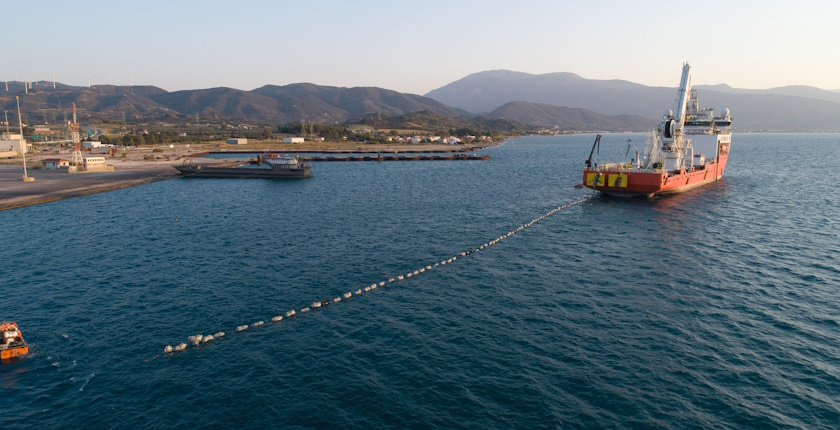
Implemented by the Independent Power Transmission Operator (IPTO), phase 1 is for a high-voltage direct current (HVDC) submarine link with the island of Kos, together with two converter stations and the associated transmission infrastructure.
Second phase is for AC cables to integrate Rhodes, Karpathos
The second phase is not part of the EU-supported project. Alternating current (AC) cables would bring Rhodes and Karpathos into the system.
“The Dodecanese interconnection project is an excellent example of how Greece, the European Commission and the European Investment Bank can work together to turn clean energy ambitions into reality. It will make a real difference to island communities, bringing them a cheaper and more reliable electricity supply while making it easier to use more renewable energy from a larger and more flexible grid. In doing so, the project shows what a socially just energy transition can look like in practice,” said the head of the European Commission’s Directorate-General for Regional and Urban Policy Director (DG Regio) Emma Toledano.
Dodecanese project to enable retirement of local oil-fired power plants
Ending the islands’ electrical isolation would allow local polluting oil-fired power plants to be decommissioned and open the way for renewable energy.
“By connecting Greek Dodecanese islands to a secure energy supply, the largest grant awarded to date under the PSLF proves that the clean energy transition can reach even the most remote communities, bringing them reliable energy, cleaner air, economic security and better living conditions,” CINEA’s Director Paloma Aba Garrote stated.
Phase 1 will create 40 permanent jobs and support sustainable tourism and economic diversification, including the electrification of transport and the growth of the blue economy, the announcement reads.
The European support underscores the strategic importance of the Dodecanese interconnection and affirms IPTO’s capacity to deliver complex infrastructure projects of both national and European significance, said the company’s Chairman and Chief Executive Officer Manos Manousakis.