


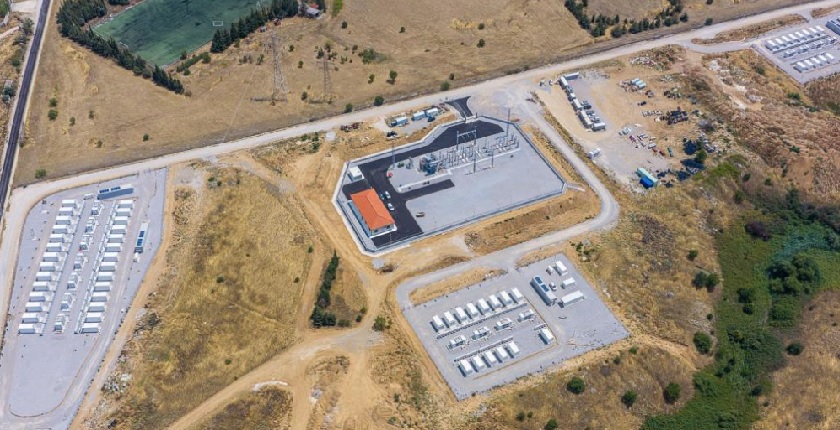
The Greek Ministry of Environment and Energy has released its long-awaited list of merchant battery storage projects, totaling 4.7 GW.
Earlier this year, the first battery energy storage systems were put into operation, from the 900 MW in operating power that received government support through auctions. The next step is to install 4.7 GW with no support, operating purely under market conditions.
The ministry said it received 831 applications for 12,319 MW. Out of these, 221 or 10,521 MW were for the transmission network and 610 or 1,798 MW for the distribution system.
After evaluation, projects of 6,366 MW altogether were selected as either frontrunners or substitutes in the first case, and 1,403 MW in the latter. All in all, 4,700 MW would receive connection terms.
Which companies succeeded
Among the protagonists in the large segment, Public Power Corporation (PPC) secured five projects for a total capacity of 470 MW, with all but one located in coal regions, including the Florina area in the north.
HELLENiQ Renewables, the green branch of Greek refiner HELLENiQ Energy, passed with 50 MW. Other well-known names in the renewables sector in the catalogue are Masdar’s Terna Energy with 197.5 MW, Rokas with 220 MW, Lightsource with 80 MW, Aenaos with 198 MW and ABO with 95 MW, all to be connected to the transmission grid.
Hundreds of investments by smaller companies are on the list for the Hellenic Distribution Network Operator (HEDNO or DEDDIE).
Mid-term goal set at up to 7 GW
According to the government, the ultimate goal is to have 5 GW to 7 GW of storage capacity in operation by 2028. It would reduce forced curtailments of renewable energy production and raise wholesale prices during the day, helping the struggling solar power producers. Batteries are expected to reduce the overall energy costs for consumers, too.
As for the next steps, the two network operators will have to provide connection terms. This will occur in phases, based on connection priority for each project category.