

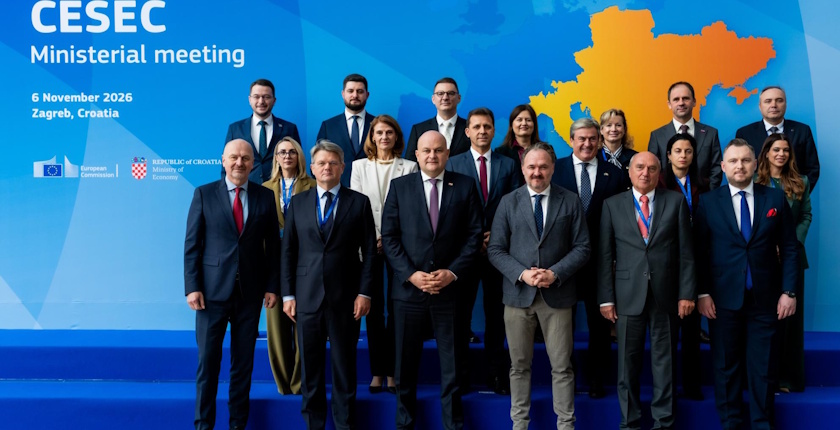
European Commission officials and ministers of the Central and South-East European Energy Connectivity (CESEC) High-level Group met in Zagreb today to explore progress on cross-border energy infrastructure, electrification and measures to meet the challenge of high energy prices.
The Central and South-East European Energy Connectivity (CESEC) High-level Group comprises EU countries and the Energy Community contracting parties. The EU countries that are participants of the CESEC are Austria, Bulgaria, Croatia, Czechia, Greece, Hungary, Italy, Romania, Poland, Slovakia and Slovenia, while members from the Energy Community are Albania, Bosnia and Herzegovina, Kosovo*, the Republic of Moldova, Montenegro, the Republic of North Macedonia, Serbia, and Ukraine.
Discussions reflected concerns over persistently high energy prices in the region and explored immediate and longer-term measures to ensure strategic projects progress swiftly, businesses remain competitive, and communities are shielded from the worst of the socio-economic impact, the European Commission said in a press release.
A particular focus was the way the gas market functions and the need to use existing electricity infrastructure more efficiently, using smart solutions and additional cross-border electricity connections to shield consumers from volatile electricity prices, it added.
Jørgensen: Now is the time to double down
At the meeting, the Group adopted ministerial conclusions and updated action plans on electricity and renewable energy and on gas.
European Commissioner for Energy and Housing Dan Jørgensen said that high energy prices were a clear signal of the financial, security, and strategic cost of EU dependence on polluting fossil fuel imports.
“Our measures to diversify supplies, deploy more homegrown clean energy and electrify the economy are the right ones. All this must be underpinned by adequate infrastructure and market integration. Through CESEC we’ve achieved a lot for this region. Now is the time to double down and make sure we have a system that truly delivers secure, clean and affordable energy,” he stressed.
Jørgensen recalled that in February, the EU spent EUR 134 billion more on energy than usual. He added that households could reduce their bills by switching from natural gas to electricity for heating.
Lorkowski: Regional cooperation on infrastructure is urgently needed
Artur Lorkowski, Director of the Energy Community Secretariat, said that growing energy demand, more renewable capacity, volatile prices, and the phase-out of Russian gas make regional cooperation on infrastructure urgent for Europe’s energy security.
Lorkowski stressed that common rules and regional cooperation will be key to ensuring that utilization of existing infrastructure is maximized and new projects are properly planned.
The Trans-Balkan Pipeline is a good example
“This year has put the region’s access to affordable energy at risk, and with its economies, public services and public trust. Through energy market integration, we mitigate this risk and construct a foundation on which everything else can stand,” Lorkowski emphasized.
“As new gas interconnectors are being finalized across the region, CESEC can help remove bottlenecks so they operate under EU-aligned rules and give economies that once relied on a single supplier real alternatives,” he added.
The Trans-Balkan Pipeline, according to him, is an example of what this cooperation can achieve. Since October, more competitive tariffs have made the pipeline a stronger route for diversified, non-Russian gas flowing northwards, he noted.
Šušnjar and Šahmanović discussed the Ionian-Adriatic Pipeline
Croatian Minister of Economy Ante Šušnjar said participants concluded that strong progress must be made – to deliver projects, not strategies.
Following a meeting with Montenegrin Minister of Energy and Mining Admir Šahmanović on the sidelines of the event, Šušnjar said that the Ionian-Adriatic Pipeline has an important role in cooperation between Croatia and Montenegro since it has the potential to open up new gas supply routes and better connect the countries of the Adriatic region.
Šahmanović: The energy sector is in a stage of stronger investment growth
Montenegro’s Ministry of Energy and Mining stated that the meeting addressed opportunities to further strengthen energy cooperation between the two countries, with a particular focus on infrastructure development, diversification of supply routes, and closer integration of regional energy markets.
According to the ministry, particular attention was paid to the Ionian-Adriatic Pipeline (IAP).
Šahmanović stressed that following intensive efforts to establish the legislative and institutional framework, the energy sector is in a stage of stronger investment growth, creating opportunities for strategic partnerships with international companies and investors in renewable energy, energy storage, and infrastructure development.
Božinovska: Regional connectivity and joint investments are key
North Macedonia’s Minister of Energy, Mining and Mineral Resources Sanja Božinovska said that regional connectivity and joint investments are key to ensuring stable energy supplies, a competitive economy, and long-term energy security.
She noted that construction of North Macedonia’s gas interconnector with Greece is underway. The Macedonian section is expected to be completed by mid-2027, while the interconnector with Serbia is targeted for completion in 2028, according to her.