


Annual investment in electricity transmission systems nearly tripled between 2019 and 2025, while distribution system investments grew by 51% from 2021 to 2025, according to ACER’s 2026 Monitoring Report on energy infrastructure development in Europe.
As renewable generation expands and electricity demand grows, driven by heat pumps, electric vehicles and data centres, electricity grids need to accommodate new connections and the shifting generation and consumption patterns, the European Union Agency for the Cooperation of Energy Regulators (ACER) said.
Meanwhile, gas networks must adapt to lower demand, and hydrogen is still at an early stage.
ACER’s 2026 Monitoring Report on energy infrastructure development in Europe examines whether electricity, gas and hydrogen networks are adapting to changing energy needs, and what this means for investment costs, delays and consumer costs.
CAPEX of electricity distribution rose by 51%
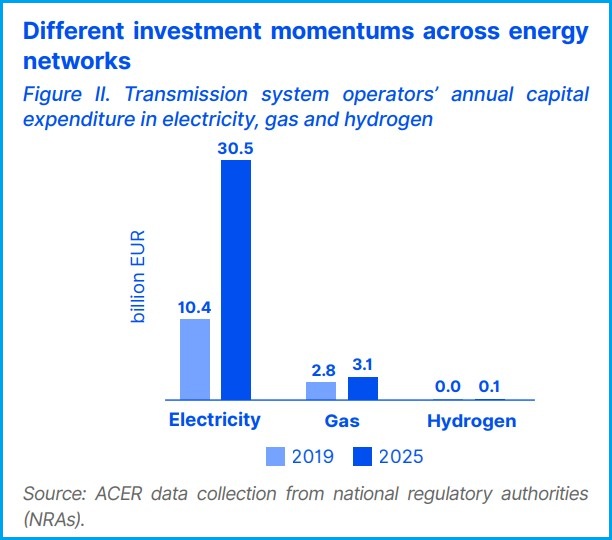
The report finds that annual capital expenditure (CAPEX) in the EU’s electricity transmission nearly tripled between 2019 and 2025, rising by 193% from about EUR 10.4 billion to EUR 30.5 billion.
In parallel, annual CAPEX in electricity distribution rose by 51% between 2021 and 2024, from EUR 23.5 billion to EUR 35.3 billion, the report reads.
Authors explained that electricity network investment has increased due to higher manufacturing prices, and, predominantly, because of growing demand for connecting new users and electricity exchanges across the system.
Two reasons why investments alone cannot ensure that infrastructure will keep pace with growing needs
However, higher capital expenditure alone cannot ensure that infrastructure will keep pace with growing transmission capacity needs. The report pointed to two factors.
First, despite great progress of Europe’s priority projects, delays persist, mainly for permit-granting reasons, leading to increased congestion costs and slow access to cheaper and cleaner generation.
Costly delay in delivering electricity transmission PCIs and PMIs
Between 9% and 30% of electricity transmission projects of common interest (PCIs) and projects of mutual interest (PMIs) are affected by delays each year, and about 40% PCIs are impacted at some point, contributing to an average implementation time of 12 years for these projects, according to the report.
ACER estimates that a one-year delay in delivering electricity transmission PCIs and PMIs results in EUR 4 billion in net economic welfare losses.
Secondly, “congestion income” has increased substantially. It is the revenue from scarce cross-border transmission capacity when electricity prices differ between EU bidding zones due to constraints on the EU power grid.
Compared with 2019, “congestion income” rose sevenfold in 2025
Between 2019 and 2025, it rose sevenfold: from EUR 1.3 billion to EUR 9.2 billion.
But, the report shows that around 60% of the total congestion income available continues to be set aside for later use, amounting to about EUR 12.5 billion in 2025.
As EU rules envisage, the income should be reinvested to address cross-border grid constraints or, where those priority objectives are already fulfilled, directed towards tariff reductions, ACER pointed out.