


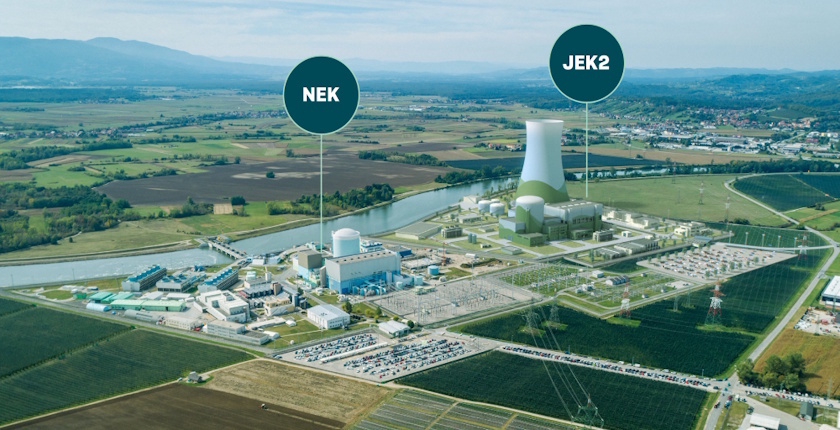
The construction of the Krško 2 nuclear power plant would cost between EUR 12.4 billion and EUR 14.8 billion, while the electricity generation cost would reach nearly EUR 133 per MWh, according to Aleksander Mervar, CEO of ELES, Slovenia’s transmission and distribution system operator. He warned that delaying the decision on the Krško 2 project is bad from the perspective of the power sector development strategy, and argued that investing in renewable energy requires a completely different approach.
In response to heightened public interest regarding various financing models for the Krško 2 (JEK 2) project, its costs, and electricity prices, ELES published calculations and remarks by its CEO, Aleksander Mervar. He is also a member of the Slovenian government’s working group monitoring the JEK 2 project, headed by Minister of Infrastructure and Energy Jernej Vrtovec.
The Krško 2 project is currently in the spatial planning phase, for the development of the national spatial plan.
Over the past two years, Mervar has produced a series of calculations and economic assessments for the planned second unit of the Krško nuclear power plant.
He based his calculations on current (nominal) prices. In contrast, most other analyses relied on the constant prices methodology, using price levels valid at the time the calculations were made.
Construction cost
Mervar used a baseline value of EUR 9.314 million per MW installed, estimating the value of JEK 2, with a net capacity of 1,100 MW, at approximately EUR 10.25 billion (in 2024 prices, excluding financing costs).
Mervar adjusted this baseline figure to account for inflation during the construction period, as well as financing costs.
In July, he modeled nine scenarios using the current prices method, factoring in annual inflation rates of 0.5%, 1%, and 1.5%, as well as a weighted average cost of capital (WACC) of 3%, 4%, and 5%.
The most likely scenario puts the cost at EUR 13.5 billion
Based on these scenarios, the estimated investment value at the time of commissioning ranges from EUR 12.4 billion to EUR 14.8 billion.
He highlighted the scenario with a 1% inflation rate and a 4% WACC as the most likely. In that case, the investment value amounts to EUR 13.5 billion.
According to his assessment, key risk factors affecting the investment’s value include the contracted price and its indexation mechanism for the construction period, alongside financing costs and the construction duration.
Electricity price
Mervar also calculated the range of average generation costs for the first twenty years using the nine scenarios under the current prices method.
Again, he identified the most likely scenario as the one with an annual inflation rate of 1% and a WACC of 4%. In this scenario, the average generation cost for the first twenty years of JEK 2 operation is EUR 132.92 per MWh. Two years ago, Mervar said that the price would not be lower than EUR 125.
He believes that the key factor are the future wholesale electricity market prices, which are currently impossible to predict with any certainty.
The generation cost will depend on which power generation technology becomes dominant
Mervar estimated future generation costs based on which power generation technology becomes dominant in the coming decades.
If major investments are made in nuclear technology, both in Europe and globally, its cost will effectively set the marginal market price, which will be adjusted upward to factor in the costs of new gas-fired power plants.
However, if the growth trend of distributed energy resources (solar and wind power) continues, wholesale market prices will be lower. However, end-user electricity prices – those that consumers see on their bills, will be higher, as numerous surcharges will be added to the market price, such as network tariffs and levies for strategic gas-fired power plants.
Such a scenario would be unfavorable for new nuclear power plants, Mervar added.
Two years ago he assessed that the cheapest scenario for Slovenia’s energy future is without nuclear energy.
What are the open issues?
ELES pointed out that the existing 400/100 kV switchyard in Krško is located west of the current nuclear power plant, right on the site where the investor plans to build the second unit.
The construction costs of a new switchyard are estimated at EUR 250 million. ELES will cover around EUR 80 million within planned upgrades, while the remaining costs will be borne by the project investor.
In addition, it is necessary to determine, and account for in all financing models, who would bear the additional costs associated with system reserves.
A 1,100 MW reserve is required
Given the 1,100 MW capacity of the JEK 2 unit, ELES would be required to secure an equivalent amount of reserve capacity – 1,100 MW, within the territory of Slovenia.
Currently, Slovenia does not possess such capacities, meaning it would be necessary to build 500–600 MW of capacity in gas power plants. At current prices, the additional costs for securing this capacity would amount to approximately EUR 31 million per year.
Mervar is convinced that these additional costs should also be paid by the owner of the JEK 2 project, rather than the end consumers of electricity in Slovenia.
Mervar advocates for bringing in a strategic partner
Mervar has also been publicly advocating for some time for the inclusion of a strategic partner, which would provide up to 50% of the investment, while the Republic of Slovenia would retain a dominant role.
It is important that decision makers clarify as soon as possible what role Slovenia will play in financing this investment – whether through guarantees, securing loans, or direct financing, as well as to determine whether a contract for difference (CfD), including a cap on the electricity purchase price, will be concluded with the supplier.
JEK 2 would have no impact on the Slovenian power grid
ELES warned that delaying decisions regarding the JEK 2 project is problematic from the standpoint of the Slovenian power sector development strategy, particularly regarding grid development.
Although JEK 2 would have no impact on the Slovenian power grid, nor would it require extensive upgrades or the construction of new infrastructure, investing in distributed renewable energy sources and supporting their deployment would require a completely different approach and strategy, as well as significant investments in infrastructure, especially in the distribution grid, Mervar concluded.