

Slovenia’s previous administration implemented a misguided green transition policy and neglected energy sovereignty, which led to a drastic decline in domestic electricity generation, the new government has stated.
The 2025 report on the state of the energy sector in Slovenia, prepared by the Energy Agency, also highlighted key challenges for the country’s future energy policy, according to the government.
The share of electricity consumption covered by domestic generation fell from 97% in 2024 to 82% in 2025, it stressed.
However, the government explained that the drop in domestic generation was driven, among other factors, by unfavorable hydrological conditions and the resulting decrease in hydropower output.
Under the previous administration, electricity traders played a prominent role
The government warned that under the previous administration, electricity traders played a prominent role while efforts to achieve energy sovereignty and self-sufficiency were neglected.
“The consequences of a misguided green transition policy, as set in the past, are increasingly coming to light, with a major reason for reduced domestic output being the significantly scaled-back operation of the Šoštanj thermal power plant (TEŠ) following its conversion into a public heat supplier,” the Slovenian government stated.
The Ministry of Infrastructure and Energy said the Energy Agency’s report confirms the need for an energy policy that prioritizes security of supply, competitive prices, system stability, and the strengthening of domestic energy production.
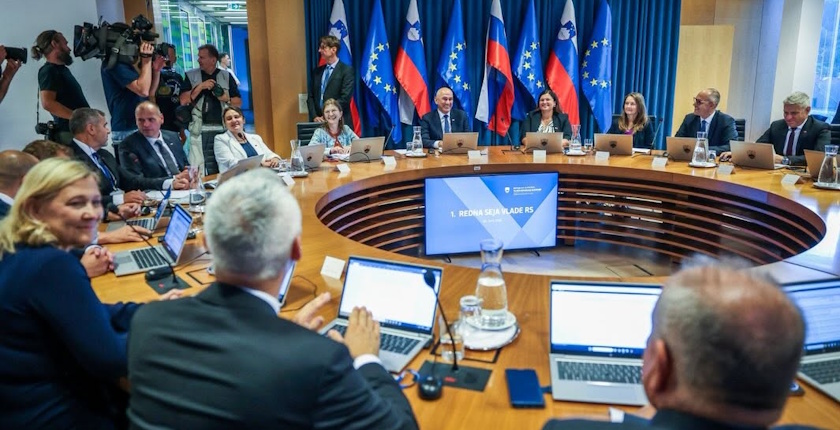
The new government took office in early June
At a time of growing geopolitical uncertainty, Slovenia must build a robust and diversified energy system over the long term, one that avoids over-reliance on a single energy source or imports and remains capable of supplying sufficient energy to households and the economy even under more challenging circumstances, the government underlined.
The country’s new government took office in early June, with Janez Janša succeeding Robert Golob as prime minister. The current Minister of Infrastructure and Energy is Jernej Vrtovec, while the Ministry of the Environment, Climate and Energy in the previous administration was led by Bojan Kumer.
Upon taking office, Vrtovec stated that his approach would focus on a smart, realistic energy policy for Slovenia, rather than a “green activist energy policy.”