


The European Union is rolling out a range of measures against the surge in energy prices, including the release of 100 million barrels of oil and diesel and extending the temporary state aid framework, European Commission President Ursula von der Leyen said after the meeting of the European Council. EU leaders are yet to agree on a more comprehensive joint approach to the energy crisis and the tradeoff with carbon pricing. Von der Leyen reiterated the core climate pledges: replacing foreign fossil fuels with affordable, clean and homegrown energy sources and electricity. “We need a whole puzzle of actions,” she pointed out.
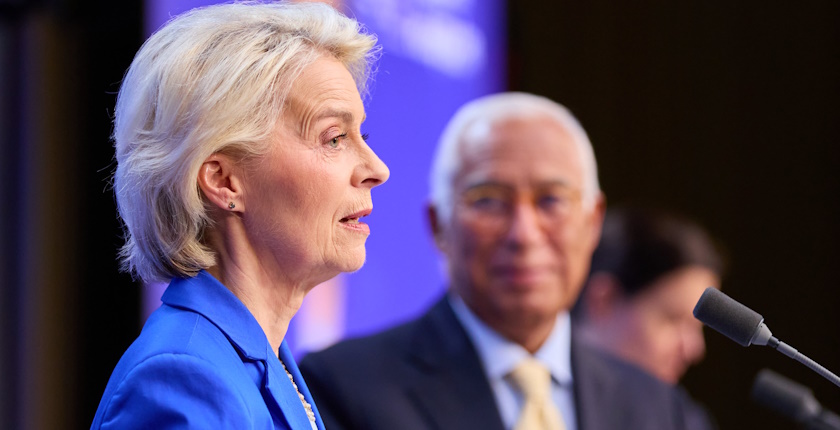
The two-day negotiations between EU institutions and member states in Brussels were “long and dense,” European Commission President Ursula von der Leyen acknowledged. Speaking alongside European Council President António Costa after their latest summit, she said “there is no silver bullet” for the energy crisis as all countries have different energy mixes.
“We need a whole puzzle of actions,” Von der Leyen pointed out. She noted that since the start of the war in the Middle East, costs for imported fossil fuels have increased by EUR 106 billion, without a single additional molecule of energy. Gas prices have risen 140% since late February, and diesel prices have doubled, Von der Leyen said.
The EU is releasing 100 million barrels of oil and diesel reserves
The EU is releasing 100 million barrels of oil and diesel reserves over the next four months. In addition, it is extending in scope and time the temporary state aid framework introduced in February for vulnerable segments of industrial production. Another recent response with short-term effect was to postpone the Methane Regulation, for monitoring emissions for imported oil and gas, until January 2028.
Von der Leyen noted that the European Commission is opening a strategic dialogue on European refineries, mainly to have more of them operating. Such facilities have been cutting capacity and closing down for years. Their profit margins have especially narrowed or even went negative in the past few months. It all translates to a greater dependence on fuel imports.
Transition from imported fossil fuels toward nuclear, renewables is essential
The heads of state and government and top EU executives didn’t find much common ground on the longer-term path forward regarding the tradeoff between climate objectives and expensive energy. For the joint statement, they decided to stick with the core climate pledges from the programs of the previous administration such as REPowerEU, Fit for 55 and the European Green Deal.
“As long as Europe depends on imported oil and gas, our prosperity remains exposed to events beyond our control. This is why it is so important to stay the course of the transition that is a transition towards affordable, clean and homegrown energy sources – nuclear and renewables. We must change the way we consume energy, that is replacing foreign fossil fuels by electricity produced in Europe,” Von der Leyen stressed.
The European Commission’s chief said the grid has to be modernized and improved. Von der Leyen highlighted the 80 GW of renewables capacity installed last year. Six times more is waiting for network connection approval, she asserted.
Member states have specific individual circumstances
The current situation urgently requires a coordinated European response of targeted and temporary measures, taking into account the member states’ specific circumstances and safeguarding the single market, the European Council underlined.
The body welcomed the initiatives of the European Commission to bundle energy demand voluntarily, for joint purchases.
The energy transition remains the most effective strategy for achieving Europe’s strategic autonomy, strengthening resilience and structurally lowering energy prices, the European Council said
“Recalling the overarching imperative of reducing the EU’s dependence on volatile fossil fuel markets, the European Council stresses that the energy transition remains the most effective strategy for achieving Europe’s strategic autonomy, strengthening resilience, structurally lowering energy prices, and delivering the clean, abundant and homegrown energy needed to power the economy of the future, by accelerating electrification and deploying renewable and low-carbon energy sources, grids and energy storage, as well as fostering energy efficiency,” the conclusions read.
The European Council said the legislative process on the Market Stability Reserve should be accelerated with a view to moderating price
volatility. It is a mechanism within the European Union’s Emissions Trading System (EU ETS) designed to fix imbalances between the supply and demand of carbon emission allowances – EUAs. They can be pulled from the market or released back to ease price movements.
In the context of the ongoing review of the ETS system and to support European industrial competitiveness, the European Council repeated that a well-functioning, transparent and predictable carbon market is necessary to effectively protect against carbon leakage, to reduce the volatility of the carbon price and mitigate its impact on electricity prices, while preserving the essential role of the ETS in the climate and energy transition through a market-based price signal for carbon emissions that drives investment and innovation.
The most urgent matter, though, is an agreement on the 27-member bloc’s 2028-2034 budget, needed by the end of this year.
Eurelectric: Beyond short-term response, any measure must be targeted, temporary
In a response to the European Council’s update on energy and climate policy, Eurelectric – Union of the Electricity Industry commended the short-term measures to ease the pressure on bills.
But it pointed out that any further measure must be targeted and temporary, so it does not disrupt the market signals that drive investment.
“Europe must keep its industry competitive while unlocking the investment needed for affordable, secure and decarbonised energy. Eurelectric’s message to leaders is clear: electrification delivers both,” the statement adds. Mirroring the conclusions from the meeting, the association said the energy transition remains the most effective way to lower prices for good and secure Europe’s energy.
There was little word in the European Council about ETS 2 and the Carbon Border Adjustment Mechanism (CBAM). Eurelectric said policymakers need to implement ETS 2 rather than reopen it, backed by strong enabling policies and funding instruments like the Social Climate Fund. Early, targeted use of its revenues would protect vulnerable households and give investors certainty.
SolarPower Europe calls for making electrification affordable
SolarPower Europe highlighted the need to ensure a level playing field between electricity and gas. It argued that fairer energy taxation and a strong, predictable carbon price are essential to making electrification the affordable choice.
“Faster deployment of rooftop solar is a proven and swift solution for lowering citizens’ energy bills, while large-scale batteries can store cheap abundant renewable electricity and push out expensive gas peakers when electricity demand is high. These are practical, easy-to-deploy measures that can help shield European households and businesses before next winter,” Deputy Chief Executive Officer Dries Acke said.