


The Government of Croatia has allocated an additional EUR 35 million to Velika Gorica, Osijek, Vinkovci, and Zaprešić for the utilization of geothermal energy.
The funds will be used to continue geothermal projects in the four Croatian cities, bringing the total investment, in two phases, to EUR 86 million.
Phase one was a project titled Preparation and Exploration of Geothermal Potential in the Context of Centralized Heating, which confirmed significant geothermal potential in these locations. It was financed through the National Recovery and Resilience Plan (NRRP).
EUR 30 million provided from the European Regional Development Fund
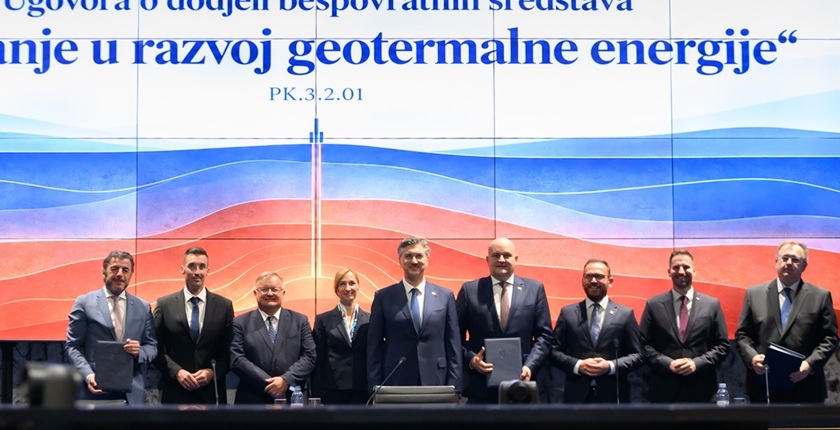
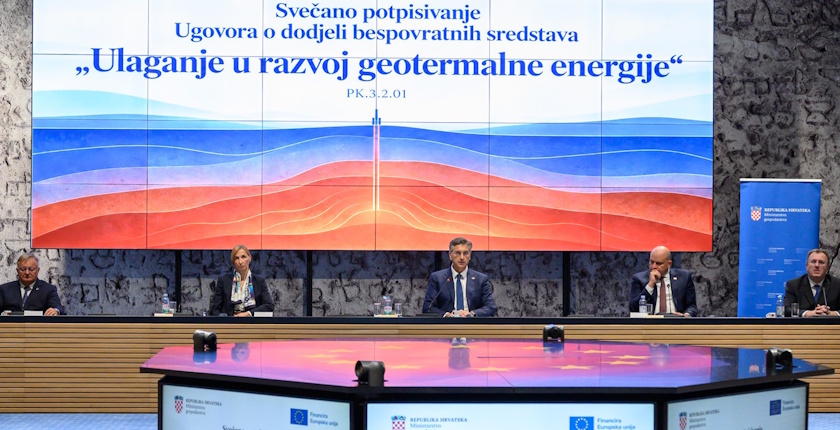
The EUR 35.3 million grant agreement for the second phase, Investment in the Development of Geothermal Energy, was signed at the National and University Library in Zagreb. EUR 30 million was secured from the European Regional Development Fund through Operational Programme Competitiveness and Cohesion 2021-2027.
The agreement was signed by Minister of Economy Ante Šušnjar, President of the Management Board of the Croatian Hydrocarbons Agency Marijan Krpan, and Director of the Central Finance and Contracting Agency for EU Programs and Projects Dragan Jelić, in the presence of Prime Minister of Croatia Andrej Plenković.
The funds are intended for drilling four additional geothermal wells in the areas of Velika Gorica, Osijek, Vinkovci, and Zaprešić, where preliminary explorations confirmed geothermal reservoirs, the Ministry of Economy said.
Krpan: Works should begin in two years
Marijan Krpan revealed that the project, if everything goes well and according to plan, should be operational by 2030. Works should begin two years earlier, he added, Jutarnji list reported.
Minister Ante Šušnjar stressed Croatia’s significant geothermal potential, primarily in the Croatian part of the Pannonian Basin, where the geothermal gradient is 60% higher than the European average.
“Unlike sun and wind, geothermal sources are available year-round, regardless of weather conditions. This is why they have special significance for district heating, which requires a continuous and reliable heat supply,” Šušnjar added.
“Others may have oil, Croatia has geothermal energy”
Prime Minister Andrej Plenković emphasized the importance of utilizing domestic energy sources to strengthen Croatia’s energy security and reduce dependence on imported energy.
“Others may have oil, Croatia has geothermal energy,” Plenković pointed out.
He highlighted the advantages of this domestic, renewable energy source available year-round.
Conditions are being created for connection to existing district heating systems
The ministry explained that the construction of new wells will enable the formation of closed production-injection systems. This creates the technical prerequisites for the long-term and sustainable use of geothermal energy and future connection to existing urban district heating systems.
It also opens up the possibility of gradually replacing fossil fuels in the heating sector, ensuring a more reliable heat supply, and modernizing local energy infrastructure.
For citizens, this means the possibility of using domestic renewable energy to heat homes and public institutions, while for the economy, geothermal sources offer new development opportunities in agriculture, greenhouse production, industry, and other activities utilizing thermal energy, according to the ministry.
Projects in five more locations under development
Geothermal potential has also been identified in the areas of Karlovac and Virovitica, while the ministry is looking for solutions to support their development.
The closest to implementation of geothermal projects are Križevci, Bjelovar, and Lipik, where significant geothermal potential has been discovered and confirmed through measurements.
Following the full realization of the projects, the use of geothermal energy for heating public buildings is planned, the update reads.
A public call for the allocation of funds through the Modernisation Fund is being prepared for these three municipal authorities, within which approximately EUR 26 million is envisaged, the ministry said.
Alongside investments in district heating systems, the Ministry of Economy is working to secure European and national funds for capital-intensive projects for generating electricity from geothermal energy.