



Fuel continued to flow across the Energy Community despite what is turning out to be the sharpest oil supply shock in more than half a century, but at a high price, according to the Energy Community Secretariat’s upcoming 2026 Oil Market Status Report. The secretariat views oil security as one of the key instruments to support energy transition. It is also establishing the Oil Coordination Group to help contracting parties navigate challenges in the oil sector.
Under the Energy Community Treaty, contracting parties are required to build emergency oil stocks and have emergency plans in place, in line with the EU’s Oil Stocks Directive.
Eight markets are covered in the 2026 Oil Market Status Report – Albania, Bosnia and Herzegovina, Georgia, Kosovo*, Moldova, Montenegro, North Macedonia and Serbia. Ukraine will be included in the final report.
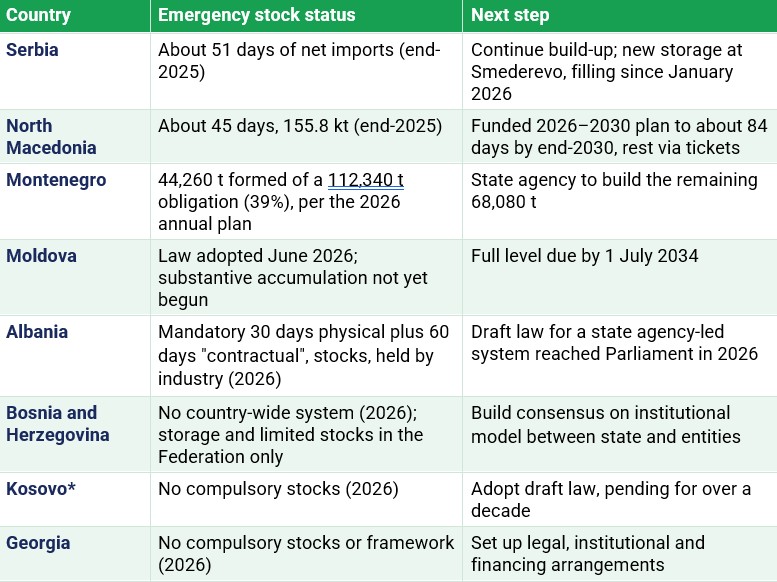
“None of those covered here yet holds the full 90-day stock. Three have built compulsory stocks under dedicated legislation – Montenegro, North Macedonia, and Serbia. Five are still putting a system in place,” the secretariat’s oil expert Priit Enok said.
This year, global events brought back the awareness that there is no time to wait, in his words. “With stocks, you can react to these disruptions and buy time. Without the stocks, you are left only to the market,” he added.
“The secretariat sees oil security as one of the key pillars to support the energy transition. We have seen again during 2026 that if you are in an energy deficit, then it’s so easy to undermine all those efforts in energy transition. So, the security of supply is important to secure the energy transition. But the transition takes time. Security is needed immediately”, he explained.
Priit said that the region has responded to the oil shock on several fronts.
Thessaloniki–Skopje VARDAX pipeline restarted in March 2026
Moldova adopted its stockholding law in June 2026, Albania’s draft law reached the Parliament in 2026, North Macedonia adopted a 2026–2030 action plan in June 2026 and Montenegro adopted its crisis plan in May 2026.
“Supply systems changed quickly, too: the Thessaloniki–Skopje VARDAX pipeline was restarted in March 2026, for example. Contracting parties are broadly advancing in both emergency planning and stockholding,” he stressed in Belgrade at the Oil Forum, organized by the secretariat.
The forum brought together representatives of governments, the European Commission, the International Energy Agency as well as the oil industry across Southeast and Eastern Europe.
Climate change has become an oil security risk
The authors of the Oil Market Status Report pointed out that climate change has become an oil security risk.
Low Danube water in July 2026 hit two countries at once. Serbia’s fuel imports by ships fell to 30-40% of the usual level, as reported on July 23, 2026. Moldovan barge loads dropped from between 2,000 and 2,500 tonnes to about 900.
In Bosnia and Herzegovina, flood damage has halted rail freight from the port of Ploče for about four months, from October 2024 to January 2025, according to the report.
The region’s markets are interconnected
Data shows the demand is growing, which raises the costs of any shortage. Deliveries of oil products rose 31% in Georgia (2021-25) and 24% in Kosovo* (2022-25), and consumption rose 20% in Montenegro (2021-25).
The region’s markets are interconnected, which makes a coordinated response logical, the report reads.
In 2024, Serbia accounted for about 15% of Bosnia and Herzegovina’s petroleum product imports. Albania provided an estimated 50-60% of Kosovo’s* fuel during the 2026 disruption, and North Macedonia re-exported about 330.000 to neighbouring markets in 2024.
However, EU markets anchor the region’s supply, with main suppliers being Greece, Croatia, and Romania.
“No country can fight the closure of Hormuz alone”

Priit opined that step one for the contracting parties is to do their homework and prepare for the domestic crisis. But, in parallel, the Energy Community needs to build the ability to react as a region, coordinated, because this is the scope of the EU’s oil stockholding and security supply policy.
“No country can fight the closure of the Strait of Hormuz alone. So, this is something we need to build in the region, this trust,” he added.
To start moving in that direction, the contracting parties need to establish a data monitoring and exchange platform. But, data has to be available on time.
“This is the objective of activating the Oil Coordination Group. However, it is not easy to establish such a flexible and comprehensive data exchange platform overnight. For starters, we need to create a certain level of competence and trust,” he said.