


Cumulative investments required to implement national energy and climate plans across the seven Energy Community contracting parties are estimated at EUR 151 billion through 2030, according to an analysis by the Energy Community Secretariat.
The Energy Community Secretariat analyzed the first cycle of national energy and climate plans (NECPs) and integrated national energy and climate progress reports (NECPRs) to determine where the Energy Community contracting parties stand in terms of their 2030 energy and climate binding commitments and where further action is needed.
The assessment report touches on all nine contracting parties, however the secretariat has so far received NECPs and NECPRs from only seven of them, namely from Albania, Georgia, Moldova, North Macedonia, Montenegro, Serbia, and Ukraine. BiH, and Kosovo* have not submitted theirs.
Nine Southeast and Eastern European EU aspirants have, in large part, laid the groundwork for energy transitions that should achieve EU-aligned decarbonization targets, the secretariat said.
The focus must now shift from planning to implementation
The findings show that, while the policy framework for the transition is largely in place, the focus must now shift from planning to implementation, backed by significant public and private investment, it added.
While the plans contain important measures to accelerate the energy transition, they could have better tapped the potential of regional cooperation, the energy-efficiency-first principle and just transition considerations, according to the secretariat.
The aim of the report is twofold. It provides an overview of the level of ambition, objectives, policies and measures of contracting parties up to 2030. Second, it serves as a basis for the preparation of the next cycle of NECPRs in 2027 and for developing the next iteration of NECPs covering the period 2030–2040.
The private sector as the main source of funding the investments
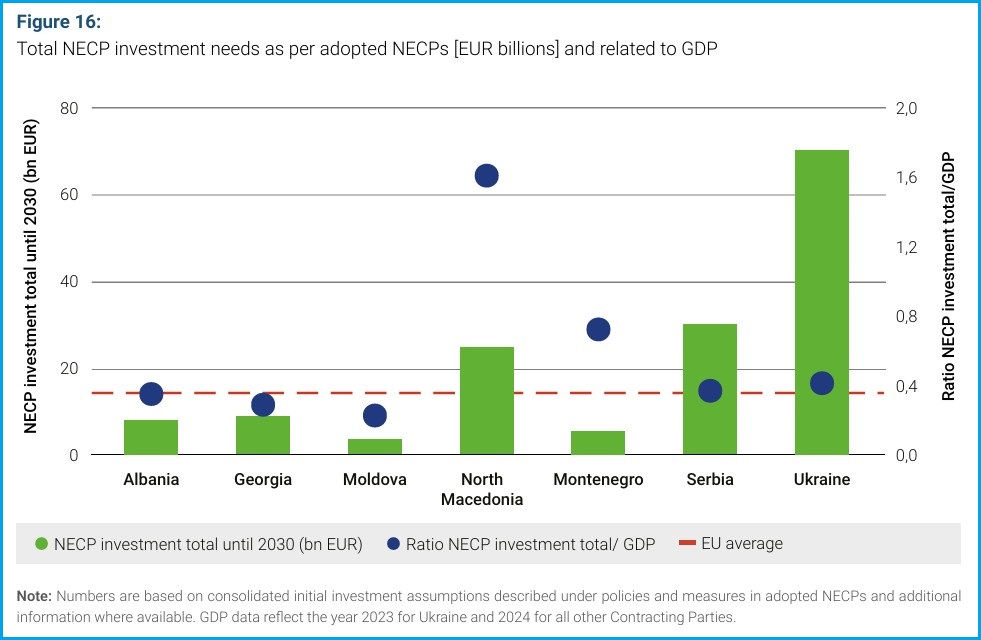
Out of the total EUR 151 billion in required investments, more than EUR 80 billion is earmarked for Georgia, Moldova, and Ukraine, while almost EUR 70 billion is needed for the four Western Balkan contracting parties.
However, the secretariat warned that this figure is based on the partial information available in the NECPs and should be used as a general indicator.
The NECPs generally identify the private sector as the main source of funding, while 10–30% of funding is typically planned to come from public budgets, according to the assessment.
NECPs should increasingly evolve into strategic investment blueprints, translating policy objectives and measures into clearly identified, priced and financeable investment priorities capable of guiding public, private and donor support, reads the policy brief summarizing the assessment.
Progress on renewables is mixed
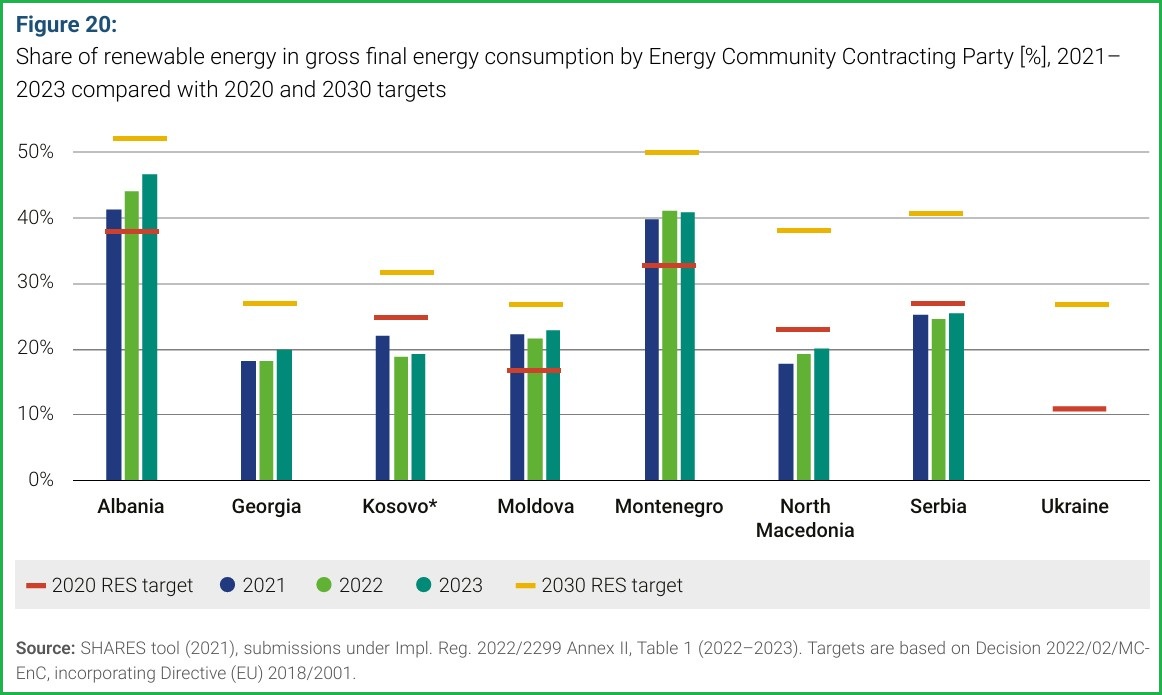
Regarding renewable energy deployment, the report sees mixed progress.
Renewable electricity generation is expanding, but only three contracting parties maintained or exceeded their 2020 renewable energy shares, which represent the minimum baseline for progress towards the more ambitious 2030 targets, the secretariat said.
These are Albania, Moldova, and Montenegro.
There has been hardly any progress in transport, while the declining use of traditional biomass in heating and cooling must be accompanied by faster deployment of modern renewable heat technologies and sustainable resource management.
NECPs lack details on carbon pricing
The secretariat stressed that carbon pricing is not adequately covered in most NECPs.
According to the report, several plans refer to emissions trading, carbon taxes or a combination of both. However, they generally provide insufficient detail on the design, timing and expected carbon price levels, as well as their impact on emissions, investment and technology choices.
Carbon pricing therefore needs to be integrated much more clearly into future modelling, policy measures and investment assumptions, the secretariat pointed out.