



Through its software platform, Swiss company Virtual Global Trading (VGT) is unlocking access to the flexibility market for producers and consumers of all sizes – from household solar and battery systems and electric vehicle chargers, to large hydroelectric power plants and factories. The company is growing rapidly and, besides Switzerland, is moving fast into the German, Austrian, Belgian and French markets.
Software platforms interconnect thousands and millions of points in the power system: from the largest power plants and high-voltage substations with the highest voltage levels, through consumers of all categories and battery systems, all the way to household photovoltaic installations with a minimum capacity of ten kilowatts and electric vehicle chargers. This type of digitalization is becoming increasingly significant, as maintaining a constant balance between supply and demand is becoming unimaginably complex in the era of accelerated and mass electrification.
Gregor Martinović has studied electrical and communication technologies, specializing in satellite communications
Moreover, software solutions for the flow and processing of countless real-time data are essential for opening new market segments and include all relevant participants, Gregor Martinović pointed out in an interview with Balkan Green Energy News. He is the co-founder of VGT, which connects producers, consumers and grid operators through its digital service, and markets their flexibility.
Martinović, who has family roots in the former Yugoslavia, studied electrical and communication technologies, specializing in satellite communications. He has been active in the digital transformation of the energy market for more than ten years. His company launched its customer platform in 2023.
Accounting for each thread in electricity tapestry
It is often said that the energy transition toward clean sources is built on digitalization, democratization and decentralization. It means that the system contains a growing number of dispersed entities producing and consuming, with their smart meters, specific profiles and performance capabilities, but also with faults and disruptions.
VGT does not sell electricity on behalf of its clients, but markets their ability to shift the time of their production, consumption and energy storing
Like individual threads in a tapestry, they are invisible elements to someone looking at the whole picture. But they must communicate with central nodes and, to a large extent, with each other.
The number of prosumers is growing rapidly, too: households, small manufacturing units, commercial buildings and institutions such as schools. For them to also benefit from the new way of managing the power system, while contributing to its stability, they need market access.
We connect them, bring them onto our platform, market their flexibility and we all earn together
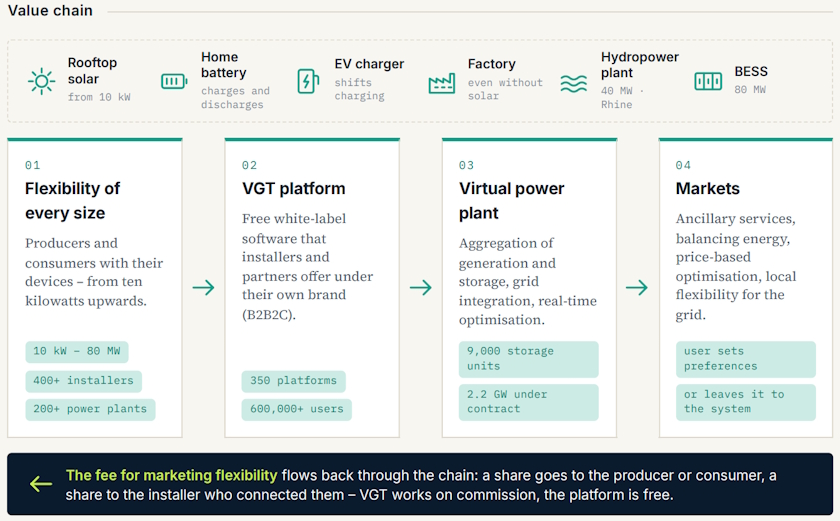
Beyond technical connectivity, it is a path that goes through an aggregator, which bundles capacities into a virtual power plant, and a company that participates in the market, Martinović explains. “And we have covered the entire chain for facilities of all sizes, including market access. Every solar or battery system from 10 kW up, as well as an EV charger, can be connected through our platform,” he underscored.
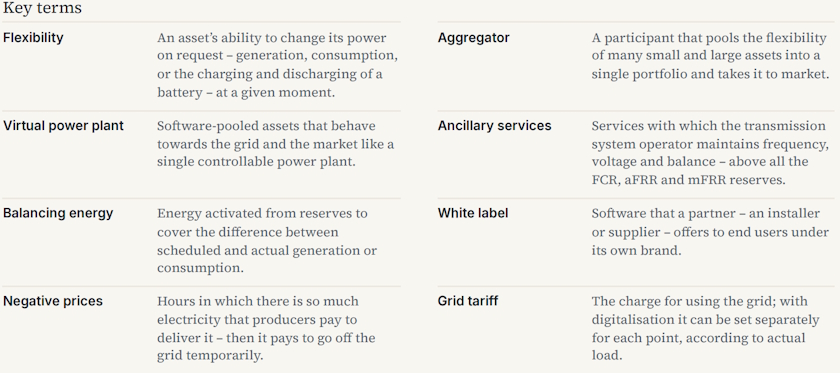
VGT does not sell its clients’ electricity on their behalf; instead, it markets their flexibility – the ability to time-shift production, consumption, and battery charging or discharging. The company handles grid integration and aggregates production and storage assets into a virtual power plant, which then operates on the flexibility and balancing energy markets.
“We connect them, bring them onto our platform, market their flexibility and we all earn together! This process must be fully digital, because otherwise it is not financially viable,” Gregor Martinović asserted.
Call installers for power market access
One of the pillars are installers of smaller solar and battery systems. They use VGT’s platform, which manages production, consumption and flexibility commercialization. It is a white label software, meaning that a partner company like that can use it under its own trademark.
What’s more, the platform is free – the operator of any device can download and install it. The end user can be purely a consumer: a factory without a rooftop solar power plant, but, for instance, with a battery that it charges when electricity is cheaper.
Simple digital logistics strengthening grid integration of renewables
VGT has simplified connection, management and monetization, thereby promoting the integration of renewable energy sources into the power system.
The approach is called B2B2C (business-to-business-to-consumer), as the company reaches end users through a partner firm. Users can set their own preferences or let the system manage operations in the most cost-effective way. One option is for a solar park or wind farm to temporarily withdraw from the grid when it is more profitable not to produce due to low or negative electricity prices and special incentives.
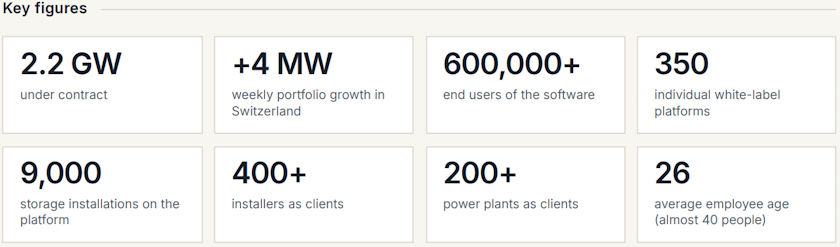
VGT operates for a fee from the flexibility commercialization, and a portion belongs to the installer. The company started with small facilities, of the said 10 kW and up, and now its portfolio includes, among other things, a 40 MW hydroelectric plant on the Rhine and a battery energy storage system (BESS) of 80 MW in operating power. The latter is one of a total of 9,000 storage systems on the platform.
Over 400 installers and more than 200 power plants are aggregated, Martinović reveals. They are VGT’s direct clients, bringing all of their flexibility – both large and small – onto the platform. From there, the scale: VGT’s software is used by more than 600,000 end users across 350 individual platforms, he said.
VGT entering EU’s largest countries
The company has 2.2 GW under contract, and with current negotiations it is on a path of exponential growth. The largest part of the portfolio is in Switzerland, where it is growing by 4 MW per week. It is currently entering the German market, independently, and next are Austria and Belgium, most likely before the end of the year, which will be followed by the opening of a firm in France.
Big capacities are not an obstacle. VGT also offers its solutions to transmission system operators (TSOs), the core anchor of stability, which manage facilities with large-scale capacity. Martinović points out that the platform enables them to connect and optimize all of their electricity and flexibility sources in real time. The advantage is that many high-voltage assets are already within VGT’s structure.
VGT’s employees are 26 years old on average
“That is the software’s contribution to the green energy transition and flexibility. We ar inviting producers and installers to join us, because every day they wait, they are losing money,” Martinović stressed.
At a time when numerous companies are struggling to attract talent, VGT has no difficulties in finding good people. “Young people from the most prestigious universities show great interest in working with us,” Martinović shares enthusiastically. The average age in the company, which is headquartered in Aarau in northern Switzerland, is 26 years, and it has nearly forty employees.
Separate grid tariffs for each individual small power plant
With the advancement of digitalization, it will become possible to optimize the grid load, meaning the delivery path of the produced electricity through the transmission and even the distribution system, Gregor Martinović points out. It opens up the possibility to determine the grid fee individually for each point, in which case it would be clear where a battery is needed and where it is not, he added.
All of it combined is a new market, a source of revenue for the creators of the fastest software and artificial intelligence.
Every local, low-voltage grid has ten to a hundred times more metering points than the transmission system. “That is why distribution system operators are hesitant to grant permits for batteries. They do not know their network well,” said the co-founder of VGT. The introduction of appropriate technology to cover such areas is yet to come, Martinović concluded.
Ancillary services: market where flexibility is paid for
The frequency in the European system must remain constantly at 50 Hertz: production and consumption must be in balance at every single moment. When it is disrupted – a power plant trips or consumption suddenly spikes – the transmission system operator activates reserves. Such reserves are flexibility: a vow that a facility would change its power level at a given point in time. A battery, a charger or a factory there don’t sell electricity, but availability and response time – which is the product that VGT aggregates and markets.
When it comes to flexibility, payment is made for reserved capacity (per megawatt) for a period in which the facility is ready to react. When the operator calls upon the reserve, payment is made for the energy actually delivered or withdrawn (per megawatt-hour).
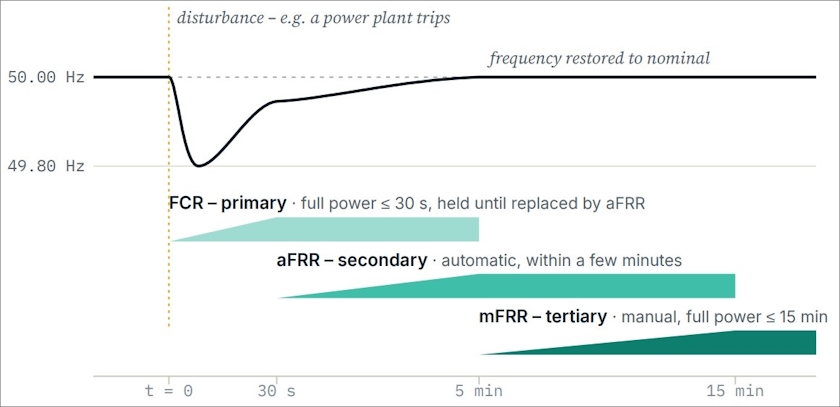
In Switzerland, the TSO, Swissgrid, procures ancillary services, among which primarily:
- Primary control – frequency containment reserve (FCR). The reaction to a frequency deviation from 50 Hertz is automatic, with full activation within 30 seconds. It stops a drop or spike in frequency but does not restore it to the nominal value.
- Secondary control – automatic frequency restoration reserve (aFRR). The transmission system operator activates it automatically within a few minutes. It restores the frequency and cross-border exchanges to their setpoints and relieves the primary reserve.
- Tertiary control – manual frequency restoration reserve (mFRR), for larger and longer-lasting deviations and with full capacity achieved within 15 minutes. It frees up the secondary reserve and covers prolonged imbalances.