


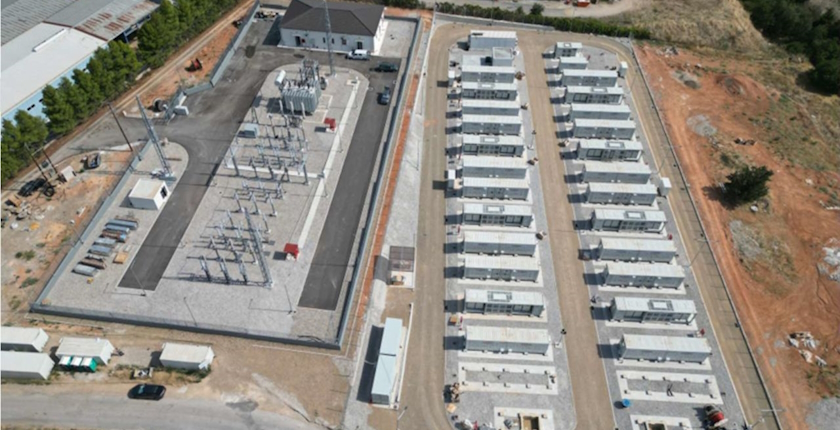
Elsewedy Energy has connected a 50 MW / 100 MWh battery energy storage system to Greece’s transmission grid, marking a step toward the national goal of between 5 GW and 7 GW by 2030. The government is also providing support for batteries for small and mid-sized firms, to be integrated with solar panels. In addition, deadlines for BESS investments in coal regions are set to be extended.
While its neighbor Bulgaria is at the top of the chart on a global scale in battery energy storage systems, Greece is rushing to become a major player itself. The country has some 600 MW of operating power from the 13 active facilities in the system controlled by Independent Transmission System Operator (IPTO or Admie).
The goal is 5 GW to 7 GW by 2030. In 2027, the total would need to reach 1.5 GW.
Elsewedy adds 100 MWh to Greece’s battery storage fleet
A standalone BESS was energized early this month. The project was developed by Elsewedy Energy and EPC and implemented by Elsewedy Electric Power Systems Projects and BMS.
The battery facility has 50 MW in capability and a two-hour duration, which translates to 100 MWh in storage capacity. It is the Egypt-based firm’s first BESS in Europe. Elsewedy won government support three years ago at the country’s first auction for standalone energy storage, in the form of a contract for difference (CfD).
Connected to the 150 kV network and a new 33/150 kV substation, the facility is located in Oinofyta in the municipality of Tanagra, part of the regional unit of Viotia in Central Greece.
The investment was worth EUR 41.9 million. In early 2025, Elsewedy obtained a EUR 18.2 financing package from the National Bank of Greece. It also benefits from a EUR 10 million grant and EUR 5.5 loan, both from the European Union’s Recovery and Resilience Facility (RRF).
SMEs win subsidies for BESS backup for solar power
Expansion is underway in other segments of battery storage as well. The ministry recently published the provisional list of beneficiaries of the support program for small and mid-sized enterprises.
The subsidies total EUR 8.15 million. Overall operating power for 209 firms is 28.2 MW, with 49.3 MWh of storage. BESS facilities will support 30.8 MW of photovoltaics altogether.
It took almost eleven months since the applications deadline for the first list. The package was intended to cover 333 MW of battery capability with EUR 153 million.
More time for projects in coal regions in transition
Futhermore, the Ministry of Environment and Energy is prolonging a deadline for the winners of the third auction.
The beneficiaries would be able to submit the so-called declarations of readiness to the Independent Power Transmission Operator (IPTO or ADMIE) by mid-December, according to a bill of law, Energypress reported.
The procedure is for four-hour BESS projects in the coal regions of Western Macedonia and the Peloponnese.
HELLENiQ Renewables and government-controlled Public Power Corp. (PPC) were the biggest winners, with two plants of 25 MW and one 50 MW system, respectively.
The rest of the list comprises Amber Energy (18 MW), Plain Solar (7.9 MW), Enercoplan (25 MW), Eunice Group’s Arkadia Storage (10 MW), EDF’s subsidiary Heliothema (10 MW) and Ardassa Energy (18 MW).
The three standalone energy storage tenders resulted in contracts for 900 MW overall.