



Small and medium-sized combustion units are one of the largest sources of air pollution in Serbia and the entire region. They include local district heating plants, boiler rooms, industrial furnaces, and dryers that burn coal, heavy fuel oil, wood, and gas to provide thermal energy for household heating or industry operations. However, municipal authorities in Serbia do not know how many there are, or if they do, they don’t monitor their operations. Moreover, even when they find such facilities violating regulations and polluting the air (310 cases), they don’t report them to prosecutors or the court (286 cases), and sometimes do not even issue orders to remedy the violations (18 cases).
A study on the regulatory inspection of combustion plant operators in Serbia and the enforcement of air quality regulations highlighted negligence among municipal authorities, which are responsible for small and large combustion plants for which they issued occupancy and construction permits. It was conducted by Leskovac-based organization Tim 42 and authored by lawyer Borivoje Đorđević.
The findings show that owners of small and medium-sized plants polluted the air across Serbia in 2025 with virtually no accountability. Whether this practice changed in 2026 remains to be seen in the coming weeks as colder weather sets in and the need for heat increases.
The study was conducted by Leskovac-based organization Tim 42
Notably, the study covers small and medium-sized combustion plants. They generate thermal energy for space heating and domestic hot water in households and other buildings, as well as thermal energy for technological processes, indirect drying or other types of processing materials and objects, and electricity generation.
They burn solid fuels (coal, wood, pellets), liquid fuels (heavy fuel oil, heating oil), and gaseous fuels (natural gas, liquefied petroleum gas), with a rated thermal input of less than 50 MWth. The primary concern with these facilities is that they emit particulate matter of the PM2.5 and PM10 types.
48 municipalities failed to submit inspection reports
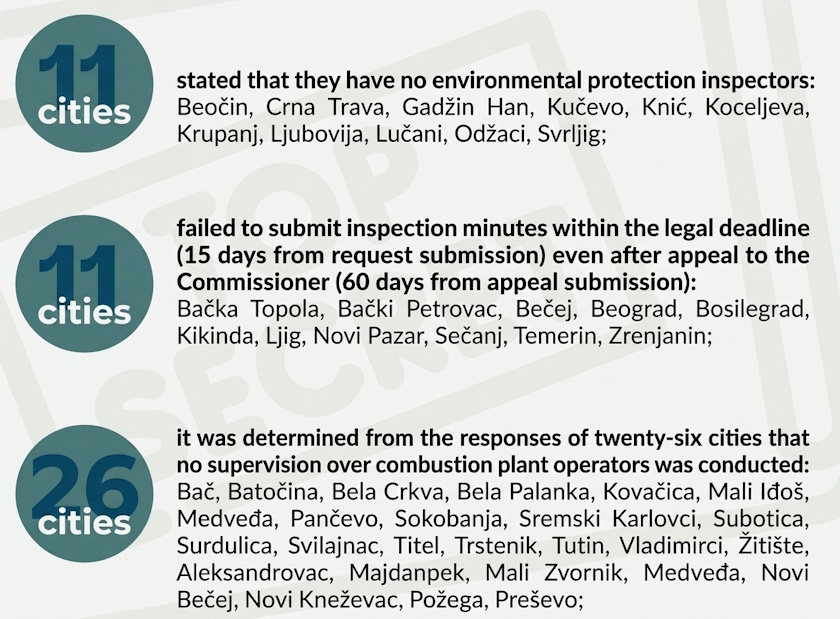
The research covered 145 municipal authorities. Environmental inspection reports from only 97 of them were analyzed, as 48 failed to submit them.
Out of 736 inspections conducted, facts regarding plant operations were established in 600 cases, while they were not established in 115 cases. In 21 reports, no facts regarding the plant’s operation were established at all.
Factual findings were incomplete in 135 cases
Taking these results into account, it can be concluded that the factual situation regarding combustion plants was not fully established in 135 cases.
Out of the 736 inspections conducted, facts regarding air pollutant emission measurements were established in 568 cases, and omitted in 147 cases. The study concludes that the factual situation regarding plant emission measurements was incomplete in 167 cases.
Irregularities recorded in 310 cases
Inspection of combustion plant operators is concluded by declaring compliance or non-compliance with the law in the operator’s work.
When non-compliance is established, the inspector takes legally prescribed measures, including issuing warnings, ordering corrective actions within a specific deadline, filing requests to initiate misdemeanor proceedings, filing criminal charges or reports of corporate offences, but also prohibiting the plant from operating.
The analysis found that out of 736 proceedings, non-compliance in the operator’s work was established in 310 cases, compliance was confirmed in 392 cases, and 34 cases contained no data on whether the operator was operating legally.
The law on environmental impact assessment (LEIA) was applied in five cases.
Violations went unreported to the prosecutor’s office or court in 286 cases
The provisions of the law on air protection stipulating the obligations of combustion plant operators are of vital importance, as they enable the timely detection and control of pollutants that directly impact human health and the environment.
Continuous emission monitoring provides reliable data based on which regulatory compliance is assessed, while the obligation to align plant operations with these standards prevents exceedances that can lead to air quality degradation, the report reads.
Measurement of air pollutant emissions was the most common violation
In most cases, operators were found to have failed to measure air pollutant emissions.
If an environmental inspector discovers a breach of law at a supervised entity, they either submit to the competent judicial authority a criminal charge, report of corporate offence, or a request to initiate misdemeanor proceedings, or they issue a misdemeanor order.
However, the analysis reveals that illegalities were not reported to the prosecution office or court in 286 cases, according to the study.
In 18 cases there was no record of any measures being ordered to eliminate the identified violations
Under the law, an inspector may also order corrective measures upon identifying operational irregularities.
Out of the 310 analyzed proceedings, legally prescribed measures to remedy operational non-compliance were ordered in 292 cases.
This means that in 18 of them there was no record of any measures being ordered to eliminate the identified violations, the report concludes.