


In light of the geopolitical tensions and extreme weather, Europe’s electricity system proved it can shield consumers and industry from fossil fuel volatility, Eurelectric’s Power Barometer 2026 shows. “Amidst the turmoil, we’re seeing real proof that Europe’s bet on clean electricity is paying off,” the organization’s Secretary General Kristian Ruby said. However, fully harnessing the benefits of homegrown electricity requires faster deployment of storage and flexibility solutions, according to the findings. The share of domestically generated clean power hit 72% last year.
Electricity prices in the European Union rose by 22.8% between February and August, while gas prices surged by 88.4%, Eurelectric – Union of the Electricity Industry pointed out in its Power Barometer 2026. The report shows how clean power generation cushioned the impact, while highlighting the need for storage, grids and flexibility to strengthen Europe’s resilience.
Gas prices rose 41% between February and May amid the blockade of the Strait of Hormuz, compared to 40% for crude oil, while electricity prices actually fell 7%. Then the record-hot summer set in. Nordic hydropower weakened and nuclear availability fell due to high river temperatures, low water levels and planned maintenance.
Yet, over the full period, electricity proved significantly more resistant to the fossil fuel shock, according to the document. It finds that 72% of EU electricity generation was clean in 2026, limiting the impact of fossil fuels on power prices. Clean electricity includes nuclear plants.
Power price spike was nowhere near 2022 peak
This year’s edition of the report is called The Power Proof, highlighting the fact that power prices rallied four times less than gas prices. In addition, the rise in electricity prices was nowhere near the 2022 peak.
“2026 has seen severe disruption of global energy markets, once again exposing the risks of reliance on imported fossil fuels. Amidst the turmoil, we’re seeing real proof that Europe’s bet on clean electricity is paying off,” Eurelectric’s Secretary General Kristian Ruby stated in the report.
At a presentation of the data, he cited the effects of wars across the globe, volatile fossil fuel prices and inflationary pressures.
“The situation is quite severe. What we’re trying to do is to make sure that we take the right decisions at this crucial moment and that we draw right conclusions from the evidence that we have,” Ruby said.
Data centers are primarily grid planning issue
The changes in power demand are a picture of redistribution rather than growth, Eurelectric underscored. “The energy-intensive industries that once anchored European electricity consumption have not fully recovered. What is growing is transport, heating and, increasingly fast, the compute behind artificial intelligence,” it added.
Annual electric vehicle charging demand in the EU has climbed by a whopping 722% between 2020 and 2025, to an estimated 28.8 TWh.
As for data centers, demand arrives in clusters rather than spreading throughout the map, making it primarily a grid planning question, the barometer reads. It can also be an asset rather than a strain: shiftable data center demand could grow from 9 TWh in 2030 to 19 TWh in 2040, and flexible operation would cut electricity procurement costs by 4% to 5%, the authors calculated.
Bulgarian battery energy storage systems are proof of price stress response effectiveness
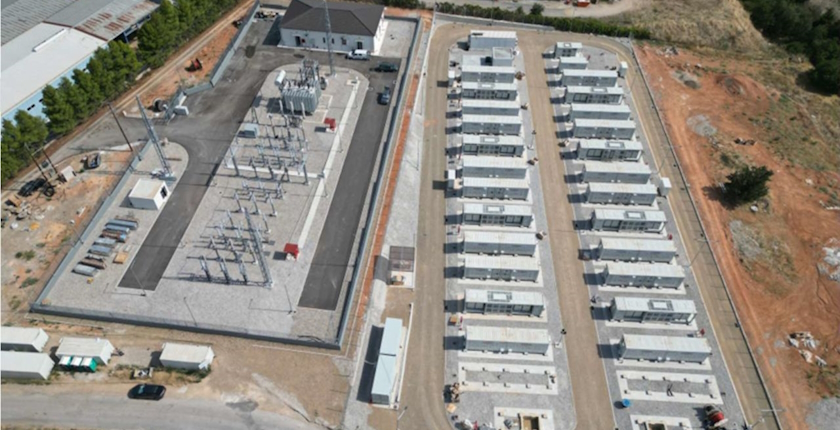
Bulgaria, a battery storage superpower on a global scale, stood out as a demonstration of response to the summer price stress, in the region where it hit the hardest. The country’s total operating power has topped 5.4 GW, against almost zero two years before.
Its wholesale power prices moved from 21.2% above the EU average in 2024 to just 8.3% above in 2026. Convergence came from storage absorbing midday solar and releasing it into the evening, Eurelectric said.
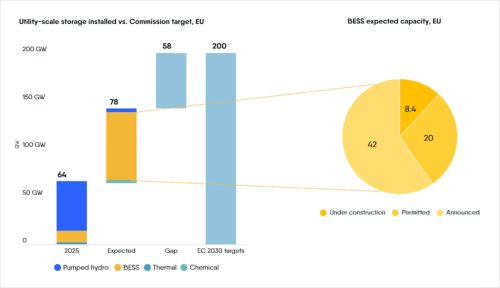
Nevertheless, Europe is lagging behind: utility-scale storage stood at 64 GW in 2025. Even with 78 GW of planned additions, it remains far below the EU’s 200 GW target for 2030.
Electric boilers helped Finland keep prices lowest in EU
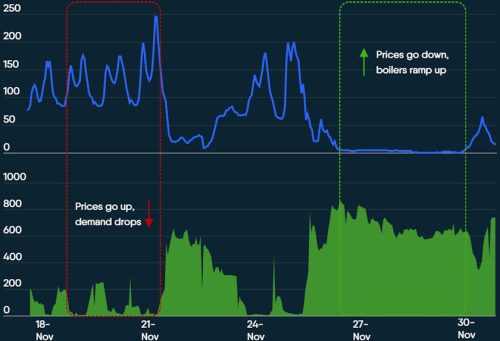
Finland is leaning on another technology for making power demand price-responsive. Electric boilers connected to district heating switch off when electricity is expensive, and get back online and store the energy as heat when expenses drop.
Installed capacity amounted to roughly 3 GW at the end of last year. It was a quarter of the peak load.
“Stable nuclear and hydro output, alongside continued wind growth, reinforced the effect. This is demand-side response already in the ground, not a future market product. District heating is not universal, but the principle is: any load that can move in time turns price volatility from a cost into an opportunity,” the authors concluded.
The average power price in Finland from March to August 2026 was EUR 38.91 per MWh, the lowest in Europe. Elsewhere they rose by more than half.
Framework must preserve electrification-leaning market signals
To strengthen Europe’s energy security and competitiveness, Eurelectric calls for accelerated permitting of grids, storage and clean power, stronger incentives for flexibility, and a stable investment framework that preserves efficient market signals supporting electrification.
The association, which represents more than 3,500 electricity companies, urged against what it called the penalization of power, compared to gas. Decision makers need to balance climate action and cost efficiency to preserve competitiveness, it stressed.