


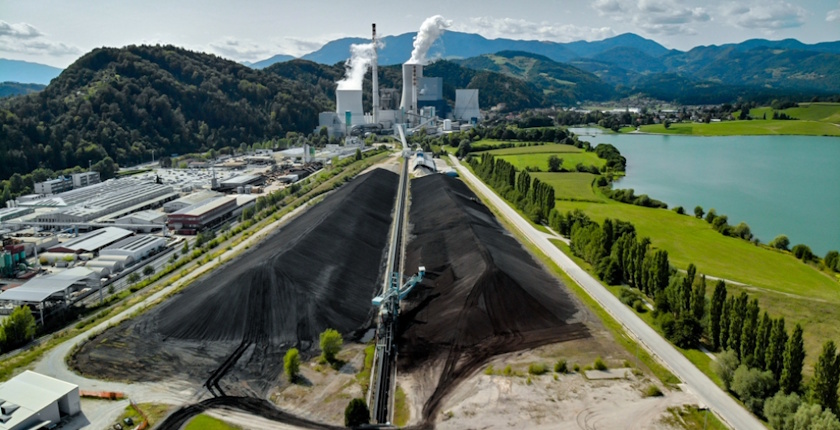
Slovenia’s Velenje coal mine is one of the sites within international project GeoSolar for exploring the possibility of converting coal mines into underground thermal energy storage facilities. The idea is to store solar energy collected during the summer in mines and use it for district heating in winter.
An increasing number of coal mines in Europe are reaching the end of their operational lives. In this context, the issues of just transition and sustainably reusing the mining infrastructure are becoming increasingly important.
The Velenje coal mine, the last one in Slovenia, is also shutting down in the coming years. It is operated by state-owned firm Premogovnik Velenje. The mine supplies lignite to coal power plant Termoelektrarna Šoštanj (TEŠ), currently the main district heating source in the Šalek valley, where preparations are underway to switch to alternative energy sources.
How coal mines could store thermal energy
The GeoSolar project could offer a solution for giving coal mines a new lease of life. European coal mines contain millions of cubic meters of mine water, with temperatures ranging from 20 to 30 degrees Celsius.
Such a level is insufficient for direct use in district heating, but coal mines are often located near cities and towns with high seasonal heat demand, making them suitable for repurposing.
The project envisages installing solar thermal systems on rehabilitated mining land to heat mine water to temperatures of 70 to 90 degrees Celsius during the summer.
In winter, the hot water would be pumped to the surface and used for district heating. The cooled water would then be returned to the underground system to continue the cycle.
Feasibility of the solution is being assessed in Slovenia and Poland
The feasibility of applying this solution is being assessed at coal mines Velenje in Slovenia and Bolesław Śmiały in Poland.
The project is coordinated by the Utrecht University and involves other partners from the Netherlands, Slovenia and Poland. It began in 2025 and is scheduled to run for 42 months. It is co-funded by the European Union’s Research Fund for Coal and Steel (RFCS).
Project partners met in Velenje on October 5 to present their findings so far on the feasibility of the proposed solutions and agree on criteria for further research.
In the next phase, they will develop more detailed models and compare the solutions based on the characteristics of the two mines.