


Only a predictable, investment-oriented ETS and carbon price can continue driving decarbonization, competitiveness and energy security, a coalition of energy, industry and investor associations said in the runup to the European Council’s meeting in Brussels. The group includes Eurelectric, WindEurope, Nucleareurope and SolarPower Europe. They urge preserving the long-term investment signal and balancing climate ambition with competitiveness.
In an open letter to European Council President António Costa and the body’s members, a broad coalition of energy, industry and investor organizations said only a meaningful carbon price can continue driving decarbonization, competitiveness and energy security.
The group consists of Eurelectric – Union of the Electricity Industry, WindEurope, Nucleareurope, SolarPower Europe, Federation of European Securities Exchanges (FESE), We Mean Business Coalition and national electricity sector associations. The letter was developed in collaboration with Institutional Investors Group on Climate Change (IIGCC) and its members.
In light of the European Council’s two-day meeting that started today, the signatories sent a message that the integrity of the European Union Emissions Trading System (EU ETS) and its long-term investment signal has to be preserved.
While EU ETS emissions have halved, the EU economy expanded 30%
They called for reinvesting revenues from the mechanism into industrial decarbonization and the energy transition, balancing climate ambition with competitiveness, and keeping decarbonization investments in Europe.
“Europe is entering a period of unprecedented investment in its energy system and economy. The sectors our organisations represent contribute hundreds of billions to EU GDP each year and are set to invest trillions by 2050 in the clean energy, energy efficiency, infrastructure and technologies needed to deliver a decarbonised, resilient and competitive EU economy. With Europe’s dependence on imported fossil fuels driving major energy insecurity and price volatility, this investment is urgent,” the letter reads.
EU ETS is core part of policy framework
According to the group, the policy framework needs to stimulate investor confidence, with EU ETS as a core part. Since 2005, emissions in ETS sectors have fallen by around 50%, while the EU economy has grown by around 30%, showing that carbon pricing can drive emissions reductions cost-effectively, while supporting economic growth, the signatories underscored.
“Its influence also extends beyond Europe, as other jurisdictions adopt carbon pricing or seek to link with ours,” they noted.
At least 50% of ETS 1 revenues should be reinvested into ETS 1 sector decarbonization
As for the integrity of EU ETS, a predictable cap trajectory and rules-based market stability reserve would stimulate demand for homegrown clean energy sources and support innovation, the coalition pointed out. It argued that flexibilities or ad-hoc interventions should not weaken such a long-term signal.
At least 50% of ETS 1 revenues should be reinvested into the decarbonization of ETS 1 sectors, the associations added.
“We welcome initiatives such as the Investment Booster, the Industrial Decarbonisation Bank and the Innovation Fund, which can help turn the carbon price signal into concrete projects in Europe. These instruments should prioritise mature and scalable decarbonisation solutions, including direct electrification. Remaining revenues should be spent on climate and energy priorities, such as energy efficiency,” the coalition said.
Turning to the tradeoff between climate action and competitiveness, it stressed that free allocations should be targeted and conditional, and aligned with the phasein of the Carbon Border Adjustment Mechanism (CBAM).
The fourth item, keeping decarbonization investments on EU soil, is a proposal for international carbon credits not to substitute domestic emissions reductions under a revision of EU ETS.
Any use should be limited to high-integrity credits, deployed indirectly in a predictable manner, the letter said.
Energy prices, seven-year EU budget on European Council’s agenda
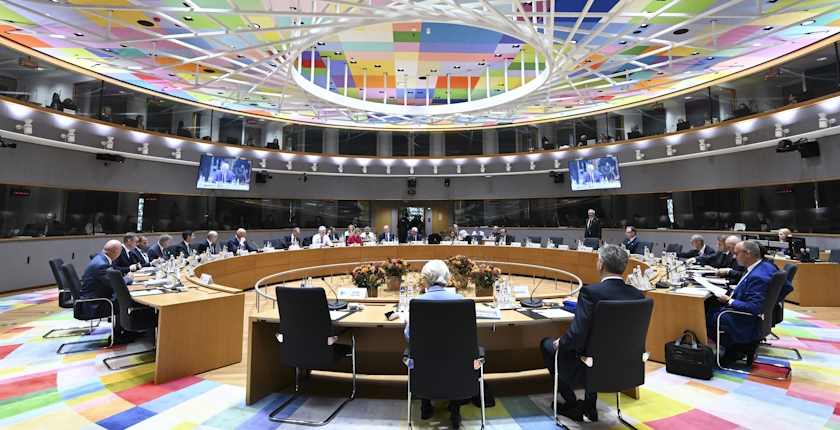
The heads of state or government came to sit with the leaders of the EU administration and discuss, among other issues, the challenges to European competitiveness, including energy prices. Especially important on their calendar is the so-called multiannual financial framework (MFF) – the 27-member bloc’s 2028-2034 budget.
In the negotiating box for the current meeting is the introduction of a call rate for revenues from the EU ETS 1. The proposition is 30%, meaning that 30% of the proceeds would go directly to the central budget.
The EU administration aims to direct 30% of EU ETS 1 proceeds to the joint budget
The member state that hosted the auction of carbon allowances would keep the rest.
There is also a 90% call rate for CBAM in the document. The scheme entered fully into force at the beginning of this year and no revenue has been distributed yet. However, the plan was for 75% to go to Brussels.
The EU is also creating the European Competitiveness Fund (ECF). The dedicated clean transition and industrial decarbonization item of EUR 55.7 billion would consist of EUR 20.2 billion from the budget and the Innovation Fund covering the rest, according to the negotiation box.