


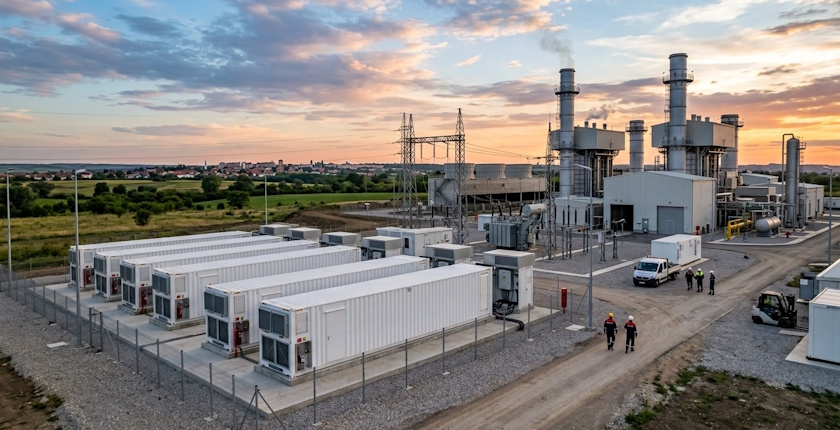
Four-hour battery storage is now less expensive than open-cycle gas turbines in 43 markets across the globe, according to the latest analysis by Wood Mackenzie.
One of the leading global research, analytics, and consultancy firms, Wood Mackenzie has modeled open-cycle gas turbines and four-hour battery energy storage systems in 43 countries.
It compared the LCOE of four-hour BESS and the gas peaking plants that are used to meet peak demand. With a growing share of renewables, gas power plants increasingly shift from baseload generation to providing flexibility and grid balancing.
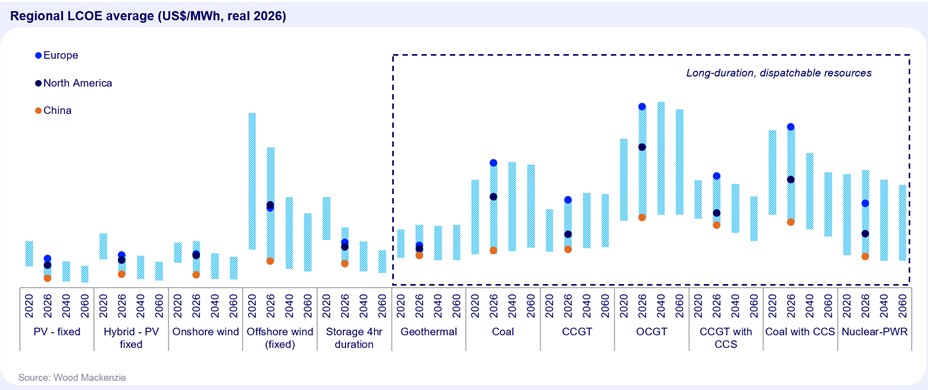
In the Middle East and Africa, where utility-scale solar already leads at USD 37 per MWh, four-hour storage is forecast to fall a further 33% to USD 80 per MWh by 2035, displacing gas peaking on cost across every gas market in the region, the analysis reads.
China remains the global storage cost benchmark, at more than 55% below the rest of Asia Pacific average, illustrating how manufacturing scale is redrawing the global cost map.
“This economic shift is decisive and widening. Gas turbine shortages and rising fuel volatility are driving up peaking costs, while expanding battery manufacturing continues to push storage costs down,” Ahmed Jameel Abdullah, principal analyst at Wood Mackenzie, said.
He noted a similar transformation has already reshaped baseload economics.
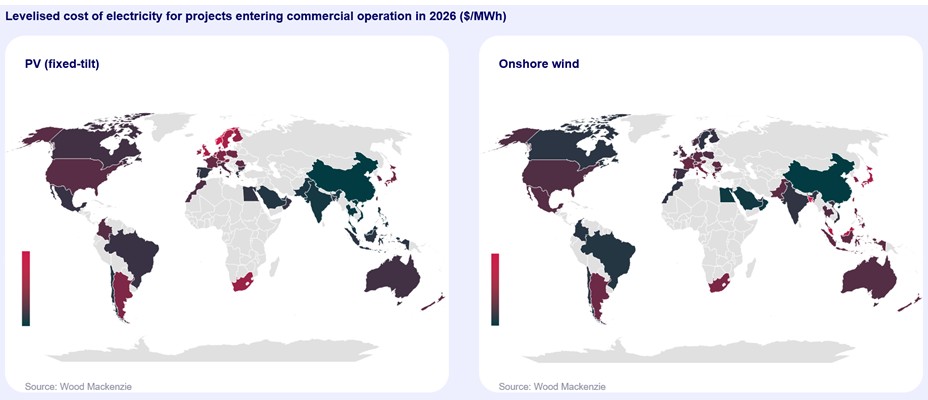
Single-axis tracker solar is now the lowest-cost new-build technology in 43 of 48 modeled markets, with onshore wind leading in five. In the most competitive markets, Saudi Arabia and the UAE, solar LCOE is on track to fall below USD 20 per MWh by 2033, according to the update.
The Wood Mackenzie reports cover the regions of Europe, North America, Latin America, Asia Pacific and the Middle East and Africa.
China leads the world on grid-scale storage costs
China leads the world on grid-scale storage costs, with a benchmark LCOE more than 55% below the rest of Asia Pacific average of USD 134 per MWh. This is driven by domestic supply chain integration and manufacturing at scale.
Competitive Chinese supply is expected to pull the rest of Asia Pacific average down to USD 92/MWh by 2036, Wood Mackenzie stressed.
Battery storage turnkey capex rose about 2% in Europe
Solar PV retains its position as the cheapest power technology in Europe, with fixed-tilt LCOE forecast to fall 22% by 2060 as capital costs decline and technology improves, despite a 14% capex increase in 2026 driven by higher PV module costs.
Battery storage turnkey capex rose about 2%, the first increase in three years, as battery cell prices rebounded around 10% from their 2025 low on stronger demand and higher lithium prices.
Capex is forecasted to fall 12% by 2031, before the pace moderates as lithium prices roughly double in 2029 when oversupply clears and demand outgrows new mine and refining capacity, according to the analysis.