


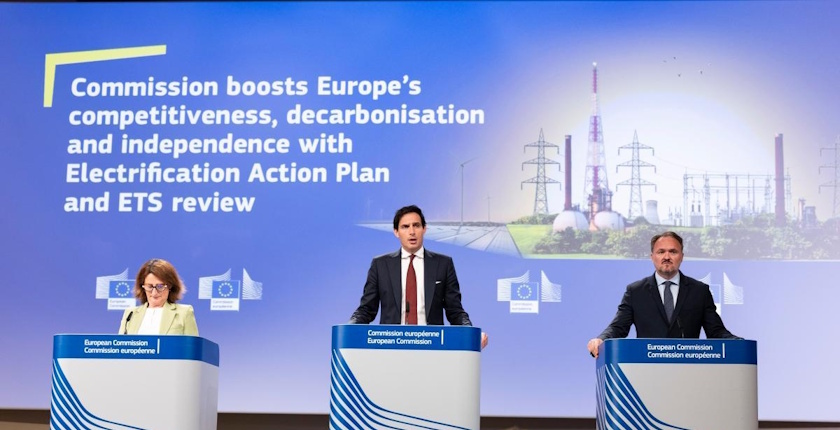
The European Commission has presented its Electrification Action Plan to lower the European Union’s reliance on imported fossil fuels and bring numerous benefits to businesses, households, and the economy.
The European Commission aims to make Europe the first electro-powered continent, and a stronger carbon market to support the EU’s industry in the clean transition and electrification.
The plan was presented by the Executive Vice-President for Clean, Just and Competitive Transition Teresa Ribera, the Commissioner for Energy and Housing Dan Jørgensen, and the Commissioner for Climate Action Wopke Hoekstra.
“Europe’s reliance on imported fossil fuels has repeatedly exposed it to geopolitical shocks. These have driven up energy prices for both households and companies, and dragged down our competitiveness,” the commission said.
The plan focuses on accelerating the transition from fossil fuels to clean electricity
The EU Electrification Action Plan focuses on accelerating the transition from fossil fuels to clean electricity across the European economy. It sets concrete targets to increase the share of electricity in final energy consumption from the current 23% to 32% by 2030, and to 46% by 2040.
It also mandates specific electrification quotas by 2040: for road transport (from the current 2% to over 40%), buildings and heating (from the current 26% to 50%), and industrial processes (from the current 26% to 38%).
The plan also outlines measures to remove market bottlenecks, modernize power grids, and deploy smart, bidirectional vehicle-to-grid (V2G) charging to ensure system flexibility.
The plan targets a 60% reduction in crude oil imports by 2040
The plan targets a 60% reduction in crude oil imports by 2040 compared to 2024 levels. To support this infrastructure shift, the EU intends to install 30 million new heat pumps by 2030 and ensure that 80% of all public EV chargers support smart, bidirectional charging by 2035, according to the plan.
The EU’s net crude oil imports in 2024 stood at approximately 440 million tonnes. There are currently around 24 million heat pumps installed across the EU, while today, less than 1% of all public EV chargers in the EU support smart, bidirectional charging.
EU ETS to drive a market shift
The implementation of these electrification goals relies heavily on the EU Emissions Trading System (EU ETS) to drive a market shift.
First, the upcoming expansion of ETS 2 in 2027 will impose a direct carbon price on heating and road transport fuels, making fossil energy significantly more expensive for end-users.
Second, the plan reinvests a dedicated share of the revenue generated from the Innovation Fund and the Social Climate Fund (both funded via EU ETS) directly into funding the rollout of heat pumps and upgrading local distribution grids in lower-income regions.
Von der Leyen: We are proposing to make Europe the world’s first electro-powered continent
Ursula von der Leyen, President of the European Commission stressed that the best way to reduce Europe’s fossil energy dependency is to power its economy with electricity from clean, homegrown sources.
“Today we are proposing to make Europe the world’s first electro-powered continent. From lowering electricity prices to adapting our carbon market to the changing global realities, this is also an investment and independence plan. To keep the clean transition on track, bring relief to our industry, and support decarbonisation. Let’s switch it on,“ she pointed out.
The implementation of these electrification targets will be legally anchored within the upcoming post-2030 Energy Union package, which will conduct the formal impact assessment for the 46% electrification goal by 2040.
Three core operational measures
The plan introduces three core operational measures to achieve its targets.
To bridge the price gap, the EU will implement the “Electricity-to-Gas Price Ratio Tax Reform”, which legally caps network levies on electricity and shifts environmental taxes onto fossil gas to make power structurally cheaper.
For grid connection, the plan enforces “Fast-Track Permitting Zones”, requiring member states to slash waiting times for new grid connections from years to a maximum of 6 months.
Finally, to unlock vehicle-to-grid capabilities, the framework introduces mandatory “EU Open-Access Data Protocols”, forcing car manufacturers and charging operators to use unified software standards for real-time grid interaction, the EU Electrification Action Plan reads.