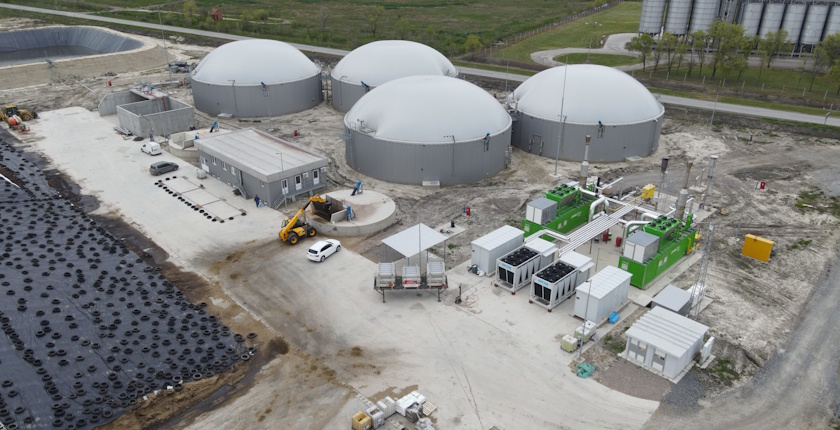


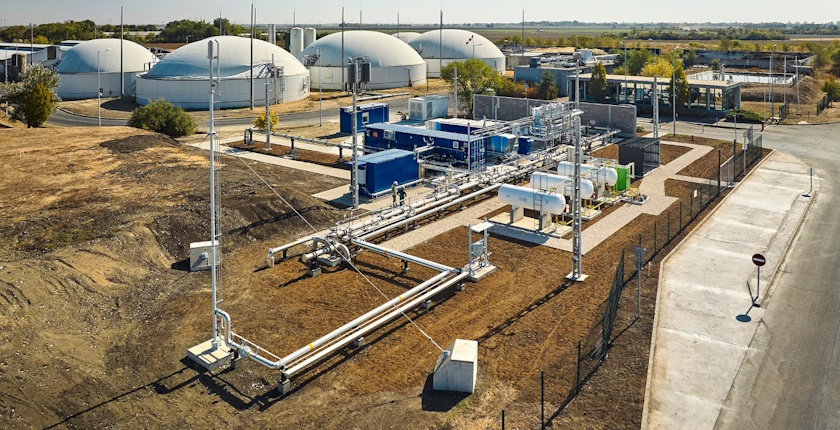
The new industrial facility in Szarvas in Hungary will produce more than seven million cubic meters of biomethane per year, MOL Group said. The investment amounts to more than HUF 2.7 billion (EUR 7.4 million). It is the company’s first plant of its kind.
While the negotiations on the proposed takeover of fellow oil refiner and fuel distributor NIS in neighboring Serbia have been dragging on for nearly a year, MOL Group is much more expedient in its decarbonization projects. The Hungarian company has inaugurated its first biomethane plant in Szarvas.
It invested more than HUF 2.7 billion (EUR 7.4 million) in the production of the fuel from biogas. The facility in Békés county in the country’s southeast, bordering Romania, enabled purity suitable for injection into the natural gas network. More than seven million cubic metres of natural gas will be replaced with renewable energy annually, according to the update. It is equivalent to the demand of some 8,500 average households.
MOL Group is pursuing its long-term Shape Tomorrow strategy to expand the green energy portfolio, strengthen energy security and contribute to the sustainable energy supply of the region.
Under its REPowerEU framework, initiated in 2022, the European Union introduced a 2030 production target of 35 billion cubic meters of biomethane. The main aim was to replace imports of Russian fossil gas. In comparison, the production capacity grew 17% in the year through mid-June 2026, reaching 8.2 billion cubic meters.
Agricultural base, gas network, industrial demand are biomethane business case in CEE
Locally produced energy is no longer simply an advantage, but a strategic factor, MOL Group pointed out. In Central and Eastern Europe, biomethane is considered promising because it can build on a strong agricultural base, an existing gas network and real industrial demand, the company explained upon the opening its first facility of the kind, and the third one in Hungary.
Biogas is a renewable energy source from the decomposition of organic materials such as plant residues, manure, and food waste. It mainly consists of methane, along with carbon dioxide and other compounds. The new unit purifies biogas.
Biomethane is not only suitable for replacing natural gas as a fossil energy carrier, but a product with much higher added value due to the associated green certificate (ISCC), according to the statement.
The fuel, chemically identical to natural gas, can be used in buses and trucks
In addition, biomethane can be used directly in public transportation and freight in the form of bioCNG or bioLNG.
The company has demonstrated it can provide a competitive, locally produced renewable energy source by leveraging the region’s agricultural potential and existing gas infrastructure, Group Chief Strategic Officer György Bacsa said.
“We are convinced that the green transition and competitiveness are not conflicting objectives, but mutually reinforcing ambitions. Achieving this requires, at the same time, supportive European regulation, a national environment that encourages investment, and industrial innovation,” he asserted.
The technology for the plant was supplied by Italy-based Gruppo AB.
MOL Group upgraded Szarvas biogas plant
MOL Group acquired the Szarvas biogas plant in 2023. In recent years, the 11-12 million cubic metres of biogas produced have been utilised through cogeneration, generating almost 24 GWh of renewable electricity and a significant amount of heat energy each year.
The company invests in photovoltaics, green hydrogen and battery storage as well
The facility processes more than 40,000 tonnes of waste annually from the region’s meat industry, and an additional 53,000 tonnes of residual waste, such as slurry and turkey manure, sourced from neighbouring livestock and meat-processing farms. In addition, approximately 18,000 tonnes of agricultural substrate is used.
MOL Group invests in photovoltaics, green hydrogen and battery storage as well. The portfolio includes INA in Croatia, which it operates via a 49.1% ownership stake, and Hungarian energy service, trading, and renewable power generation company Alteo.
Jørgensen: Energy independence needs to be priority
The announcement about the Szarvas facility was published during the European Biomethane Week in Brussels.
“There is nothing more relevant than security. Yes, we need to look at prices and at flexibility, but independence needs to be the priority. Second thing is that climate change is here, and we know we need to act fast and do way more. Renewables play a big part to transition away from polluting electrons, but we will still need molecules and biogas biomethane is a part of those solutions”, European Commissioner for Energy and Housing Dan Jørgensen stated at the event.