


The Bird Protection and Study Society of Serbia is opposing the construction of a solar power plant and battery energy storage system spanning nearly 500 hectares in the municipality of Opovo, citing threats to unique natural habitats of floodable salt marshes and the public interest of the local community.
The special purpose vehicle, Baranda Energetski Park, plans to build a 317 MW solar power plant alongside a battery energy storage system (BESS) of at least 31.7 MW and 126.8 MWh.
The draft detailed regulation plan for solar power plants in the cadastral municipalities of Opovo and Baranda, along with the strategic environmental impact assessment (SEIA) report, was open for public comment until October 21.
One of the main objections raised by the Bird Protection and Study Society of Serbia (BPSSS) is that the documents were only available for review at the municipal building rather than online on the municipality’s website. The organization argued that it significantly reduced public scrutiny.
The planned construction of PV plants in wetland lakes serves the private investor’s interests at the expense of nature conservation
This is the second draft of the plan and the SEIA report, following the adoption of the first plan and report in 2025. In the meantime, the plant’s capacity was increased from 300 MW to 317 MW and a battery was added, requiring new planning documentation. The revised documents refer to solar power plants rather than a single solar power plant because the project has been divided into multiple units to allow for phased construction.
The society submitted formal objections to the draft plan, demanding its rejection due to the threat posed to the unique natural habitats of floodable salt marshes and the public interest of the local community. It warned that the planned construction of photovoltaic plants in wetland lakes serves the interests of the private investor at the expense of nature conservation.
Šćiban: We support the development of renewable energy

Marko Šćiban, an ornithologist at BPSSS, said that the society supports the development of renewable energy sources, but believes it must be based on selecting environmentally acceptable sites, and that here it is an extremely opposite case.
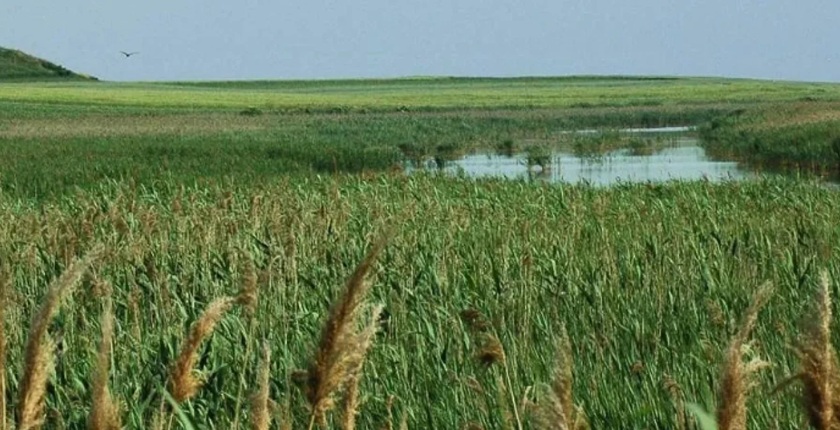
“The project envisages backfilling and adapting inland saline ponds, wetlands, and salt marshes that represent extremely rare, ecologically specific, and endangered habitats of exceptional importance for biodiversity conservation,” Šćiban said.
The project is located entirely on the site of former salt marsh lakes and fishponds
The planned solar project covers approximately 493 hectares and is located entirely on the land of former salt marsh lakes and fishponds. According to BPSSS data, 185 bird species, over 102 algae species, and 14 amphibian and reptile species have been recorded in the wider area of the planned solar facility.
Data from the Center for Biodiversity Information at the University of Belgrade’s Faculty of Biology also shows that 127 species of conservation significance are present in the wider area surrounding the planned PV plant, 18 of which are designated as relict, endemic, or rare species, DZPPS noted.
Area rezoned from fishponds to construction land
The society said it was particularly controversial to rezone the fishponds into construction land, under the spatial plan of the municipality of Opovo and the spatial plan for the special purpose area of the Potamišje.
This decision was driven by the investor’s interests rather than those of the local community, BPSSS added.
Instead of local residents engaging in fish farming, sport fishing, and ecotourism, for which the conditions are ideal, members of parliament voted for a land-use conversion that can only benefit the owner of the company Ribarstvo doo Baranda, the society stressed.
Solar panels could be installed on houses and other buildings in Baranda and Opovo, achieving the same or even higher electricity output at a significantly lower installation cost, according to BPSSS.