


The European Union and a bloc of climate-vulnerable countries rejected a draft COP31 closing declaration without explicit commitments to decarbonization. “Climate impacts will not wait for agreement – they are here now,” UNEP’s Executive Director Inger Andersen said as the negotiations broke down.
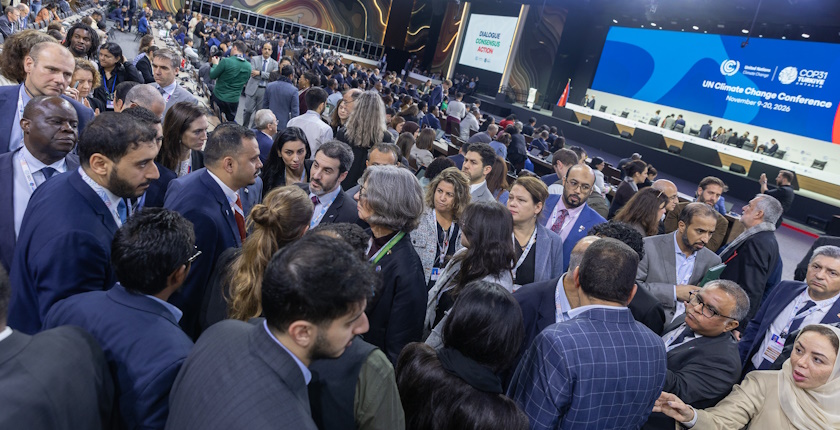
The United Nations Climate Change Conference COP31 in Antalya, Turkey, closed after record overtime discussions, but to no avail. It is the first time since 2009, when countries of the world failed to adopt a final declaration in Copenhagen. Such a document requires the broadest possible consensus between almost two hundred governments.
As usual, the main sticking points were fossil fuels, role of carbon capture and climate finance. Instead of a binding joint communiqué – the so-called cover decision – the 31st Conference of the Parties to the UN Framework Convention on Climate Change (UNFCCC) issued declarations on separate global initiatives.
More than 130 countries wanted to call for a transition away from fossil fuels
The European Union, United Kingdom and a group of climate-vulnerable nations rejected the final draft because it omitted explicitly mentioning fossil fuels and the target of keeping global warming under 1.5 degrees Celsius.
In addition, they criticized an attempt to promote a wide deployment of carbon capture solutions, arguing that it would serve as an excuse to keep using fossil fuels.
Even though more than 130 countries wanted to urge a “transition away from fossil fuels,” it wasn’t enough.
Oil and gas producers wouldn’t accept a call for a fossil fuel phaseout, while poorer countries were dissatisfied with climate adaptation commitments.
COP31 breakdown cannot change science
The outcome does not – and cannot – change science, said Executive Director of UN Environment Programme (UNEP) Inger Andersen, pointing out it was the first COP since UNEP’s data made clear that the 1.5 Celsius threshold would be overshot. Coming back is possible, but only with the best climate science and the political will, she added.
“Science is not up for negotiation. Climate impacts will not wait for agreement – they are here now,” Andersen stated.
There are 46 countries backing the Antalya Compact for Energy Efficient Buildings, led by the COP31 Presidency and UNEP, the statement adds.
Rapidly cutting methane and other short-lived pollutants remains one of the fastest ways to slow warming, the executive director noted. Nations also brought much needed attention to non-CO2 gases – including a pledge to curb sulphur hexafluoride (SF6), the most potent greenhouse gas used to insulate electrical cables, Andersen stressed.
World urgently needs action to avert disastrous level of global warming
The EU was represented by Ireland’s Minister for Climate, Energy and the Environment Darragh O’Brien and European Commissioner for Climate, Net Zero and Clean Growth Wopke Hoekstra.
“At a point where the world urgently needs action to avert disastrous level of global warming, the draft cover decision falls short. We will not endorse a cover decision that does not respond to the science, that disregards the implementation gap, and risks deepening the chasm between global commitments and the action required to correct the overshoot and bring 1.5 degrees Celsius within reach,” they stated.
The proposal didn’t properly respond to the adaptation and loss and damage needs of developing countries, whose communities are at the front line of the climate crisis, the two officials underscored.
COP32 is scheduled for next year in Addis Ababa, Ethiopia.