


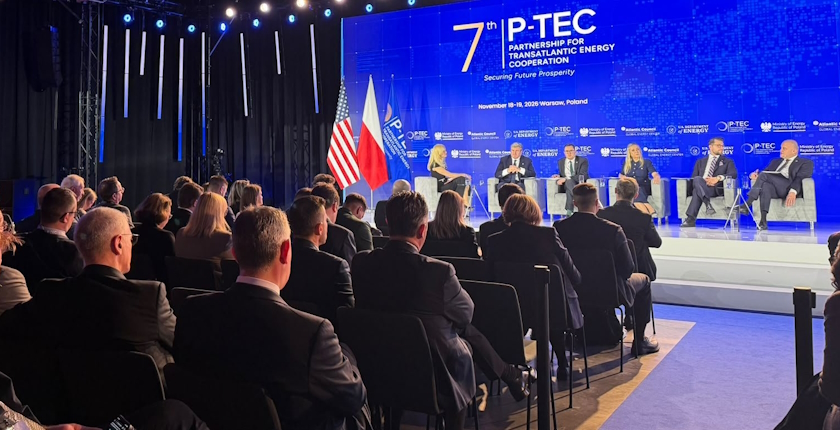
Central and Eastern and Southeastern European nations are eager to deepen their energy links with the United States, in a continued regional shift away from Russia. The 7th Partnership for Transatlantic Energy Cooperation (P-TEC) conference in Warsaw paved the way for more potential supply and technology deals for liquefied natural gas (LNG) and nuclear energy. The event was held just as Bulgaria almost doubled its gas delivery capacity to Romania. It is along the region’s Vertical Gas Corridor route.
There is “no sensible alternative” to cooperation between Europe and the US regarding LNG, nuclear energy and energy trade, Prime Minister of Poland Donald Tusk said in Warsaw, opening the seventh meeting of the Partnership for Transatlantic Energy Cooperation.
“We decided here in Poland, and later managed to convince Europe, to build a diversified system that would make Europe independent of any single energy source. Those years when dependence on Russia was being built are behind us,” he stressed.
Wright: The economic and energy future of Europe will not be written in Paris or London
The economic and energy future of Europe will not be written in Paris or London, according to US Secretary of Energy Chris Wright. “It will be written in Warsaw, in Prague, in Bratislava, in Sophia, in Bucharest, in Athens, in Dubrovnik, in Kyiv. These are the future economic drivers,” he said at the event.
On that note, a major highlight of the two-day meeting was the formal start of US-based Venture Global’s long-term deliveries of American LNG to Poland. The quantities are equivalent to a third of Poland’s annual natural gas demand, Wright noted.
Simultaneously, Polish state-controlled energy company Orlen signed a contract with Ukraine’s Naftogaz for the regasification and delivery of gas from three US cargos in the first quarter. Orlen said it also signed an agreement with Slovakia’s government-owned energy supplier Slovenský plynárenský priemysel (SPP) on opening a new phase of talks on gas supplies using LNG imported into Poland.
In addition, Orlen and Hungary-based MVM ONEnergy, part of state-owned MVM Group, have signed a memorandum about the same kind of a potential deal.
Capacity of Croatia-Hungary gas pipeline capacity to be more than doubled
Participants in the P-TEC conference included energy ministers of Montenegro, Hungary, Greece, Croatia, Bosnia and Herzegovina, Romania, North Macedonia and Bulgaria.
By expanding its LNG terminal in Krk island to 6.1 billion cubic meters per year and developing the gas transmission network, Croatia is facilitating the supply for Central and Southeastern Europe, especially landlocked countries, Minister Ante Šušnjar said. The government earmarked EUR 558 million for investments in the segment, he pointed out.
The annual capacity of gas supply for Hungary will be more than doubled to 3.5 billion cubic meters per year, the minister stressed.
Šušnjar highlighted the JANAF (Jadranski naftovod) oil pipeline as another strategic supply route for the energy security of Central Europe, especially Hungary and Slovakia.
Greece is gateway for American LNG
In the context of growing US presence in Southeastern Europe’s energy sector, the most important project is the Vertical Gas Corridor. It is a gas pipeline route from Greece, including its LNG terminals, through Bulgaria and Romania toward Moldova, Ukraine and Central Europe. Serbia and North Macedonia are establishing another branch.
The Ministry of Environment and Energy of Greece said the focus of Minister Stavros Papastavrou’s meeting with Secretary Wright was on the country’s strategic role as an energy gateway to Southeastern and Central Europe, through the further strengthening of the bilateral cooperation with the US and full utilization of the Vertical Corridor.
Serbia and North Macedonia will establish a branch within the Vertical Gas Corridor
Just before the event, Bulgaria almost doubled its gas supply capacity to Romania. The Kardam – Negru Vodă 1 interconnection’s volume increased 86% to 296.8 GWh per day. It is roughly 27 million cubic meters.
Bulgartransgaz has upgraded its internal sections Kulata-Kresna and Rupcha-Vetrino, of which the latter was completed just last week.
The Bulgarian transmission and storage operator and its Romanian counterpart Transgaz have another, much smaller interconnection, Ruse (Rousse) – Giurgiu.
MoU signed for development of SMR projects in Bulgaria
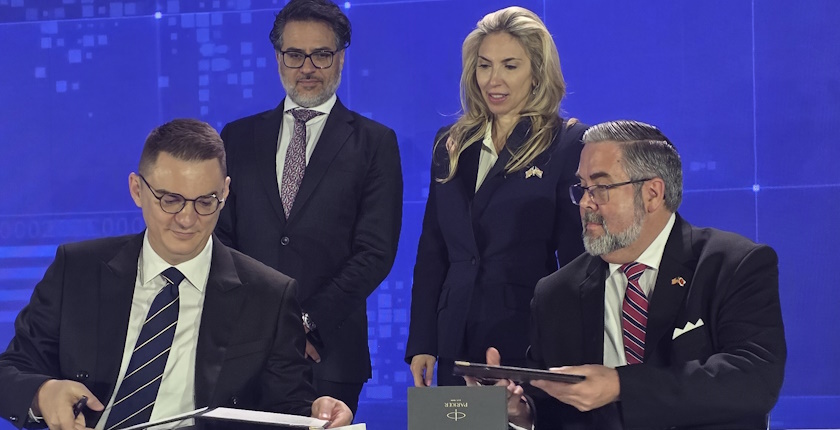
Among the nuclear power deals signed at the meeting of the Partnership for Transatlantic Energy Cooperation in Warsaw is a memorandum of understanding between Warsaw-based small modular reactor (SMR) development platform SGE, Bulgarian state-owned National Electricity Co. (NEK) and Bulgarian SMR project developer Blue Bird Energy.
They established a preliminary framework for cooperation on the potential development of nuclear power projects based on GE Vernova Hitachi Nuclear Energy’s BWRX-300 technology.
The participation of NEK, a wholly state-owned company within Bulgarian Energy Holding (BEH), expands the cooperation between SGE and Blue Bird Energy, which signed a letter of intent in December 2025.
The MoU supports SGE’s broader strategy to develop a standardized, cross-border BWRX-300 fleet across Europe. In Poland, decisions in principle have been issued for 26 units.