

The European Commission has selected 77 net-zero technology projects to receive EUR 3.4 billion in grants from the Innovation Fund, including, for the first time, a small modular reactor project and a direct air carbon capture and storage project. The list comprises projects in 23 countries, including Greece, Romania, Bulgaria, Cyprus, and Croatia.
The projects, selected under the December 2025 call issued by the Innovation Fund, represent a wide range of sectors, including energy-intensive industries, renewable energy and innovative energy storage, cleantech manufacturing, net-zero mobility, critical raw materials processing and recycling, advanced alternative fuels, and industrial carbon management, according to a press release from the European Commission.
The projects are expected to strengthen the EU’s industrial leadership and competitiveness, contribute to its clean transition, energy independence, and security, and help achieve the 2050 climate neutrality goal.
The funding will come from EU Emissions Trading System (EU ETS) revenues. The next call is expected in early December.
Over their first decade of operation, the 77 projects could avoid around 290 million tons of CO2 emissions, or roughly one ton per second, according to the press release.
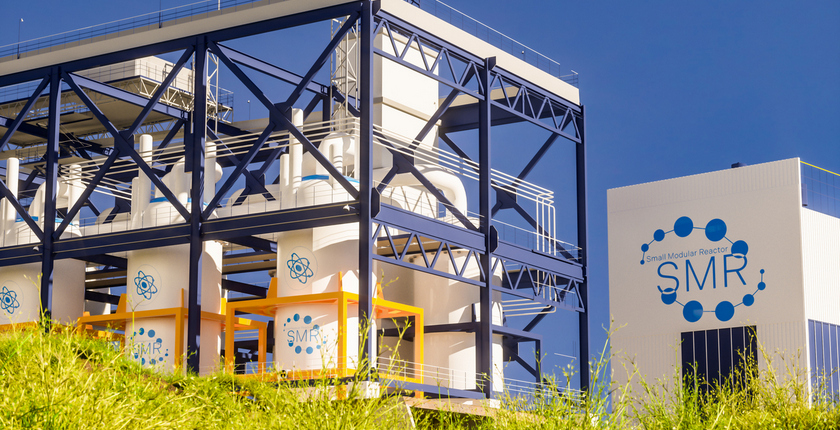
For the first time, the list includes a small modular nuclear reactor (SMR) project and a direct air carbon capture and storage (DACCS) project, the commission noted.
France plans a 30 MWh heat-only SMR to supply district heating
The SMR project, NetZeroHeat in France, features a heat-only reactor that is expected to supply 131 GWh of low-carbon heat per year to a district heating network. It will feature a 30 MWh module suitable for near-urban deployment.
Europe’s first DACCS project, Furu in Norway, will be powered by renewable electricity and connected to the Northern Lights geological storage facility. It will remove some 4,000 tons of CO2 from the atmosphere annually.
The DACCS project in Norway will capture and remove CO2 from the atmosphere
The list also includes six critical raw materials (CRM) projects aimed at strengthening the supply chains for clean tech applications, including rare earth permanent magnets and batteries.
Among the selected projects is AGeLi (Alsace Géothermie Lithium) in France, the country’s first industrial geothermal direct lithium extraction (DLE) plant. It is expected to produce up to 15,000 tons of battery-grade lithium carbonate per year, covering roughly 10% of the EU’s stationary energy storage needs.
In March 2025, the Commission adopted a list of 47 strategic projects for critical raw materials, which included 18 lithium projects. Seven were for mines in Spain, Portugal, the Czech Republic, France, and Finland. Earlier this month, it added 46 projects across 16 member states, including three for lithium extraction.
Grants for projects in Greece, Romania, Bulgaria, Cyprus, and Croatia
The AegeanFloat project, developed by Terna Energy in Greece, envisages a 45 MW floating offshore wind farm in the Aegean Sea. It will feature three 15 MW turbines mounted on concrete floating platforms using Swinging Around Twin Hull (SATH) technology.
The other Greek project is Talos (Technology for Advanced Long Duration Organic Storage), which involves building a large-scale renewable microgrid on Crete, coupling solar and wind farms with a 400 MWh solid-flow battery.
Other selected projects in the region include a flexible virtual power platform in Cyprus, called EuniFlex VPP, featuring ultra-fast bidirectional electric vehicle (EV) chargers and battery systems, as well as the Romanian-Hungarian Flow4EVE project to industrialize a heat pump-based system that enhances EV battery performance, extending winter driving ranges by up to 20%.
Croatian company Končar was selected with its Koncar-Nexus project to industrialize a modular 2.5 MW medium-voltage-to-DC power conversion platform, designed to connect standard medium-voltage grids with large DC loads such as green hydrogen electrolyzers.
Grants will also be disbursed for eco-friendly tile production in Romania and innovative copper recycling in Bulgaria.