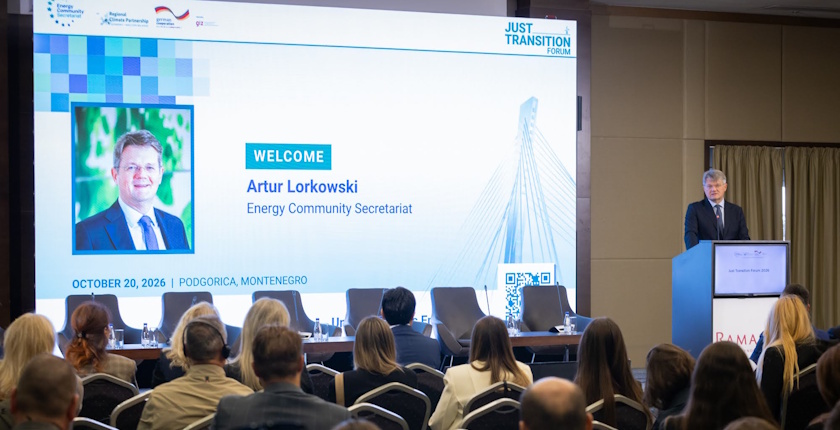
A successful energy transition in the Energy Community region requires clear plans, stable sources of financing, and the active involvement of all stakeholders, particularly communities directly affected by the changes. This was the key message of the Just Transition Forum, held on October 20 in Podgorica, Montenegro.
The Just Transition Forum brought together more than 100 participants from Southeast and Eastern Europe, including representatives of governments, local communities, trade unions, young people, and financing institutions.
The event was organized by the Energy Community Secretariat in cooperation with Deutsche Gesellschaft für Internationale Zusammenarbeit (GIZ), within the framework of the Regional Climate Partnership between Germany and the Western Balkans.
Artur Lorkowski, Director of the Energy Community Secretariat, warned that the energy transition cannot be sustainable if decisions are made without the involvement of the people directly affected by them.
Lorkowski: Without stable financing, the transition will remain on paper
“This means that it is also time to dig deeply into all the financing pockets, including domestic revenue generation. A just transition will not be powered by ad hoc financing. It requires predictable and stable finance flows. Without this, it will remain a transition on paper alone,” Lorkowski stated.
Dubravka Bošnjak, Project Leader at GIZ, said Germany is stepping up its support for a just transition in the Western Balkans through a dedicated project that puts people and local communities at the center of change.
“Young people, workers and vulnerable groups must have a meaningful role in shaping these plans from the outset, so that decisions reflect their needs and give them a real stake in their communities’ future”, Bošnjak said.
National energy and climate plans should better address the social impacts of the transition
One of the key topics of the forum was national energy and climate plans (NECPs), which set out countries’ targets for 2030 and provide a framework for planning investments in decarbonization.
These documents serve as a blueprint for governments, investors, and development banks seeking to finance the transition to cleaner economies while taking its social implications into account.
However, the Energy Community Secretariat’s first assessment of the NECPs showed that their potential to support a just transition remains underused and underrepresented in the current plans. Drafts of the next generation of these plans are due by January 1, 2028.
According to the secretariat, a more detailed analysis of the impacts of the energy transition on local communities and regions, as well as energy poverty and gender equality, would help direct support to those who need it most.
Just Transition Forum fosters regional dialogue on energy transition
The annual forum serves as a regional platform for discussing who drives the energy transition and how. It links a growing number of related initiatives, including the Just Transition Talks, an online webinar series that brings together NGOs, government bodies, utilities, entrepreneurs, financial institutions, and journalists.
The series builds a regional community around just transition and brings affected communities’ experiences into policy debates, and its results are often presented at the forum.
Young people presented recommendations for a just transition
In Podgorica, young people from across the Western Balkans presented recommendations developed under the Regional Climate Partnership, calling for a meaningful role for youth in transition planning. Winners of the Just Transition Young Voices Awards also shared their visions for a just transition.
In addition, the photo exhibition Women Powering Energy displayed the winning entries of the first Women in Energy Photo Contest, in which women from the region photographed themselves at work to make their roles in the energy sector more visible.