


The rapid changes in the energy markets in Central and Eastern Europe and beyond are fueling risks related to possible disputes. With the complexity of energy projects, there are more elements that could go wrong, so investors and other parties involved require integrated legal advice, according to the participants at a conference that CMS organized in Belgrade. As for dispute resolution mechanisms, including the ones that arise from changes in the regulatory sphere, they agreed that dialogue between stakeholders goes a long way, but also pointed to the growing role of international arbitration.
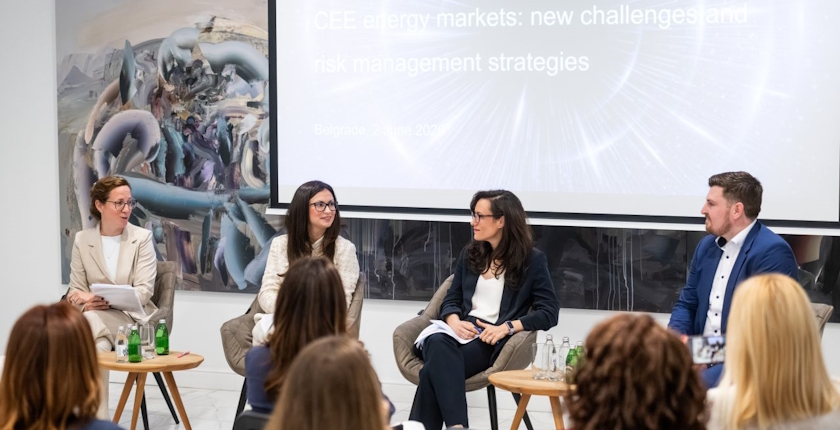
CMS held an event in Serbia’s capital city about new challenges and risk management strategies in the energy markets in Central and Eastern Europe (CEE). It has brought together legal experts from a dozen jurisdictions, with emphasis on dispute avoidance and resolution as well as energy and climate change.
Against the backdrop of repeated crises and disruptions in the region and worldwide, for the past several years, they stressed that investors need comprehensive legal advice. On top of all the fluid legal environment, the participants acknowledged artificial intelligence, among others, as an emerging factor, from battery marketing and energy trading all the way to AI-created contracts.
The first line of dispute prevention is the contract drafting phase, according to representatives of the law firms that make up CMS.
TSO goes broke – connection contract is futile
A party involved in an energy project needs a good contract in case of a dispute, keynote speaker Thomas Hamerl, a partner in CMS Vienna, noted.
But there are situations that derail the business case for an investment.
A rise in the price of equipment or a change in technology can substantially set back a project
If the grid connection takes longer than expected, it delays the start of operation and causes losses, Hamerl explained. Financing can’t be paid back and the customer doesn’t get electricity in time, he added. And there are worse things: an increase in the price of equipment, change in technology, another permit required.
“That means another delay. Sometimes there are competing projects. So if your capacity reservation wasn’t binding, other projects can be faster than you. You don’t have a grid connection anymore,” Hamerl stressed.
If, for instance, the electricity transmission system operator, TSO, takes longer to strengthen its connection to the local distribution system, the grid connection contract isn’t worth anything anymore, he added. Also, grid usage charges can jump.
When it comes to infrastructure agreements, a district or a municipality where the authorities want a certain project will pay for part of the infrastructure costs, Hamerl said. “But it can also be the opposite. Suddenly you experience someone sitting on the other side of the table and asking to finance a kindergarten. Then you need good advisors who make sure that this does not happen,” he asserted. Thomas Hamerl is also the co-head of energy and climate change at CMS Vienna.
Renewables targets at odds with grid queues
Senior Attorney Tamara Zejak from CMS Belgrade, who is also part of the Energy and Climate Change Group, outlined the energy trends in CEE with a focus on Serbia and Croatia. The market is constantly changing, including notable shifts in government policies towards renewables, she said. International commitments are at odds with grid connection queues and lack of grid capacities, which is sometimes driven by objective needs of the market and sometimes by political motivation, Zejak underscored.
She highlighted the recent case of delaying grid connection studies in Serbia by three years, comparing it to the situation in Croatia, where the connection fee was undetermined for three and a half years.
In practice, dialogue between the government and stakeholders, including associations of investors and chambers of commerce, does resolve some issues amicably, Zejak said. Otherwise, as a possible solution, foreign investors may turn to institutional arbitration.

Risk of leaving out clauses
Co-Managing Partner of CMS Sofia, Dimitar Zwiatkow, brought attention to occurrences of important requirements missing from draft contracts.
Zwiatkow: Usually the contracts are meant to stay on the shelf
“It’s very often that the parties forget that, at some point, the bank will come for step-in rights within an offtake agreement between the offtaker and the SPV. Lenders would like to have control of termination rights, the rights for events of default under the contracts. Very often this clause is not observed. And when the project is in the ready-to-build stage and everyone wants to get the financing from the bank, the bank comes and says: Your contract is not good, we should renegotiate,” Zwiatkow described.
Financing of a major battery energy storage system (BESS) project was recently delayed due to the said clause missing from the contract, he revealed.
“Usually the contracts are meant to stay on the shelf. But we, as good experts on the market, we believe that our contracts are good and can save lives,” Zwiatkow stressed.

One bad case can prompt reset of company procedures
In the second part of the event, Sonja Otenhajmer from CMS Vienna and Nenad B. Kovačević, a partner at CMS Belgrade, discussed risk management strategies with Sofia Kovačević from the Energy Community Secretariat and Sanja Bogaroški from Siemens Energy.
They agreed that arbitration is the preferred alternative tool for disputes, especially for cross-border projects.
The panel was set up to analyze where disputes in the energy sector and energy projects can arise, and how to minimize and effectively manage the risk, said Nenad B. Kovačević, who participates in the dispute resolution teams at CMS Belgrade and CMS Podgorica. He expressed a preference for alternative resolutions including arbitration.
Sonja Otenhajmer is a partner in CMS Vienna specialized in dispute resolution with a focus on international arbitration proceedings. She pointed to examples where companies refrain from a structured approach and diligent consideration of the dispute resolution clauses they agree on, until losing a larger case triggers a revision of their internal procedures.
The panelists have shed light on the tradeoff between draining a firm’s resources for such a reset and penciling in some risks and costs, while strictly preventing other ones.
Energy Community contract parties face challenge to keep up with EU legislation
Sofia Kovačević made a distinction between acute geopolitical effects, like the war in Ukraine or a conflict in the Middle East, and the constant changes in the regulatory framework in energy. Energy Community contracting parties aren’t European Union member states, where EU legislation in the form of regulations is directly applicable, or which transpose every EU directive as-is, she noted.
“For our contracting parties, that’s not so easy, because there is no legal infrastructure, there is no Court of Justice, there aren’t certain entities or mechanisms like on the EU level. And the second challenge, even if the contracting parties adopt everything one for one, there’s already a change on the EU level,” Kovačević underscored and added that it creates uncertainty for investors.
Sofia Kovačević is an energy lawyer at the Energy Community Secretariat in Vienna, with a focus on electricity law. She is the lead counsel for the verification process required for electricity market coupling of the Energy Community contracting parties with the European Union.
Arbitration is safeguard for sensitive info
In the opinion of Sanja Bogaroški, companies that opt for local litigation and state courts, instead of arbitration, are usually focused on costs. On the other hand, there are other relevant factors to be considered and with arbitration they also protect their sensitive business information, she pointed out.
Bogaroški, the principal counsel for contract management at Siemens Energy’s subsidiary in Belgrade, recommends investing as much energy in preventing disputes as in resolving them.
“Also, success is not measured by winning a case. It’s actually measured by avoiding the need for one,” she added.