

French investment group Meridiam signed a deal to become a shareholder in Great Sea Interconnector (GSI), the project that aims to connect the electricity systems of Greece, Cyprus and Israel. The Greek transmission system operator Independent Power Transmission Operator and Nexans also agreed to continue forward with necessary works.
Works have been delayed since the summer of 2024, as a result of Turkish reactions during bathymetric surveys carried out in international waters between Greek islands Crete and Kasos.
At the same time, Cyrpus has raised issues concerning the possible benefit for itself in terms of financial and energy cost. Nicosia asked for new viability studies to conclude before continuing payments to the GSI consortium and the European Investment Bank (EIB) is expected to finish them soon.
Mitsotakis: A vote of confidence for Greece
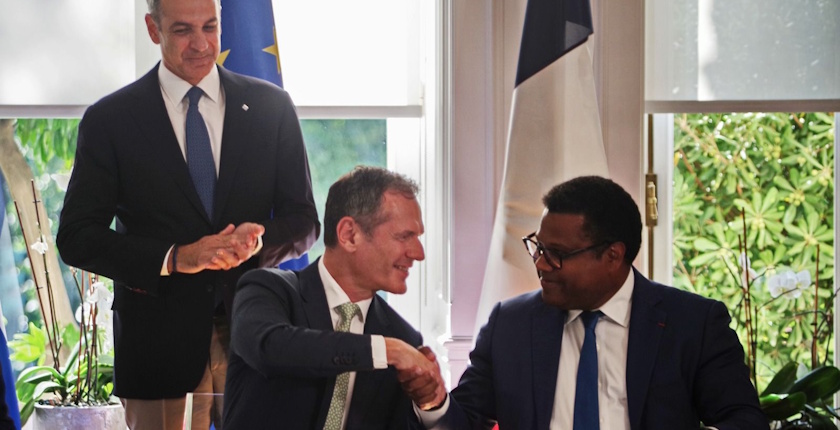
Under this new deal signed in Athens, Meridiam will acquire a 66% majority share in the project, in order to provide funds, knowhow and its experience in large infrastructure investments.
Independent Power Transmission Operator (IPTO) remains a strategic shareholder, as well as the technical leader.
The agreement was signed by IPTO Chairman and CEO Manos Manousakis and Meridiam CEO Thierry Déau in the presence of Prime Minister Kyriakos Mitsotakis and Minister of Environment and Energy Stavros Papastavrou.
“Meridiam’s entry is a strong vote of confidence to our country,” said Greek PM, Kyriakos Mitsotakis. “We are joining forces for a European project of common interest,” he added.
Second deal with Nexans to continue surveys
In a seperate development, IPTO, selected cable producer Nexans and GSI agreed to continue bathymetric surveys and further advance the connection.
So far Nexans has produced a part of the 900 kilometers of cable needed. This agreement allows the company to save space in its manufacturing capacity for GSI for the next few years, instead of giving it to other projects.
Currently Athens and Nicosia await the completion of new viability studies by EIB, in order to form the basis for new funding.
The two governments have said they are interested in drawing more foreign investors in GSI, which is included in the Projects of Common or Mutual Interest (PCI-PMI) of the EU.
Regulatory issues yet to be resolved for Great Sea Interconnector
What is interesting about these developments is that they simultaneously attempt to solve both economic and geopolitical issues plaguing GSI. It now benefits from wider financial support, as well as the partipation of a group from one of the largest European economies.
What is left are regulatory issues, such as the green light for payments to the consortium for 2026. So far, energy regulatory authorities in Greece and Cyprus have not paid, awaiting positive developments.
Last but not least, Greece will have to publish a new Navigational Telex (NAVTEX) for the survey ships to conduct bathymetric surveys some time in the near future.