


Holcim Hrvatska and Nexe will remove and handle 650 tons of non-hazardous waste from Gospić in central Croatia, the government said. More than 30,000 tons of waste have been illegally dumped and buried at the site of the former PPK Velebit agro-industrial complex in the town, sparking widespread public discontent and a protest in Zagreb on September 5.
At a session held on September 10, the Government of Croatia decided to award Holcim Hrvatska and Nexe the job of urgently collecting, removing, transporting and utilizing non-hazardous waste from the site of the former PPK Velebit agro-industrial complex in Gospić.
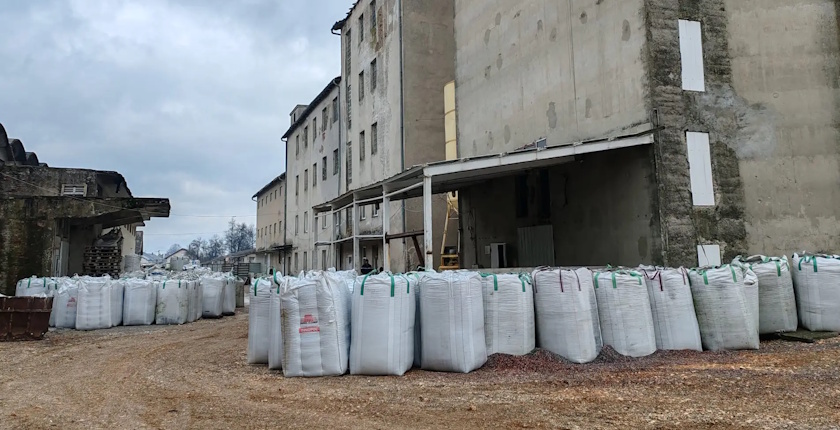
The value of the works is capped at EUR 357,500 excluding VAT. The companies have 45 days to remove and process 650 tons of waste stored in approximately 300 jumbo bags. This is only a small part of the total amount of waste at the site, where almost 35,000 tons have been buried.
The Environmental Protection and Energy Efficiency Fund previously selected a bid submitted by Tabak Grupa in a public procurement procedure, but the company withdrew on September 9.
“We responded immediately and agreed that the two domestic cement producers, Holcim Hrvatska and Nexe, with whom we have held talks in recent days, would carry out the procedure,” Prime Minister Andrej Plenković said.
Waste to be used as alternative fuel in cement production
The waste will be incinerated in cement kilns and used as alternative fuel. Nexe said it has been using waste as alternative fuel for energy recovery in clinker production at its cement plant in Našice since 2008, checking the material’s properties before it accepts it and continuously monitoring emissions.
Holcim said it would use around 300 tons of the waste in its regular production process.
“The material to be accepted does not differ in its properties from waste-derived fuel that Holcim uses in its regular cement production. It poses no danger to employees or the local community, while emissions will remain below the limit values,” the company said.
Media: Microplastics found in groundwater in Gospić
Plenković also said remediation work in Gospić is addressing all other aspects of the problem, including loose and buried waste.
Referring to the results of a report on the physicochemical analysis of microplastics in groundwater samples at the Gospić site, published on September 7 by the Office for the Suppression of Corruption and Organised Crime (USKOK) and prepared by the Josip Juraj Strossmayer Water Institute, the prime minister pointed out that all relevant reports should be published transparently and interpreted by experts.
The media reported that plastic particles were found in groundwater samples from a borehole downstream of the waste site. Plenković said that, according to expert assessments and reports published so far, drinking water from the public water supply systems in Gospić and the surrounding Lika-Senj County is not at risk.
Citizens staged Walk for Lika, Walk for Croatia protest in Zagreb
The scandal involving the illegal dumping and burial of waste across Croatia has triggered widespread public outrage. Official estimates indicate that more than 30,000 tons of waste were disposed of in Gospić alone.
According to investigation reports, similar activities also took place in areas around Zadar, Šibenik, Kistanje, Drniš, Benkovac and Pađene.
On September 5, citizens gathered in Zagreb for the Walk for Lika, Walk for Croatia protest. The Gospić is Our Home civic initiative presented seven demands, including that the government publish a comprehensive remediation plan with binding deadlines within 20 days, remove 33,000 tons of buried waste within three months and introduce long-term monitoring with the involvement of independent experts.