


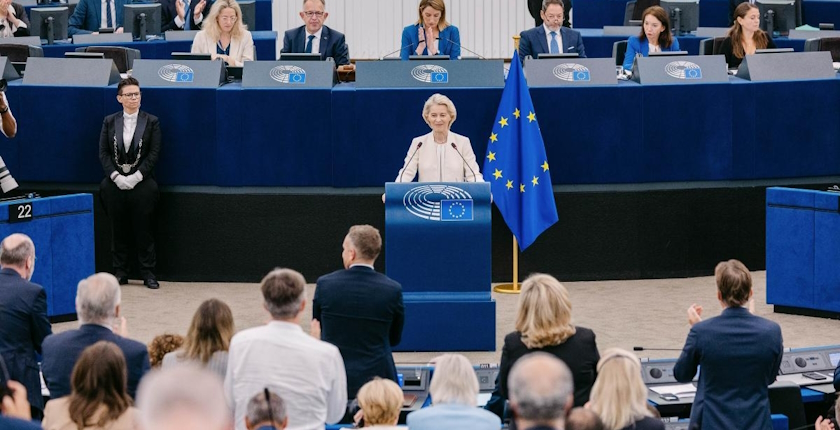
Among the priorities in her annual State of the European Union address, European Commission President Ursula von der Leyen pointed to the upcoming plans for combating heatwaves and wildfires, securing water and improving climate resilience. The efforts have been shifting away from decarbonization to climate adaptation, though the focus on clean energy, electrification and energy independence and security remained strong. The other major points include defense and artificial intelligence.
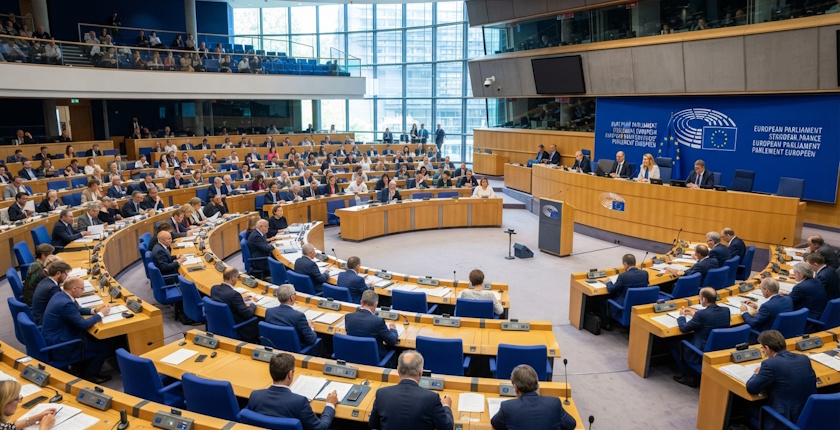
The European Union is doubling down on its measures for protection from the effects of global warming. European Commission President Ursula von der Leyen told members of the European Parliament that the summer months were the hottest ever, “but probably the coolest of the years to come” and a “mere preview.”
Europe can, must and will stay the course on its climate targets, she pointed out in her annual State of the (European) Union address, also known as SOTEU.
Nevertheless, adaptation to climate change has been gaining importance along some other priorities, and probably at the expense of mitigation, in the sense of decarbonizing the economy and society as much and fast as possible.
On climate change, this summer was the summer of truth
“On climate change, this summer was the summer of truth. Almost no part of our continent was spared. In Belgium’s High Fens, a peatland formed over centuries burned into a wasteland of ash. Flames roared from the mountains of Ireland to the islands of Greece and Croatia. In the Alps, ancient glaciers retreat further every day. The impact of all of this is simply devastating: 660,000 hectares burnt to the ground. Some 12 million tonnes of crops lost,” Von der Leyen warned.
More than 35,000 additional deaths occurred during the heatwaves, she noted.
“Key rivers like the Danube, der Rhein and La Garonne are disappearing before our eyes,” the president of the EU’s executive body added.
Step up dramatically on preparedness
The 27-member bloc needs both mitigation and adaptation for climate resilience, Von der Leyen explained. “But we need to step up dramatically on preparedness,” she stated and recalled that Europe is warming at double the global rate.
The commissioners are preparing to unveil a climate resilience framework next month. It includes identifying one hundred of the most vulnerable territories, Von der Leyen said.
On that note, she revealed the goal of making Europe the champion in adaptation technologies. She called them “a huge emerging market” including drought-resistant crops, flood prevention and energy-efficient cooling.
There is a financial segment under development as well. “Today, only around 25% of catastrophe losses in Europe are covered by private insurance. This means that, far too often, national budgets become the insurer of last resort. We need to take action to close this gap. This is why the commission will set up a Climate Insurance Alliance,” the commission’s chief underscored.
Heatwave plan soon, alongside outline for joint firefighting fleet
Von der Leyen promised a European heatwave plan soon, with improvements in early warning systems and health preparedness.
“There can be no repeat of this summer… We need urban adaptation and cooling. And we need to support the most vulnerable. The second point is on water and food security. We know the risks of water scarcity for our farmers, energy and supply chains. Yet, European pipes lose almost one in every four litres, mostly through leakage,” she asserted.
That is why a water initiative is underway. In addition, Von der Leyen suggested that a European firefighting fleet would be formed.
Climate change is tipping point, but so is artificial intelligence
Von der Leyen claimed that the current era’s tipping points are climate change and artificial intelligence. One more prime concern, in her view, is defense. She pointed to the rise in defense spending of 80% in the past five years.
Beyond the critical importance for the EU to limit its risks, AI needs to be moved “from the screen to the real economy and society,” Von der Leyen said, highlighting factories, hospitals, precision agriculture, energy grids, autonomous driving – and defense.
Clean energy including nuclear is solution for fossil fuel dependency
Europe is “breaking free from its toxic dependency on Russian fossil fuels,” she stressed. On the other hand, Von der Leyen acknowledged that the closure of the Hormuz strait and the surrounding conflict in the Middle East cost the EU an additional EUR 90 billion for imported fossil fuels.
The answer is in affordable and homegrown clean energy, be it renewables and nuclear, or biomethane and others, she said.
Doubling the share of electricity could cut the fossil fuel import bill by EUR 260 billion per year
“For this independence, we need to electrify Europe. Our goal is to double the share of electricity by 2040. With this, Europe could cut its fossil fuel import bill by EUR 260 billion a year,” Von der Leyen reiterated, while also throwing the pressures of energy price spikes and borrowing costs into the spotlight.
Europe cannot remain an industrial powerhouse if its energy prices are structurally too high, she added.
Permits, grid connections and financing decisions can be crucial for investments, so the European Commission will propose measures to accelerate permitting, Von der Leyen told lawmakers.
More than 80 GW of renewables capacity was installed in the EU last year, but six times more is waiting for network connection approvals, she said, concluding that the grids package is urgently needed.