


Non-governmental organizations warned that the National Assembly has adopted amendments to the law on planning and construction that allow forest land damaged or destroyed by fire to be reclassified for the construction of public infrastructure facilities.
Transparency Serbia and the Renewables and Environmental Regulatory Institute (RERI) announced that on August 31, 2026, the National Assembly passed the amendments to the law on planning and construction, without prior public consultation.
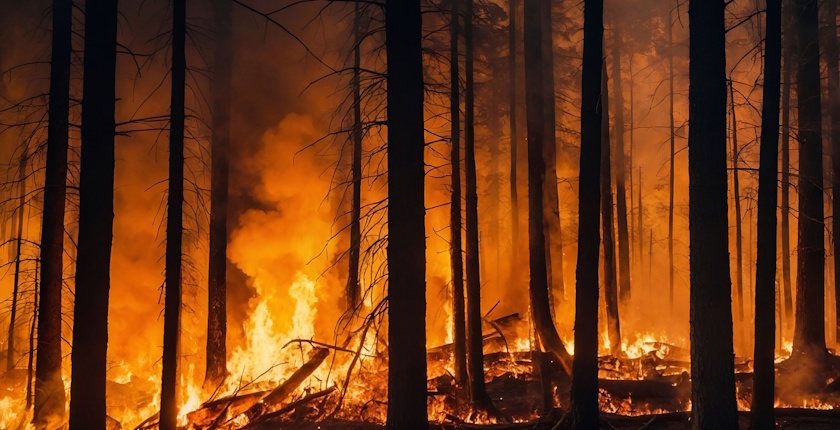
During the wildfire in Deliblato Sands (Deliblatska Peščara), which engulfed approximately 4,000 hectares of forest and vegetation starting July 21, reports surfaced suggesting the blaze could be exploited by interested private investors for construction.
Public hearing scheduled in Albania for a wind farm while wildfire raged
There was an interesting controversy in Albania in August. While fire was engulfing the forests around the town of Puka in northern Albania, the municipality launched public consultations for a wind power project in the affected area.
Zdravko Ponoš, president of the Srbija Centar (SRCE) party, said that the fire serves as an effective tool to initiate the reclassification of forest land into construction land.
Ponoš added that several countries have legally discouraged such activities, arguing that there is no other way to conduct them than in collusion between investors and the government, Nova reported. He highlighted the examples of Spain, Italy, and Greece.
However, these claims were denied by Minister of Environmental Protection Sara Pavkov and Minister of Mining and Energy Dubravka Đedović Handanović.
Pavkov: Deliblato Sands is a natural asset protected by law and its status will not change
Pavkov stressed that certain individuals are alarming the public with fabricated stories about alleged plans for construction and land-use changes in the Deliblato Sands, Blic reported. She added that Deliblato Sands is a legally protected natural asset and that its status does not change simply because a portion of the area was affected by the fire.
Đedović Handanović explained that there are no plans to construct wind farms in Deliblato Sands. Fire does not free up space for development, and Deliblato Sands remains a protected natural asset, she underlined, according to N1.
Meanwhile, on August 31, Dragana Ostojić, State Secretary at the Ministry of Environmental Protection, said that the wildfire in Deliblato Sands has been contained and stabilized. She noted that the fire is soon expected to be declared completely extinguished.
No public consultation held on the amendments to the law
Transparency Serbia and RERI explained that the adopted amendments to the law on planning and construction include article 88. It stipulates that forest land damaged or destroyed by fire retains the land use designation set out in the planning document prior to the fire.
However, the next paragraph of the same article specifies an exception to this rule. It allows for a change of land use if it is necessary for implementing a project for which public interest has been legally established – for the construction of public infrastructure facilities.
Provisions on forest land use were not included in the bill submitted to the parliament
The organizations stressed that not only did the Ministry of Construction, Transport and Infrastructure fail to organize a public consultation regarding these amendments, but the provisions concerning the use of forest land were not even part of the bill submitted by the Government of Serbia to the assembly on August 7, 2026.
They add that it seems that these changes were included in the final version of the amendments, by the parliamentary committee on spatial planning, transport, infrastructure, and telecommunications, during its session on August 26.
Lack of government transparency creates room for further doubts
The organizations noted it all took place during unprecedented wildfires that swept through Europe’s largest sand area – the Deliblato Sands – an invaluable reservoir of biodiversity, a protected area of exceptional (category 1) and national importance, and a special nature reserve.
“The lack of transparency in the authorities’ conduct during these legislative amendments, rather than reassuring an anxious and concerned public, opens up room for new doubts regarding the future use of the land affected by the fire,” the two organizations underlined.
They thus proposed to change the law in a way that all risks would be thoroughly assessed and addressed.