


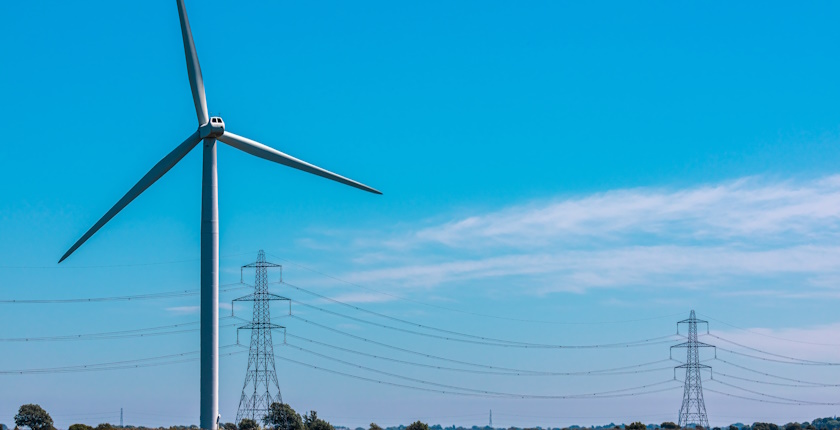
For large wind farm and solar park projects in Serbia, applications submitted until now for conducting studies for the connection to the high-voltage system will not be processed until 2029. Amendments to the relevant decree have postponed the period by three years. In addition, it covered the active consumer segment and enabled end users to enter into dynamic pricing electricity contracts with suppliers.
In the domain of electricity generation from variable renewable energy sources, the Government of Serbia prescribed by decree last year that, under the requests submitted up to that point, the transmission system operator would conduct grid connection studies from July 1 to October 31, 2026. The requests are, in particular, for concluding contracts on making the studies. But according to the latest amendments to the decree on conditions for delivery and supply of electricity, the procedure is postponed until an interval that will last from September 1 to December 31, 2029.
The rule is for the transmission system – high voltage – and the part of the distribution system managed by the transmission system operator, Elektromreža Srbije (EMS). After the delivery of the study, the future producer has three years to obtain the connection approval. The same applies to end users, active consumers and electricity storage operators. The contract on the grid connection study is signed before it starts.
The Law on the Use of Renewable Energy Sources defines variable renewables as primary energy sources – wind, sun and other – for which the energy potential depends on meteorological conditions that are hard to forecast precisely. It means there can be greater discrepancies between the actual output and the production plan than the remaining energy sources.
Serbia introduces bank guarantee of EUR 12,500 per MW for active consumers’ projects for power plants, BESS
The legislation entering into force adds rules for the active consumer segment. Of note, in Serbian law, they are formally called active buyers. Entities within this category can participate in the electricity market directly or through aggregation, sell the electricity they generate via power purchase agreements (PPAs), use their own output exclusively for their own needs, and participate in flexibility services and energy efficiency schemes.
The capacity of a power plant (on internal installations) is not below 150 kW and it does not exceed the connection capacity for consuming electricity from the grid, and the same applies to a battery system in generation mode.
The ones that will generate power only for themselves, without the possibility of delivering it to the network, aren’t obligated to provide bank guarantees
The study development periods for active buyers are from March 1 to June 30 and from September 1 to December 31. Upon delivery, it is obligatory to provide a bank guarantee for the power plant or energy storage facility project, in the amount of EUR 12,500 per MW of connection capacity to the alternating current grid. If both types of facilities will exist simultaneously, the guarantee is submitted for the one with the higher active capacity.
A bank guarantee of EUR 25,000 per MW of connection capacity for consumption is for a potential active consumer that intends to construct an end-user facility without a power plant or battery energy storage system (BESS). The amount is the same as for power plants connecting to the transmission system.
On the other hand, active consumers that want to use the electricity that they will generate and store without the possibility of delivery to the power system, exclusively for their own needs, have no obligation to submit a bank guarantee.
Pay as much as you consume – in line with power exchange prices
Another novelty is that the end user can conclude a contract with the supplier for variable electricity prices. The option was previously introduced through the Law on Energy. In the arrangement, the amount tracks price changes on the organized market, including the intraday and day-ahead markets on the power exchange.
It is also referred to as a dynamic contract or tariff. The user must have a smart electricity meter.