



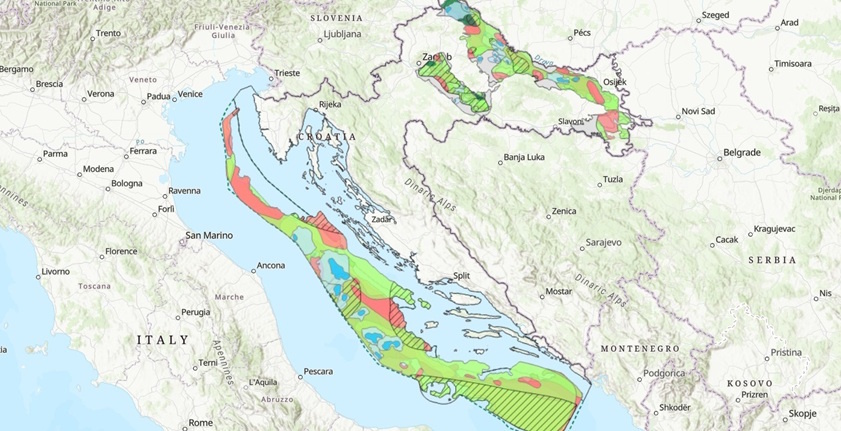
The Croatian Hydrocarbon Agency has published the first comprehensive expert studies of the potential for geological carbon dioxide storage in the country.
The results show that Croatia has more than 1,000,000,000 tons of potential CO2 storage capacity, of which approximately 346 million tons in the Panonian Basin and 717 million tons in the country’s part of the Adriatic Basin, according to the Croatian Hydrocarbon Agency.
It produced atlases of geological structures suitable for permanent onshore and offshore storage of CO2, and an integrated GT-CCS feasibility study for the Bockovac site.
The Bockovac site study confirmed the possibility of integrating permanent CO2 storage and geothermal energy production
Croatia now has the first comprehensive map of CO2 storage capacities and a key expert basis for the development of carbon capture, utilization, and storage (CCUS) projects, the agency pointed out.
Particularly significant is the Bockovac study, which confirms the possibility of integrating permanent CO2 storage and geothermal energy production (GT-CCS), it added. The optimal scenario envisages permanent storage of about 19 million tons of CO2 over 30 years, along with the production of renewable energy.
The agency believes that the preparation of these studies represents an important step toward the development of the Croatian CCUS sector, strengthening energy security, attracting new investments, and achieving national and European climate goals.
The Croatian government has allocated EUR 2.7 million for the project
In late April, the Croatian government allocated EUR 2.7 million for a project to determine the potential for geological carbon dioxide storage in Croatia.
The project is part of the National Recovery and Resilience Plan 2021-2026.
Of note, one of the most advanced carbon capture and storage (CCS) projects in Southeast Europe is Prinos CO2 in Greece.
In January, Serbia said that the draft law on hydrocarbon exploration and exploitation will include permanent disposal of carbon dioxide in geological formations of depleted fossil fuel deposits.