


As a growing number of countries worldwide embrace nuclear power as a core component of energy security and climate goals, a new analysis by the Nuclear Energy Agency (NEA) finds that increasing global capacity significantly will require a larger qualified workforce, stronger supply chains, and far more financing. The report also highlights the importance of extending the operating life of the existing nuclear fleet.
The report, titled Nuclear Energy Outlook: Global Installed Capacity to 2050 and Beyond, comes at a pivotal moment for the nuclear sector, following decades of limited construction of new facilities, according to a press release from the NEA, which operates under the Organisation for Economic Co-operation and Development (OECD).
It comprises four scenarios describing how global installed nuclear capacity could evolve by 2050 and beyond, taking into account refurbishments and lifespan extensions of the existing fleet, as well as new builds of gigawatt-scale plants and small modular reactors (SMRs).
Four scenarios for global nuclear expansion by 2050
The first projection, called the Low Scenario, sees global installed nuclear capacity reaching only 347 GW by 2050, as power plant retirements in OECD countries offset new projects and recent momentum fails to translate into sustained deployment.
In the Current Trends Scenario, global capacity reaches 619 GW, driven largely by planned and proposed projects in non-OECD countries.
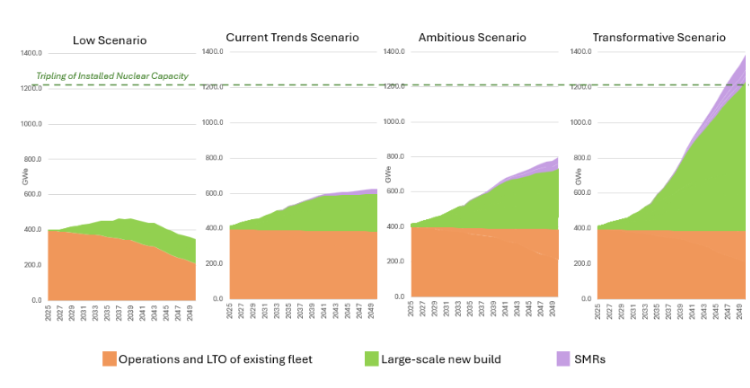
The Ambitious Scenario envisages 883 GW of global nuclear capacity by 2050, with a larger contribution from new build and SMRs, while the most ambitious vision, the Transformative Scenario, sees global capacity more than tripling, to about 1,324 GW.
The most optimistic scenario sees global nuclear capacity reaching 1,324 GW by 2025, driven by ambitious targets of the US and India
The Transformative Scenario is based on long-term national goals, including the United States’ ambition to quadruple its nuclear capacity by 2050 and India’s target of 100 GW by 2047, combined with successful operating life extensions, accelerated large-scale new build, and significant SMR deployment.
However, this will require major changes in government policies, as well as project execution, industrial capability, and financing, the NEA stressed.
China and Russia dominate the international nuclear market
The NEA also notes that while OECD countries currently account for around 78% of global nuclear capacity, non-OECD countries are driving most of the near-term expansion. Of the 70 GW currently under construction, around 80% is in non-OECD countries, led by China with more than 33 GW.
When it comes to technology vendors, the report underscores that China and Russia currently hold a strong position in the international nuclear market, with OECD-based vendors maintaining a significant but less developed project pipeline.
Non-OECD countries account for 80% of nuclear capacity under construction
China leads with 85 GW under construction, planned, or proposed based on Chinese designs, though mostly domestic projects. On the other hand, of the 57 GW of Russian-designed reactors in the pipeline, 54% are export projects. Also, Russian technology accounts for more than 40% of internationally procured reactors, according to the report.
OECD-based vendors from France, South Korea, and the United States have a combined pipeline of about 75 GW, with export projects representing 54% of OECD-designed reactor projects.
Extending the lifespan of ageing nuclear plants is essential
The NEA also stresses that extending the operating life of the existing nuclear fleet remains a key factor in meeting global targets. Many reactors in OECD countries will reach the end of their initial licenses before 2040. Extending their operations to 60 years and, increasingly, 80 years could preserve reliable low-carbon capacity and support energy security, the report notes.
Extending the operation of existing nuclear plants is as important as building new capacity
However, the report warns that nuclear power plants totaling more than 50 GW in OECD countries have not yet secured licenses to operate until 2040.
When it comes to workforce and supply chains, the NEA notes that the limited number of new nuclear projects over the past 25 years has weakened industrial capabilities and project delivery experience.
Financing for nuclear projects must rise sharply
Financing is also a major challenge. Recent global capital expenditure on new nuclear projects has averaged around USD 30 billion per year, mainly driven by China and Russia. To meet higher deployment scenarios, this will need to rise sharply, the NEA stressed.
The Transformative Scenario could require USD 200 billion in annual investment in OECD countries during the 2030s
It estimates that annual capital requirements in OECD countries would need to increase from about USD 12 billion per year over the last decade to an average of USD 68 billion in the Ambitious Scenario and USD 143 billion in the Transformative Scenario. During the 2030s, the Transformative Scenario could see OECD financing needs approach USD 200 billion per year.
However, the report notes that state budgets will not be able to meet these requirements alone and that mobilizing private capital will be essential. It also calls for concerted efforts by governments, industry, and financial institutions.