


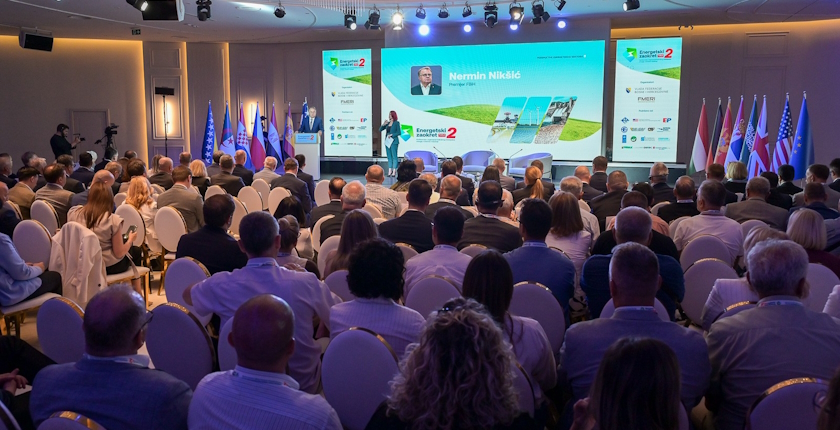
Officials from Bosnia and Herzegovina, Croatia, Montenegro and Serbia agreed to improve coordination in connecting energy infrastructure and maintaining the security of supply. Minister of Energy, Mining and Industry of the Federation of Bosnia and Herzegovina Vedran Lakić, who hosted the Energy Transition 2 conference in Tuzla, said the event has emitted encouraging messages about the region’s energy future.
Energy security must be viewed in a state context rather than ethnically, Prime Minister of the Federation of Bosnia and Herzegovina Nermin Nikšić said at the two-day conference Energy Transition 2: Regional Energy Security and a Sustainable Investment Cycle. It was held in the city of Tuzla in the Federation of BiH, which is one of the two entities making up Bosnia and Herzegovina.
While conveying a message that energy security cannot be separated from economic and national security, Nikšić stressed that energy security is increasingly the result of regional connectivity and the integration of energy systems.
“Those connected to the region and Europe are certainly stronger and more resilient to the challenges that may arise in the energy sector. This is the path that the Federation of BiH wants to take, and I am sure Bosnia and Herzegovina and the countries of the region do too,” the prime minister added.
In his view, cross-border electricity and gas infrastructure projects hold special importance, including the Southern Gas Interconnection.
Region’s energy future through security of supply
The entity’s Minister of Energy, Mining and Industry Vedran Lakić said the conference’s main focus was on regional connectivity through energy infrastructure, pointing out it is the reason that officials from Montenegro, Croatia, and Serbia attended it.
Encouraging messages regarding the energy future of the region were sent from Tuzla, he stressed.
“This is a place where we discuss our energy future through security of supply, building energy infrastructure alongside gas, oil, and electricity connectivity, regional cooperation, reforms, European Union rules and the investments that must accompany all of these processes,” Lakić stated.
Minister of Energy and Mining of the Republic of Srpska Petar Đokić, said such gatherings can significantly contribute to the energy future of Bosnia and Herzegovina and to better coordination on energy issues. Energy security and the future lie in a strong connection among the countries of former Yugoslavia, in his words. The Republic of Srpska is BiH’s other entity.
Serbia’s Đedović Handanović: Connecting infrastructure, new capacities are key for region’s energy security
Energy connectivity is crucial for the energy security of the Balkans and Southeastern Europe, because only well-connected countries can be energy secure and resilient to energy shocks and turbulences, said Minister of Mining and Energy of Serbia Dubravka Đedović Handanović, addressing the gathering via video link.
“The energy sector is particularly susceptible to geopolitical influences, which has been visible since the beginning of the war in Ukraine, but also during the conflict in the Middle East. We need to strengthen our position both individually and collectively, as a region, through better energy connectivity, diversification of supply routes, and the construction of new production capacities. Energy systems in the region were built 30, 40, and 50 years ago, and large new investments are needed and important both for decarbonization and the security of supply for our citizens,” the minister stated.
Đedović Handanović: The energy sector is particularly susceptible to geopolitical influences
She noted that the Serbia 2035 plan envisages a total of EUR 14.4 billion of investments in the energy sector, arguing that it contributes to energy security and supply diversification of Serbia and the Western Balkans but also Central and Eastern Europe.
“The largest investments are planned for production capacities, around EUR 6.5 billion. About EUR 2.4 billion is planned for the transmission and distribution systems, and about EUR 1.2 billion is for the gas sector. We plan to increase cross-border capacities on the transmission network from around 4,000 MW to more than 6,000 MW through better connections with Bosnia and Herzegovina, Montenegro, Bulgaria, Hungary. The Trans-Balkan Corridor, a project that will connect Romania, Serbia, Bosnia and Herzegovina and Montenegro on the transmission network and continue onwards to Italy, is in its final phase and we expect it to be completed in the next two to two and a half years,” Đedović Handanović said.
She added that it is important that the dialogue has begun between Serbia, the Republic of Srpska and FBiH regarding the use of the hydropotential of the Drina river through joint projects. “We already have cooperation with the Republic of Srpska and a joint venture of our power companies for hydroelectric power plants on the upper Drina, and I believe that based on that example, we can discuss cooperation and projects on the middle section of the Drina,” she stated.
US eyes hydropower, SMR investments in BiH
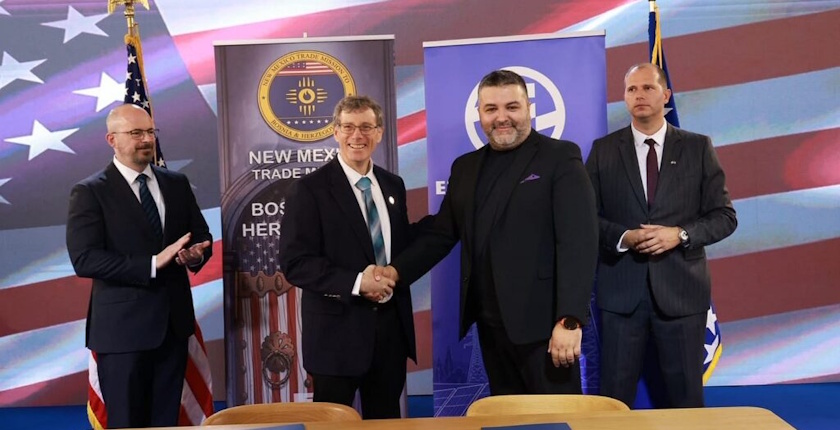
On his part, Chargé d’Affaires, a.i. of the United States John Ginkel underscored that BiH has significant energy potentials, especially for hydropower, revealing that American companies are negotiating with domestic officials about the possibilities for development.
Talks are underway about small modular nuclear reactors (SMRs), he added, as quoted by the federal ministry.
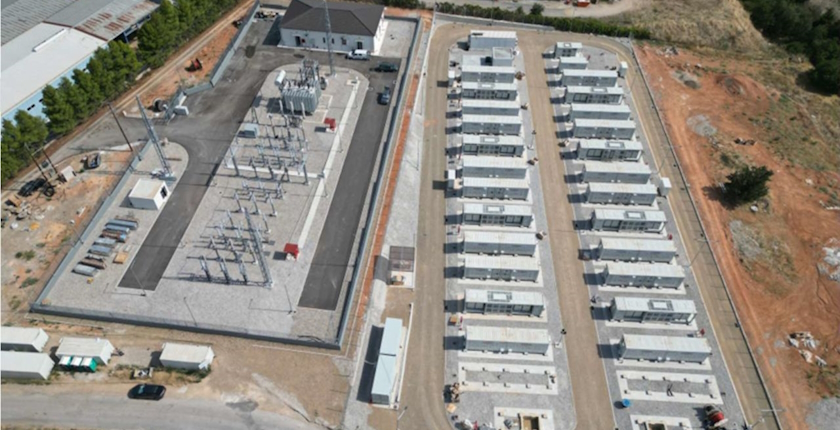
The conference facilitated the presentation of projects for stabilizing and prolonging the activity of coal-fired thermal power plant Tuzla. Among them is a plan for a battery energy storage system (BESS) worth BAM 16.8 million (EUR 8.6 million), funded by FBiH.