


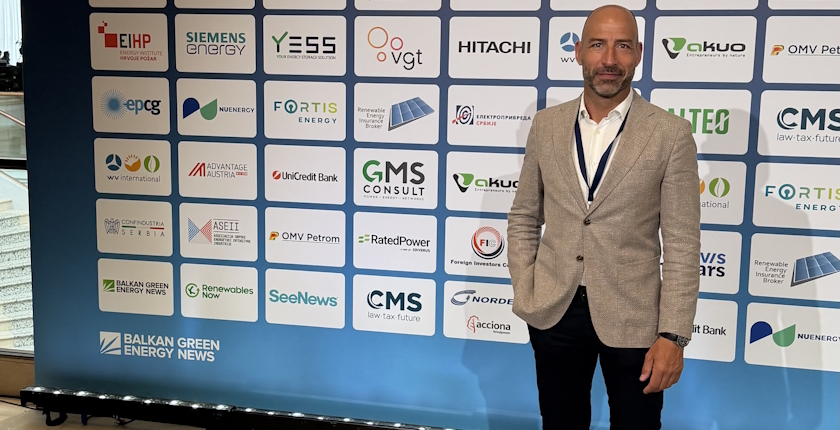
Author: Miquel Yafari, CRO, Growth & Strategy Advisor
Solar works. Wind works. Storage is scaling. After a year of conversations across Europe’s energy markets from the Belgrade Energy Forum to Bucharest and, most recently, the halls of Intersolar in Munich I have become convinced that the decisive question of the energy transition has quietly changed. It is no longer whether we can generate clean electricity. It is whether we can integrate, operate and monetize it. The transition has stopped being a technology problem and become an execution one and that shift changes who wins.
For fifteen years, the story of renewable energy was a story of technology and cost. Would solar ever compete with fossil fuels? Could wind scale? Was storage viable outside a laboratory? Those questions are now settled. Solar is the cheapest source of new electricity in most of the world, turbines have grown, batteries have fallen in price, and the digital tools for forecasting and control keep improving.
That success has moved the frontier. At the Belgrade Energy Forum, and again in Bucharest, I noticed the conversation had shifted. Almost no one asks whether the technology works. They ask why projects stall, why grids bottleneck, why permitting drags on for years, and why so many megawatts sit stranded between financial close and commercial operation. The challenge has migrated from innovation, the realm of the engineer and the investor to execution: the realm of operators, integrators, policymakers and market designers.
From building assets to orchestrating systems
It helps to see where we stand in the arc of the industry. The first era was deployment: build capacity as fast as possible, measured in installed megawatts and falling costs, proving that renewables could compete. The second was industrialization: scaling operations, professionalizing delivery, attracting institutional capital, and turning renewable energy into a mature infrastructure asset class.
Every battery, every hybrid project, every grid connection, every software platform adds value and adds complexity
We have now entered a third era — the era of orchestration. The challenge is no longer simply to build more assets, but to coordinate increasingly complex systems, technologies and stakeholders without letting complexity itself become the industry’s greatest cost. Every battery, every hybrid project, every grid connection, every software platform adds value and adds complexity. Managing that complexity, rather than compounding it, is the defining skill of the decade ahead.
Where the bottlenecks really live
This is not an abstract claim. The bottlenecks are concrete, and they are almost never about technology.
Start with the grid. More than 500 gigawatts of wind and solar capacity is waiting to connect across the European Union. By broader estimates, over a thousand. Networks largely built between the 1950s and 1980s cannot absorb what developers are ready to build. The result is waste: in 2024, roughly 72 terawatt-hours of mostly renewable electricity was curtailed across Europe, and 2026 is on course to break that record. Every curtailed megawatt-hour is clean energy generated and thrown away and revenue a project counted on and never earned.
In our region the pattern is sharper. In Croatia, several gigawatts of ready-to-build solar have stalled not for want of sun or capital, but because a single connection-fee rule was never adopted. In Romania, of more than 1,200 projects holding valid grid approvals in early 2025, only around thirty-five included storage in a system that badly needs flexibility. Bulgaria has raced past six gigawatts of solar, now sees midday prices turn negative, and is pivoting hard into batteries to become Southeast Europe’s flexibility hub.
Grid access is still treated as an administrative formality rather than a scarce economic resource to be allocated by value
Read together, these are the same story: grid access is still treated as an administrative formality rather than a scarce economic resource to be allocated by value. And behind the physical bottlenecks sits a quieter, organizational one. In most companies, commercial teams pursue growth, engineering optimizes performance, operations maximize availability and finance manages returns each excellent in isolation yet working from different data and different definitions of success. The cost rarely shows up in a financial statement. It shows up as slower decisions, duplicated work, delayed projects and missed opportunities. Increasingly, renewable energy is less an engineering challenge than an organizational one and execution means closing the distance between information and action.
Why going second can be an advantage
Here is where the Balkans hold a genuine and underappreciated opportunity. Mature markets — Spain, much of Western Europe — treated the transition as a technology race, building assets first and solving integration and market design afterward. The cost of that sequencing is now visible: congested grids, curtailment, merchant-price volatility, and capacity stranded while infrastructure catches up.
Southeast Europe can choose a different path. Because the technology is proven and bankable, the region can front-load the unglamorous work — grid planning, storage strategy, market mechanisms, digital asset management — instead of retrofitting it later at a premium. Going second is not a disadvantage here; it is a strategic advantage, provided the region learns from the markets that went first and is honest about where execution, not ambition, is the binding constraint.
That reframes who creates value. The most important players will no longer be those who simply deliver megawatts, but those who integrate generation, storage, grid and digital layers into a coherent, operable system — and who treat performance optimization as a lifecycle discipline, not a commissioning milestone. It is a shift I have watched first-hand: helping to reposition a SCADA engineering business around a data-centric platform for monitoring and optimizing utility-scale solar, where the question has moved from “can we monitor these assets?” to “how do we turn operational data into performance and revenue across an entire portfolio?”
None of this is achieved by technology alone. Grids are reinforced by regulators and system operators; markets are redesigned by policymakers; assets are optimized by teams. Execution, in the end, is about aligning people, processes and systems around a common direction so that good technology finally delivers on its promise. That is a leadership challenge as much as a technical one.
Europe has already won the argument about whether clean energy works. The competition now is about who can make it work best and that is a contest decided not by what we build, but by how well we make everything run together. On that measure, the Balkans start with a rare advantage. The next chapter of the energy transition may not be written by those who generate the most electricity, but by those who execute with the most clarity. In a system growing more complex by the year, that may prove the most valuable renewable resource of all.
About the author
Miquel Yafari is a growth strategist and executive in the renewable energy sector, with more than fifteen years of experience in international market expansion, commercial strategy and digital transformation across energy, SaaS and smart infrastructure. He serves as CRO, Growth & Strategy Advisor to renewable energy companies, developers, IPP and EPC contractors on market entry, sales processes and growth strategies across Europe, MENA and Americas. A frequent presence at industry events including the Belgrade Energy Forum, he writes and speaks on the energy transition, execution and leadership. The views expressed here are his own.
Comments (2)
mervyn Hobden
The problem is not management, the problem is the baseline technology. All industrial process require continuous power, which renewables cannot supply due to intermittancy of supply. Currently, the grid systems depend on the AC distribution of electrical energy, using technologies developed by our great grandfathers. Storage of electrical energy is in the form of DC supplies, using chemical batteries, or using Newtonian gravitation by pumping water uphill, neither of which is capable of the expansion in scale required to meet current or future demand, or capable of demonstrating the technical change to make such a system feasible. We have demonstrated that using wind and solar we can generate enough electrical energy, but the distrution and storage of that energy defeats us. It is a similar problem to that Watt and Boulton solved, as Boulton stated to Boswell in 1784, ‘I sell here what all the world desires, Power! For the first time, a continuous source of power was available to set mankind free from the bondage of renewables, sun and wind. But that revolution was based on the application of science in the 18th century, which allowed the steam engine, in factory, rail and sea to foster the biggest increase in human productivity ever seen. Now, we face the problem that ‘globalisation’ has tranferred that means of production, still driven by coal and steam, back to a means dependent on ‘slavery’ in a dictatorship in China. And, by default, has created a new world power. Is there no-one who can pick up the promise of real economic progress in the West?
Mervyn Hobden
The problem is not management; the problem is the baseline technology. All industrial processes require continuous power, which renewables cannot supply due to intermittency of supply. Currently, the grid systems depend on the AC distribution of electrical energy, using technologies developed by our great grandfathers. Storage of electrical energy is in the form of DC supplies, using chemical batteries, or using Newtonian gravitation by pumping water uphill, neither of which is capable of the expansion in scale required to meet current or future demand, or capable of demonstrating the technical change to make such a system feasible. We have demonstrated that using wind and solar we can generate enough electrical energy, but the distribution and storage of that energy defeats us. It is a similar problem to that Watt and Boulton solved, as Boulton stated to Boswell in 1784, ‘I sell here what all the world desires, Power! For the first time, a continuous source of power was available to set mankind free from the bondage of renewables, sun and wind. But that revolution was based on the application of science in the 18th century, which allowed the steam engine, in factory, rail and sea to foster the biggest increase in human productivity ever seen. Now, we face the problem that ‘globalisation’ has transferred that means of production, still driven by coal and steam, back to a means dependent on ‘slavery’ in a dictatorship in China. And, by default, has created a new world power. Is there no-one who can pick up the promise of real economic progress in the West?