


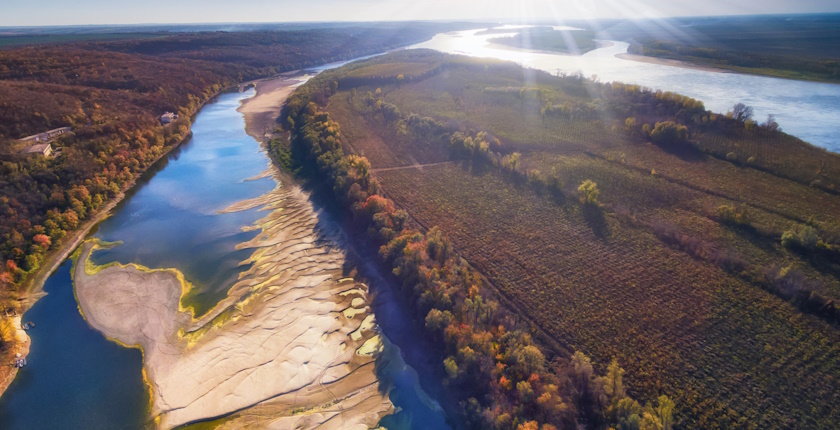
Power production is plummeting in Hungary, Serbia, Romania and Bulgaria due to an almost unseen drop in the Danube water level. It is jeopardizing the electricity system, while the situation is similar across Europe. In addition, Romania is experiencing instability in the deliveries of crude oil because of the Ukraine war. The historic decline of the Danube has also disrupted shipping along the river. All the issues point to a full-blown energy crisis and elevated risk of fuel rationing. Governments are preparing rolling blackouts.
Europe’s second-longest river has been drying up, which spells major trouble for the energy sector, but also agriculture and nature. The current heatwave brought massive wildfires in Spain, Greece, France and elsewhere. Romania is experiencing multiple issues. Hydropower and nuclear power output are dwindling due to historical lows of the Danube water level. The phenomenon disturbed fuel shipping as well, but there’s more: the Caspian Pipeline Consortium has again shut down its Black Sea oil terminal in Russia.
The complex near Novorossiysk that handles Kazakh oil bound for Romania has been under repeated drone attacks. Earlier, Russia and Kazakhstan blamed Ukraine. The disruptions spilled over to fuel stations in Romania, which mostly uses Kazakh oil. The country declared a state of crisis in the sector, capping retail prices.
Acting Prime Minister Ilie Bolojan estimated that the situation could last “a week or two” and called on consumers to voluntarily reduce consumption.
Acting Prime Minister Ilie Bolojan asked consumers to lower consumption
The shutdown of the second of the two reactors at Romania’s only nuclear power plant, Cernavodă, was ordered yesterday, but later canceled. Or just delayed. The country must import very high amounts of electricity. Nuclear power plants normally suspend production if the temperature of river water for cooling the reactors is too high.
After the government’s emergency session, the Ministry of Energy said it would discuss with large energy consumers to shift their activities away from peak hours.
The Association of Prosumers and Energy Communities in Romania (APCE), which earlier took credit for preventing a crash in the electricity system, urged owners of small battery systems to show solidarity by saving electricity for injecting it into the network at times of the highest demand, between 20:00 and 23:00.
Bulgarian battery power crucial for stability
Another benefit from the energy transition and the contribution of renewables is evident in Bulgaria’s battery power. Its fleet is the largest in the world relative to population and the size of the economy – and growing!
Romania and Greece are thus leaning on their neighbor Bulgaria for easing the price peaks and covering power shortfalls. Energypress reported that day-ahead prices for this afternoon and evening in Romania jumped to as high as EUR 340 per MWh amid congested interconnections with Bulgaria. At the same time, the level in Greece remained under EUR 150 per MWh.
Also of note, solar power systems, abundant in all three countries, have a production curve that roughly matches high temperatures and the demand for cooling. Operators in Greece are even suffering from a rise in curtailments, as the deployment of battery energy storage systems (BESS) is slow.
Paks nuclear power plant completely off table
The Danube is a few months ahead of the usual annual trough, so the worst is yet to come.
Bulgaria warned that it could be forced to suspend the operation of Kozloduy, its only nuclear power plant. Taking away the 2 GW facility from the equation would be another drastic test for regional stability.
Hungary could resort to rolling outages
In Hungary, Prime Minister Péter Magyar acknowledged the possibility of power outages for large industrial consumers. State-owned power utility MVM has said the complete shutdown of the 2 GW Paks nuclear power plant is inevitable. It accounts for almost half of the country’s electricity production and just above one third of consumption, because Hungary is a net importer.
Paks was already working at half of its capability.
Hungary is reducing unnecessary energy consumption in government buildings, according to the prime minister. Magyar urged citizens to show moderation in consumption, especially between 17:00 and 22:00. It includes charging electric vehicles and using air conditioners.
He referred to rolling outages for everyone as a last resort measure.
Critical for energy, agriculture in Serbia
At the Danube’s entry point into Serbia, the water level is nearing the negative record from 1909. The irrigation system is struggling and an emergency was declared in three municipalities in the area.
Fuel imports are extremely low as it is shallow for ships. Coal plants and hydropower plants on the Danube have a very limited production scope.