




The global average sea surface temperature set a new daily record of 21.1 degrees Celsius on August 22, the Copernicus Climate Change Service (C3S) said. What concerns scientists is the fact that the highest sea temperatures are usually recorded in March or April, rather than in August.
Sea surface temperature hit an all-time high on Saturday, August 22, reaching 21.1 degrees Celsius. The previous record was set in 2024, when 21.09 degrees were measured. Until now, the highest-ever temperature in August was 20.98 degrees Celsius, in 2023.
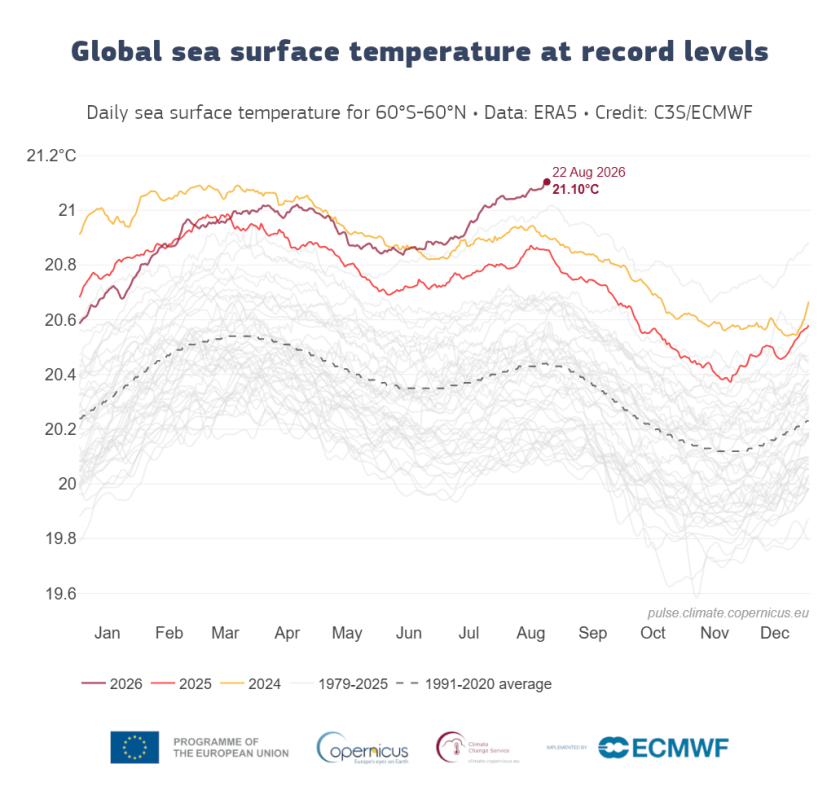
Although the new record is only slightly higher than the previous one, scientists from the Copernicus Climate Change Service (C3S) point out that the fact that it was recorded in August is particularly concerning. Global ocean temperatures generally peak in March and April, following summer in the Southern Hemisphere, which contains a larger share of the world’s ocean surface.
Exceptionally strong El Niño contributes to rising ocean temperatures
Another cause for concern is the development of a strong El Niño in the tropical Pacific Ocean, which is further warming an ocean whose temperature has already been rising for decades due to human-induced climate change.
The World Meteorological Organization expects El Niño to continue strengthening in the coming months, while C3S forecasts indicate that it could reach levels not seen in several decades.
This could push ocean temperatures even higher. However, the strongest effects of El Niño are usually felt the following year, which is why some scientists forecast that 2027 could become the hottest year since records began.
Ocean warming has far-reaching consequences for people and ecosystems
Record or near-record sea temperatures have been recorded throughout 2026, which, according to C3S, shows that a large part of the global ocean remains unusually warm.
Higher ocean temperatures contribute to sea level rise through thermal expansion, increasing risks for coastal communities and low-lying island states. They also increase the likelihood and intensity of marine heatwaves, which can damage coral reefs, seagrass meadows and other ecosystems, as well as fisheries and aquaculture.
A warmer ocean also increases the likelihood of extreme weather events, as it transfers more heat and moisture into the atmosphere, potentially contributing to more intense rainfall and some storm systems. A warmer ocean is also less efficient at absorbing CO2 from the atmosphere.