




By August 1, five months before the end of the year, humanity will have used all the natural resources that our planet can regenerate in a year. Over the last three decades, Earth Overshoot Day has mostly arrived earlier each year. In 2000, it fell on September 23, while this year it is 54 days earlier.
According to calculations by the Global Footprint Network, humanity consumes resources at a rate that would require nearly two planets (1.7 Earths) to maintain the equilibrium.
Earth Overshoot Day is calculated by dividing the planet’s biocapacity (the amount of natural resources Earth can regenerate in a year) by humanity’s ecological footprint, or projected consumption for the current year, and multiplying by the number of days in the year.
The costs of this global ecological overspending are becoming increasingly evident
Ecological debt arises because we are overloading and depleting our natural capital, thus threatening resource availability for future generations. “The costs of this global ecological overspending are becoming increasingly evident in the form of deforestation, soil erosion, biodiversity loss, and the buildup of carbon dioxide in the atmosphere. The latter leads to climate change, more frequent extreme weather events, and lower food production”, warns the Global Footprint Network.
As for the countries that Balkan Green Energy News tracks, Slovenia has been in ecological debt since April 25. It was followed by Bosnia and Herzegovina (May 9), Serbia (May 23), Greece (May 25), Croatia (May 28), Montenegro (May 30), Bulgaria (June 2), and Romania (July 10). Albania is not yet in debt, but it will be from September 23.
Globally, Qatar was the first country to fall into the red this year, on February 11. The last among the larger countries are Ecuador and Indonesia, on November 24. At the very end of 2024 are Guinea, Moldova, and Kyrgyzstan, indicating they are close to managing their natural resources sustainably.
Only about twenty countries, mostly extremely poor or with low population density, are excluded from the main list as they do not exceed their biocapacity. The best performers according to the sustainability index are Timor-Leste, Papua New Guinea, Mozambique, Madagascar, the Democratic Republic of the Congo, Eritrea, and Ivory Coast.
How to move the date of Earth Overshoot Day
In the last three decades, Earth Overshoot Day has generally arrived earlier each year. For example, in 2000, it was on September 23, while this year it is 54 days earlier, on August 1.
An interesting parallel drawn by the Global Footprint Network shows resource consumption each Summer Olympic Games year.
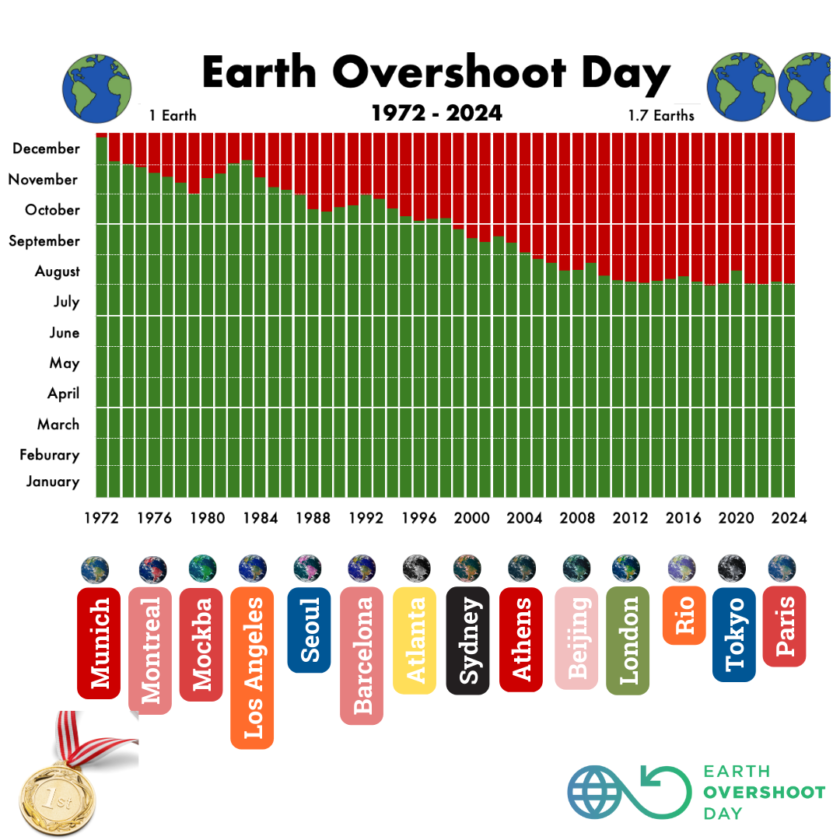
In 1968, when Dick Fosbury set a high jump record at 2.24 meters, humanity was still using less than one Earth per year. By 1988, when Olympic sailor Lawrence Lemieux abandoned the lead to save two fellow competitors, humanity was using 1.3 Earths’ worth of resources. By 2008, when Usain Bolt began breaking Olympic records, we were consuming resources at 1.6 times the sustainable rate.
To stop the overconsumption of natural resources, focus, innovation, and effort is needed, similar to what athletes demonstrate at every Olympic Games, according to the network.
Reducing carbon dioxide emissions from fossil fuel combustion by 50% would push the date back by three months
There are solutions to postpone the date of entering ecological debt. For example, reducing carbon dioxide emissions from fossil fuel combustion by 50% would push the date back by three months.
Christoph Bals, policy director of the climate organization Germanwatch, notes that there are indications that the burden will ease thanks to the use of renewable energy sources, energy storage, electric mobility, and heat pumps. “But these and other encouraging trends must be significantly accelerated to prevent irreversible climate tipping points and massive further biodiversity losses,” he emphasized.
Air travel is particularly harmful to the climate. However, over 80% of people never fly, meaning a small portion of the world’s population is responsible for one of the main drivers of the climate crisis, explained Jacob Rohm, who is responsible for the climate-neutral mobility sector at Germanwatch.