


Ember calculated that 18% of planned wind and solar power across seven major hydropower markets in the European Union requires no extra grid capacity. They can be connected via existing hydroelectric facilities, hybridizing and complementing them. Romania’s potential is among the highest, at 17.3%.
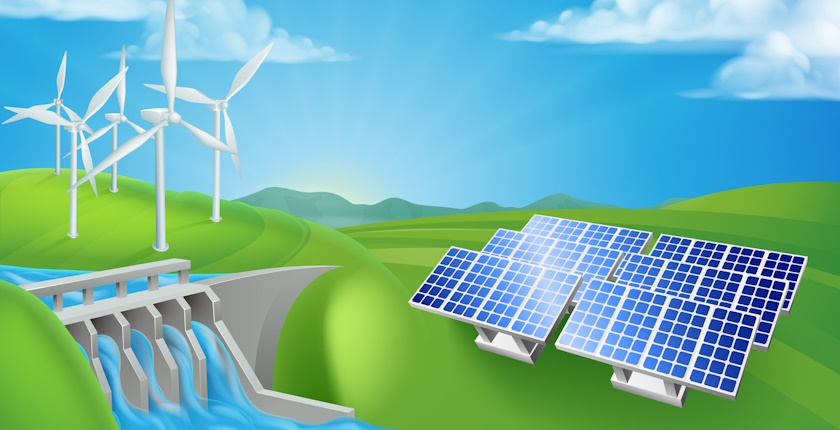
Adding wind and solar to the same grid connection of existing generation plants, referred to as hybridization, is a near-term way for renewables to bypass grid constraints and lower network build-out costs. Hydropower assets in Europe are especially suited because they typically leave substantial grid capacity unused for much of the day, according to Ember’s new report.
It can be a solution for an overall 25 GW in Austria, Bulgaria, France, Italy, Portugal, Romania and Spain. They account for 93 GW of the EU’s 131 GW in hydropower. Pointing to the European Commission’s push toward clean electrification, the think tank said operators can stay within injection limits and maximize utilization of existing grid infrastructure by adding wind and solar behind the same grid connection point.
Hybridization almost doubles the use of existing hydropower plants’ grid connections, but in some cases it can even triple it
Hydropower assets could therefore integrate 18% of the new renewables anticipated by 2030 without any interventions. Hybridization almost doubles the use of existing grid connections, as such systems operate at just 19% of their maximum on average. Many operate as peaking plants, generating primarily during the morning and evening high-demand hours. It leaves room for wind and solar to increase utilisation to 36% and 31%, respectively.
The impact varies by site and country, and in some cases, wind and solar can even triple use of the same hydropower grid connection, the numbers showed.
From large volumes of renewables stuck in grid connection queues to data centre developers choosing to relocate to areas with available grid capacity, the financial impacts of the grid crunch are becoming increasingly evident.
Austria has behind-the-meter potential to fit 77% of upcoming renewables capacity
Austria has room for 5.2 GW behind the meter at hydropower plants, of its 6.8 GW in wind and photovoltaic projects penciled in. France is in second place, with 4.5 GW of 17.8 GW. Romania is next, as it can cover 1.8 GW of 10.4 GW through the grid connections of its hydropower plants, coming slightly below average, at 17.3%. Bulgaria is at the bottom of the chart, with just 150 MW or 6.8% of its 2.2 GW.
Only Portugal and Spain have dedicated rules for hybrid projects. While lacking such a framework, Bulgaria’s state-owned National Electricity Co. (NEK) is converting several hydropower facilities into battery-coupled hybrid assets and considering the development of two floating solar plants at existing dams.
Transmission networks in both Austria and Bulgaria have zero capacity for new generation, and in Portugal and Romania, it is negligible, the document shows.
The Tâmega wind farm in Portugal would be the country’s largest. It is being developed as a hybrid project, connected to the same substation as the Tâmega hydroelectric complex.
Joint operation of components stabilizes supply
Hybrid projects bring together complementary generation technologies, typically alongside storage assets, behind the same grid connection point. The core mechanism is infrastructure sharing, referred to as cable pooling.
Sites can operate as partially integrated hybrids, with fixed export limits for each component, or as a single commercial entity with an overall export limit that optimizes output. The latter offers the additional advantage of managing the variability of renewable generation and contributing to a more stable power supply.
Floating solar, popularly known as floatovoltaics, is emerging as an increasingly attractive option for hydro’s hybridization, without land-use conflicts. Solar cell efficiency benefits from the water’s cooling effect, while evaporation is reduced.
Solar complements, wind follows typical hydro dispatch
With hydro output largely concentrated in the morning and evening hours, solar complements it with its production between peak hours. Developers can strategically oversize the photovoltaic facility, as it rarely generates at its full nominal capacity.
The strategy would be especially viable at pumped storage facilities, the report adds. On the rare occasions when solar generation would exceed connection export limits, the hydro asset can pivot to pumping mode, capturing the solar surplus as stored water.
A hybridized pumped storage hydropower plant would accumulate its solar asset’s rare surplus output
“Complementarity between hydropower and wind is less pronounced, but the combination remains potentially effective due to its alignment with broader electricity market dynamics. Wind generation seasonality typically mirrors that of power demand in Europe,” the authors pointed out.
Facilities within areas protected under European or national legislation were excluded from the analysis. It translates to 28% of large hydropower plant capacity eligible for hybridization. The level ranges from 6% in Bulgaria to 41% in both Austria and Italy.