


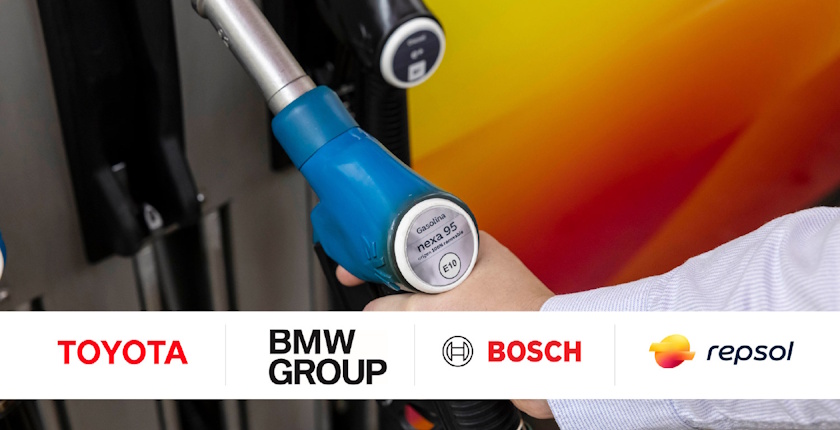
Toyota, BMW, Bosch and Repsol have launched a six-month pilot project in Spain in which existing vehicles will run exclusively on 100% renewable gasoline. The companies aim to demonstrate that the fuel can be used in existing gasoline engines without modifying vehicles or investing in new infrastructure.
The pilot project, which began in early July, is intended to demonstrate, under real-world conditions, the potential of Vehicles running Exclusively on Eligible Fuels (VEEF).
The endeavor entails renewable and low-carbon fuels that meet the European Union’s sustainability criteria established under the Renewable Energy Directive (RED). They have substantially lower greenhouse gas emissions than fossil fuels across the entire lifecycle, from fuel production to use in a vehicle.
Nexa 95 is Repsol’s renewable gasoline, which will be used by around 20 Toyota and BMW vehicles over the next six months.
According to the partners’ statement, the fuel is fully compatible with existing gasoline engines and infrastructure.
Spain was selected for the project because of the availability of renewable gasoline and Repsol’s infrastructure. Repsol is currently the only company offering 100% renewable gasoline at public filling stations in the country.
Renewable fuels can play a significant role in reducing carbon dioxide emissions
The use of renewable gasoline will be monitored using Bosch’s Digital Fuel Twin technology. The system digitally records data on the fuel’s origin, properties and quantity from production to refuelling. By linking data from vehicles, filling stations and fuel card transactions, it notes which fuel and how much of it is supplied to each vehicle. According to Bosch, the collected data are used to determine the carbon footprint of the fuel and issue a certificate that can be used for reporting and auditing purposes.
“By precisely monitoring fuel usage on individual vehicles in real-time, we are building the foundation of trust and regulatory compliance needed for higher acceptance of renewable fuels in the mobility and transport sector,” said Marko Babic, head of the Bosch product area responsible for the Digital Fuel Twin.
The project aims to demonstrate that existing vehicles can already run on 100% renewable fuels using existing infrastructure. According to the companies, the findings will be shared with EU policymakers, representatives of the automotive industry and the media.
Renewable fuels can help bridge the gap on the path to carbon neutrality
Electrification is currently the main focus of EU policies for decarbonising road transport. The companies participating in the project aim to demonstrate that renewable fuels can also play a complementary role in reducing carbon dioxide emissions.
The real-world data collected should contribute to discussions about technology neutrality and the potential inclusion of vehicles running exclusively on eligible fuels in future EU regulatory frameworks.
“As the transition progresses, it is becoming clear that there is a growing risk that 100% zero-emission vehicles by 2035 may not be fully achieved. In such a scenario, renewable fuels can help bridge the gap to deliver carbon neutrality, especially when combined with hybrid and plug-in hybrid technologies,” said Pascal Ruch, Vice President Corporate and Governmental Affairs at Toyota Motor Europe.