


The European Union is expected to phase out Russian natural gas purchases by late 2027, marking a turning point for European gas markets. In the post-Russian gas era, Central and Eastern Europe could emerge with a stronger-than-expected gas balance, with Poland and Romania playing a key role in new regional supply routes, according to an analysis by Independent Commodity Intelligence Services (ICIS).
If the phaseout is fully enforced, 2028 could see Poland and Romania emerge as the two main anchors of new regional gas supply corridors, thanks to Poland’s new liquefied natural gas (LNG) import capacity and Romania’s Neptun Deep offshore gas project in the Black Sea, ICIS noted.
In the analysis, Central and Eastern Europe (CEE) includes Austria, the Czech Republic, Poland, Slovakia, Hungary, and Romania. The six EU countries together accounted for around 602 TWh of gas demand in 2025, or 15% of the EU’s total demand, ICIS explained.
Romania could generate annual gas surpluses of around 60 TWh
Romania could become a significant net gas exporter by 2028, with surplus production exceeding domestic demand by more than 60 TWh a year, according to the analysis.
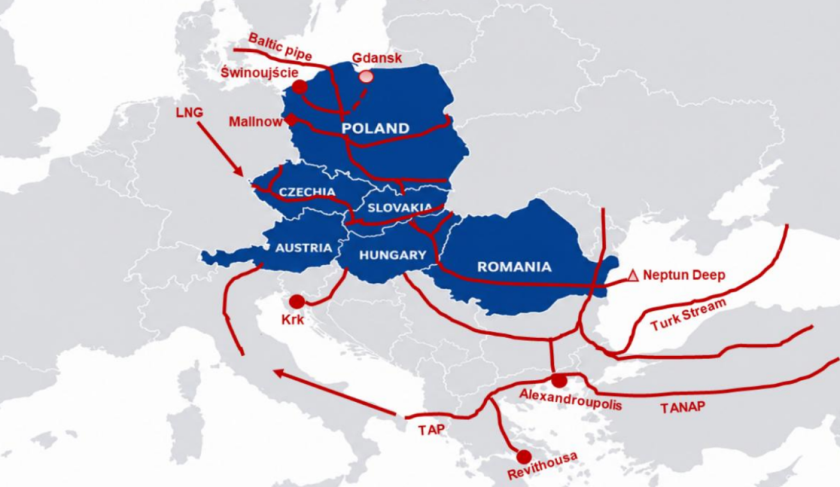
ICIS stressed that the Romanian Government’s upcoming decision on pre-emption rights for Neptun Deep gas could determine whether neighboring markets gain access to up to 5 billion cubic meters of Romanian gas exports per year or are forced to seek tighter, more expensive alternatives.
One of the neighboring countries, Serbia, is planning to build a gas interconnection with Romania. The link is expected to be built in the next two years, Serbian Minister of Mining and Energy Dubravka Đedović Handanović said in March.
Poland is expected to commission a new LNG terminal in April 2028
The commissioning of the Neptun Deep facility, which is currently under development, is expected to make Romania the largest gas producer in the EU. First gas from Neptun Deep is expected in September 2027.
Poland, for its part, is expected to play a central role in enabling gas to flow southward. The commissioning of its Gdańsk FSRU terminal for LNG unloading and regasification is expected in April 2028, with a projected regasification capacity of 179.7 GWh per day.