



The number of hours with negative electricity prices on the Croatian Power Exchange, CROPEX, increased by 30% last year compared with 2024, according to the annual report by the Croatian Energy Regulatory Agency.
The authors of the annual report published by the Croatian Energy Regulatory Agency (HERA) pointed out that the number of hours with negative electricity prices continues to grow sharply.
They explained that, at times, the market literally pays someone to take over surplus electricity from the system. Therefore, in Croatia, as in other European Union member states, the construction of energy storage facilities is necessary, the report added.
The number of hours with negative prices jumped from 196 in 2024 to 257 in 2025.
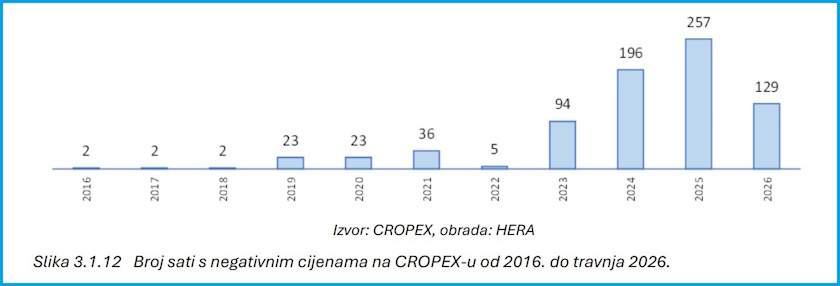
Hours with negative prices mostly occur during spring months and sunny Sundays, when there is a surplus of solar power generation, the authors explained.
Short-term negative prices are mainly a consequence of generation surpluses resulting from the seasonality of primary energy sources or mandatory electricity offtake – for example, under previously established incentive schemes stipulating purchases of all electricity fed into the grid, the report reads.
Important signal for energy storage technology development
The authors noted that one of the consequences of increased renewable energy generation is the rise in the number of hours with negative electricity prices.
Parts of the Croatian regulatory framework already foresee the suspension of market premiums for future contracts when market electricity prices are negative.
Such market conditions represent an important signal for the development of energy storage technologies, particularly battery energy storage systems (BESS), the report stressed.
Strong investor interest in grid connection for batteries
The authors highlighted a strong investor interest throughout 2025 and 2026 for connecting energy storage facilities to the transmission and distribution networks.
At the beginning of 2026, the country’s first large-scale BESS entered trial operation, representing an important step in modernizing the Croatian power system, according to HERA’s annual report for 2025.
Of note, battery capacity in Croatia stood at just 11 MW as of March, according to estimates by the Croatian Chamber of Economy (HGK).
Croatia is wrapping up a regulatory framework for BESS development, paving the way for their deployment in 2027.