

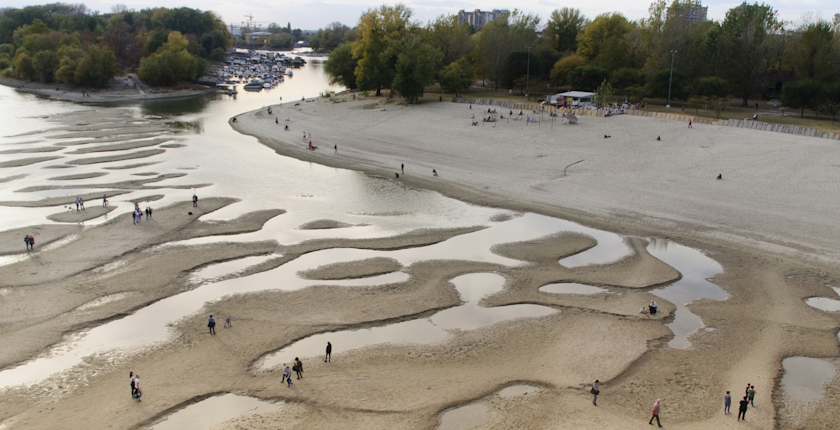
The drop in water flow in Europe’s second-largest river has broken multi-decade records. Given the extremely low levels in the Danube in Serbia, the impact on groundwater and unfavorable forecasts, water restrictions will probably follow, hydrologist Dejan Vladiković warned. He estimated that the basin of the country’s biggest internal river, Morava, is sliding toward the biological minimum.
The dramatic reduction in the amount of water in the Danube is worsening the chronic energy crisis caused by the Ukrainian war and the cycles of flare-ups and relative calm in the Persian Gulf and elsewhere in the Middle East. Moreover, it is threatening ecosystems, irrigation and water supply.
Negative records are lining up across Europe. The situation in Serbia is slightly better just on the lower section, toward the Đerdap (Iron Gate) hydropower complex, shared with Romania. As is the case with other navigable rivers on the continent, cargo needs to be transferred to or carried by smaller vessels, which significantly raises costs.
No improvement at least until mid-September
In Serbia, the circumstances on the Danube are worse than on other international waterways, following very weak precipitation in the March-May period, hydrologist of the Republic Hydrometeorological Service Dejan Vladiković told N1.
Vladiković: In ten days or so, the Great Morava river’s basin is set to weaken to a biological minimum
Domestic climatologists do not expect a significant improvement before mid-September, judging by the forecasted above-average temperatures and lower-than-usual precipitation, he noted. In Vladiković’s opinion, in about ten days, the West, South, and Great Morava and their tributaries will enter a biological minimum, threatening wildlife and bringing water supply disruptions.
State-run water management company Srbijavode is cleaning the most vulnerable sections of the Danube waterway, expecting that the hydrological conditions there and on other rivers will remain similar or even more unfavorable over the next 45 days, public broadcaster RTS reported.
Groundwater is linked to river water levels
The water levels of the Sava and Tisa are, by the way, only slightly better. On the Danube, it was already the lowest in April for its time of year, and then even worse in May, Vladiković told Danas.
“It isn’t better at all with groundwater, because they are a connected system. The situation is quite serious,” he warned. Vladiković explained that at the biological minimum, aquatic life is threatened and there is not enough oxygen.
Notably, flow reduction leads to the concentration of pollutants and the spread of pathogens. Simultaneously, a heatwave raises water temperatures to levels unbearable for fish and other living creatures in rivers.
Vladiković expressed the view that water restrictions would probably be imposed to reduce consumption.
But drinking water shortages already hit increasingly larger parts of Serbia every summer – due to infrastructure breakdowns. To be clear, it is not rationing and regular rolling outages for a couple of hours within an area. Whole towns and cities remain without water for days, while in others, water not even of technical grade continuously comes out of taps.