







Battery storage and digitalization stepped into the spotlight in 2025, according to the readers of Balkan Green Energy News, after solar power was for several years the primary pillar of the energy transition in most of Southeastern Europe. In our annual overview of the most popular articles, the other main topics were the European Union’s Carbon Border Adjustment Mechanism (CBAM) and the possible fossil fuel crisis caused by the sanctions that the United States imposed on two Russian-owned refiners and service station operators.
In 2025, we marked the first decade since the launch of Balkan Green Energy News, and also achieved the best results so far. Thank you for the amazing growth and for making us the most popular energy news website in the region!
Our readers have taken note of the advances in 2025 in the energy sector in Southeastern Europe. Major investments are underway and the Western Balkans are gradually catching pace with neighboring EU member states. On the other hand, CBAM is a tough emerging hurdle.
Over the past year, the Western Balkans and Turkey were undergoing final preparations for the introduction of the European Union’s CO2 charge.
Yet another energy crisis has struck the Balkans. The United States imposed sanctions on oil refiner and fuel retailer NIS in Serbia, controlled by Russian state-owned Gazprom, and on Lukoil after that.
Among other most read articles on Balkan Green Energy News, the blackout in Spain and Portugal highlighted the urgent need for more interconnection capacity, digital control and energy storage and other solutions for balancing, throughout Europe.
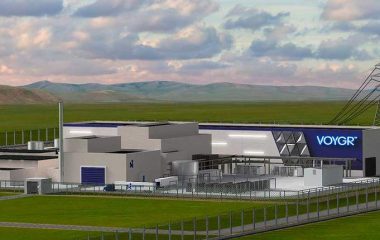
Several projects are under development in our region for conventional nuclear power plants. At the same time, countries and investors in the region are increasingly counting on small and advanced small modular reactors.
Rest assured that we will keep providing you with first-hand information with added value – on sustainable energy, the environment, and green technologies. In the meantime, you can scroll through the most popular articles of 2025 in the Serbian language section.
1. Battery storage becomes essential for cost-effectiveness, grid stability
Bulgaria approves RESTORE funds for over 4 GWh in BESS projects
The solar power boom is continuing and even spreading. Wind power investments have rebounded in much of Southeastern Europe, especially with Romania returning them to center stage after a quiet decade. But it’s a new phase in the energy transition.
Energy storage has become essential for countering negative prices, by bridging the intraday gaps between the peak renewables production and consumption. Moreover, such capacities maintain grid stability.
Bulgaria is the region’s champion in BESS deployment
Bulgaria is, without a doubt, the region’s champion of battery energy storage systems (BESS) with its tenders for state aid. The total capacity at the end of 2025 is estimated at 1.3 GWh, including a facility that was the biggest in Europe at the time of its commissioning. In addition, the country is leaning heavily on investments in pumped storage hydropower for its energy future.
The battery segment is opening up business opportunities. One of the pioneers in Bulgaria is Renewable Energy Insurance Broker (REIB), which installed some of the first larger BESS facilities in the region.
Romania is gaining speed in the deployment of battery energy storage systems, together with Turkey and Greece. Other countries are prevailingly transitioning into the implementation stage for the first projects.
2. Digitalization is strengthening renewables uptake as well as energy security
Virtual power plants: How they work and who can benefit from extra income
The all-out blackout in Spain and Portugal in April got decision makers and investors thinking more seriously about the most important factors for the stability of the electricity system. The surge in distributed photovoltaics and wind, together with the challenges of the two-way supply between the grid on one side and active buyers and prosumers on the other, make the network much more complex to handle and make projections.
It’s the growing realm for aggregators and software makers. Their job is to bundle assets such as small PV plants and batteries and manage the placement of their output in the market. A massive hike in demand is evident for digital solutions: starting with prosumers and owners of electric car chargers, all the way to giant hybrid power plants, demand response schemes and network operators overseeing power plants and batteries.
A distinct example in Southeastern Europe is Slovenia-based NGEN, with its project portfolio expanding in a range of markets in the EU. The company combines engineering, procurement and construction (EPC) services with cutting-edge storage technology, proprietary software and advanced connectivity. In October, the group inaugurated the largest grid-supporting BESS in Austria.
3. Major global companies keep focus on Southeastern Europe
Construction of largest wind farm in Western Balkans kicks off in Štip in North Macedonia
Solar power remained on its throne in the region throughout 2025, in line with stellar expansion across the world. Wind power investments are accelerating again, especially as Romania has returned to the fore.
Turkey still eclipses the remainder of Southeastern Europe in nominal terms. In November, it reached 14.5 GW in wind power and 24.7 GW in PV capacity, out of 121.8 GW in total. On the other hand, tiny North Macedonia surpassed 1 GW in solar power, so it hosts two times more capacity per person than Turkey! Yet, the level in Greece is twice as high as that, above 1 kW for every inhabitant.
In mid-June, solar power production in Bulgaria, where the overall capacity later reached 5 GW, covered the country’s entire consumption for the first time. The episode lasted two hours. With its neighbor Romania, Bulgaria is among the strongest growers in Europe.
PV capacity per capita in North Macedonia is two times higher than in Turkey
The expansion and combining wind and PV projects with storage has prompted the need for more diverse financing services. Lenders are tailoring their products for renewable energy investors, which are bringing an increasing number of power purchase agreements (PPAs) to make their projects bankable.
Romania hosts several projects for solar power plants that are set to become the biggest in the country, or also the Balkans excluding Turkey, but in Europe as well.
Between the hundreds of ongoing investments in renewables in the region, Alcazar Energy Partners has stood out by starting the construction of a 400 MW wind park in North Macedonia.
4. Energy crisis strikes as Russian-owned refineries come under US sanctions, EU bans Russian gas
Serbia warns of gas crisis as EU transit ban threatens Balkan Stream supply
Serbia managed to postpone US sanctions against NIS for several months. However, the only refinery in the country recently stopped operating after oil supply ended, and the company’s fuel stations face shutdown.
Russian state-owned Gazprom, which has a majority stake in the Serbian company, is negotiating with Hungarian MOL about a sale. Importantly, Serbia is also dependent on natural gas from Russia. The country secured a supply deal for the three months until the end of March, but the EU could at some point ban transit through the TurkStream pipeline, after it imposed measures to end Russian gas imports by the end of 2027.
To make matters worse, Russia-based Lukoil came under US sanctions as well, affecting refineries in the region and a widespread network of service stations.
In the final hours of 2025, Croatian oil pipeline operator JANAF and Serbian officials announced that the US has granted a reprieve until January 23.
5. Success of Belgrade Energy Forum 2025 paves way for best energy conference in region – BEF 2026!
Belgrade Energy Forum 2025 – energy market reforms accelerate integration into EU
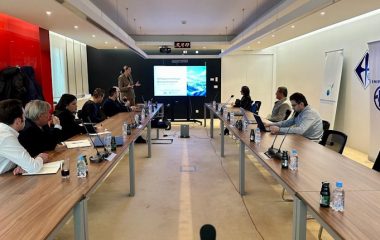
The third Belgrade Energy Forum gathered four hundred participants from 30 countries of the region, Europe and beyond in Serbia’s capital city. At the two-day conference organized by Balkan Green Energy News, eight panel discussions were held with more than fifty government officials, company managers and prominent energy experts.
BEF 2026 is scheduled for April 28 and 29. It will cover the main challenges and opportunities in the energy sector in Southeastern Europe. It is the place to be for everyone who wants to do business or expand it in the region.
The unique platform combining the Balkan Green Energy News website and the conference provides dedicated cooperation throughout the year, and not just during the conference. Join us at the event as a sponsor, institutional partner, exhibitor or attendee and contact our team that organizes BEF.
6. CBAM tax entering into force, hampering power exports from Western Balkans
Renewable electricity should not be subject to EU’s CO2 import tax
In line with its plan from several years ago, the European Union is starting to charge a tax on January 1 on imported iron and steel, aluminum, cement, fertilizers, hydrogen and electricity, reflecting their carbon intensity. The aim is to protect domestic producers, which pay a similar levy within the EU Emissions Trading System (EU ETS).
The tariffs within the Carbon Border Adjustment Mechanism for goods and commodities will rise gradually every year until they match EU ETS in 2034. For electricity, however, the tax will be charged fully from the start.
Authorities in the Western Balkans have been substantially slow in efforts to secure exemptions for electricity, so now exporting it to the EU is becoming uncompetitive. Ironically, it impedes the ambition of the administration in Brussels to integrate the region’s energy markets.
The EU has been reluctant to make the system more flexible. The European Union proposed several simplification measures only in mid-December, so it may streamline the exemption process for electricity.
7. WISE Serbia women’s network: Ljiljana Velimirović is Female Leader in Sustainable Energy laureate for 2025
Ljiljana Velimirović is the Female Leader in Sustainable Energy for 2025
The WISE Serbia women’s network focuses on sustainable energy, the green economy, and climate action. It is continuing to push boundaries in the promotion of the significance of women in these important sectors. The year 2025 was marked by the first mentorship program.
During the six months of intensive collaboration, seven mentor-mentee pairs built mutual trust, exchanged knowledge, and developed leadership potential, demonstrating the vital role of support in career development.
At the annual event of WISE Serbia Women’s Network, Ljiljana Velimirović received the Female Leader in Sustainable Energy 2025 award. The ceremony was organized for the third consecutive year with the support of Deutsche Gesellschaft für Internationale Zusammenarbeit (GIZ) GmbH.
8. Rio Tinto shelves its lithium mining project Jadar in Serbia, but no exit for now
Even though in June the European Commission declared it one of the first 13 strategic investments in raw materials extraction and processing outside of the EU, project Jadar in Serbia was later suspended.
Rio Tinto, which intended to open a lithium and boron mine and processing plant, turned its focus to opportunities for faster growth. The project faced public backlash with several waves of massive protests since 2020.
However, the company still considers the lithium deposit in Jadar valley in western Serbia important.
9. State-owned power utilities in Western Balkans strained by legacy coal power
Bosnia and Herzegovina’s power utility keeps posting losses amid weak output, increased imports
Unlike their counterparts in neighboring European Union member states such as Greece, which are investing billions of euros from EU into decarbonization, the main power utilities in the Western Balkans remain stuck with obsolete coal plants and loss-making mines. Of note, Albania has no such facilities.
The coal-dependent and state-owned utilities experience difficulties in power generation and increasingly rely on imports, including purchases of coal abroad. They earn much of their income under regulated prices, limiting cost-effectiveness.
On top of it all, with the introduction of the CBAM charge, the companies are becoming almost completely uncompetitive for power exports to the EU.
However, North Macedonia’s Elektrani na Severna Makedonija (ESM) is an exception with several investments in renewables and its public-private partnerships. Such cooperation can bring know-how and experience for navigating the energy transition.
As for the rest of the region, the Montenegrin Elektroprivreda Crne Gore (EPCG) has selected Nordex to design, procure, supply and install the turbines at its Gvozd wind park, as well as for long-term maintenance. The Hamburg-based company has contracted or installed 222 turbines in 16 wind projects in Montenegro, Croatia and Serbia.
10. Renewable energy auctions changing shape
Serbia allocates entire quota at second auctions, investors to install 645 MW of wind, solar
Europe is adjusting the design of renewable energy auctions as onshore wind and solar power technologies have become all but conventional. It is also affecting energy policy in Southeastern Europe.
Contracts for difference (CfDs), awarded in auctions, are still important for many project developers to obtain financing. But the market is turning toward the inclusion of batteries or tenders for batteries colocated with PV or wind power plants. Romania, which completed its program for both segments, has been planning to put grid capacity up for bids. It could become a model for other countries in the region.
Turkey isn’t giving up on public calls for solar and wind power, under its YEKA support model. However, it offers mid-sized and large projects in predetermined locations and grid access is secured.
Turkey earned EUR 530 million in 2025 in its wind and solar power auctions
In practice, auction participants compete by offering to pay to win each zone. Turkey earned EUR 530 million overall in 2025 that way, according to Minister of Energy and Natural Resources Alparslan Bayraktar.
Greece came up with another approach after completing its auction schemes for conventional PV and wind power, followed by battery storage. Through its Apollo program, aimed at reducing energy costs for vulnerable consumers, it plans to put 400 MW of wind power to auction, as well as 200 MW of solar power combined with BESS.
Investors in Serbia are waiting for the third round of auctions. The Ministry of Mining and Energy allocated the entire quota the last time. Elsewhere in the Western Balkans, auctions and tenders are ongoing or in preparation.
Here are more news and analysis that captured a lot of attention by our readers since the beginning of 2025:
Final investment decision for Romania’s SMR project could be delayed
GGF’s Kostadinov: Western Balkans responded to energy crisis with innovation, ambition (video)
Guarantees of origin: turning renewable ambition into action
LONGi ignites Romania’s energy transition with 54.1 MW BC technology triumph
CATL: World’s first mass-produced sodium ion battery is here
CWP Europe signs PPA, CfD for its Solarina PV project with Serbia’s EPS
Decarbonization of Southeastern European region: both renewables and nuclear are speeding up
Albania, Italy sign undersea cable deal with UAE as strategic partner
DRI acquires 112 MW battery storage project in Poland from Greenvolt
Be the first one to comment on this article.