

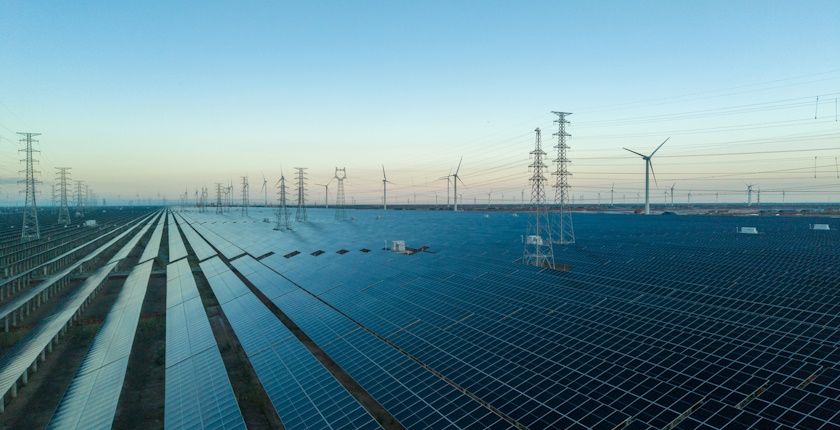
Amid the current energy crisis, European companies have turned to power purchase agreements (PPAs) as a key hedge against spikes in electricity prices, IEEFA’s analyst Jonathan Bruegel wrote. In stress periods, they are roughly half as cheap as the spot market.
Before the United States and Israel attacked Iran on February 28, the European corporate power purchase agreement (PPA) was a sustainability instrument for most companies, notes Jonathan Bruegel from the Institute for Energy Economics and Financial Analysis (IEEFA). Now it has become a tool to protect against high prices, he pointed out in a commentary.
“Procurement teams used to sign PPAs to meet environmental, social and governance (ESG) targets and satisfy emissions reporting requirements. Management tolerated the premium over wholesale power prices as the cost of compliance. The energy security argument existed in theory, but it was rarely validated,” said Bruegel, IEEFA’s power sector analyst for Europe.
The 2026 Iran war has changed that calculus faster than any policy intervention managed in the preceding decade, he stressed and highlighted day-ahead market prices in Germany and Italy of EUR 120 per MWh to EUR 150 per MWh in streess periods.
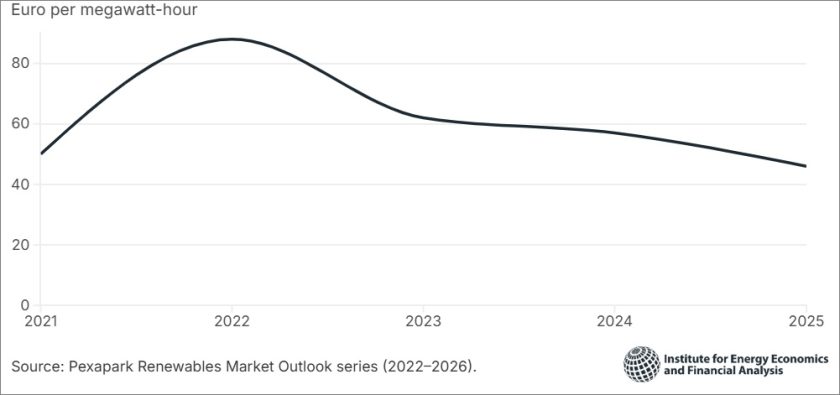
PPA prices are in the EUR 60 per MWh to EUR 85 per MWh range, according the LevelTen Energy platform. Moreover, the average in Europe fell last year to EUR 46 per MWh, the lowest since 2021.
Some developers directing large chunk of output to spot markeet
Fossil gas sets the marginal electricity price in countries such as Germany and Italy for a substantial share of hours, dictating the market, under the merit order mechanism. As gas became more expensive, corporate consumers got more interested in PPAs and they accelerated deal talks.
A shift from sustainability-driven to risk management-driven PPA procurement produces fundamentally different contracts
But more demand hasn’t automatically sped up the execution of such agreements, Bruegel stressed.
Several developers are selling 30% to 40% of output on the spot market rather than contracting it all, he added. The author explained that, by doing so, they are betting that the current price environment will continue.
“A shift from sustainability-driven to risk management-driven PPA procurement produces fundamentally different contracts. Sustainability-driven PPAs often have long tenors and fixed prices,” he explained.
New PPAs providing power when cost risk is highest
The new wave prioritizes protection from price spikes rather than long-term price certainty. The market is shifting toward five-year to ten-year contracts with minimum and maximum prices and indexation clauses, which pricing platform Pexapark reports as standard in recent deal flow, the article reads.
“A PPA to protect against high prices can’t just deliver power when it’s cheap and abundant. It must cover the hours when prices spike. The response is a rapid shift toward PPA contracts that provide power when the cost risk is the greatest. These contracts feature shaped structures, day/night splits, hybrid solar-wind-storage bundles and storage-backed baseload-equivalent products,” Bruegel added.